• العربية
  • فارسی
Brand
  • Iran Insight
  • Politics
  • Economy
  • Analysis
  • Special Report
  • Opinion
  • Podcast
  • Iran Insight
  • Politics
  • Economy
  • Analysis
  • Special Report
  • Opinion
  • Podcast
  • Theme
  • Language
    • العربية
    • فارسی
  • Iran Insight
  • Politics
  • Economy
  • Analysis
  • Special Report
  • Opinion
  • Podcast
All rights reserved for Volant Media UK Limited
volant media logo

Hardline cleric rebukes Ghalibaf over US talks

Jul 1, 2026, 21:37 GMT+1

Amir Hossein Jafari, hardline cleric criticized Parliament Speaker Mohammad Bagher Ghalibaf over his defense of engagement with the United States, saying talks with what he called the "murderer of the Imam of the nation" would neither protect Iranians' rights nor solve the country's problems.

"Mr. Ghalibaf! You could be our political leader, our president, our parliament speaker, and... you could be absolutely in charge of everything for us! But understand that sitting with the killer of the Imam of the Ummah does not fulfill any right of the nation-far from it, it only makes the knots of the country's issues tighter and more complicated!" Jafari posted on X.

Most Viewed

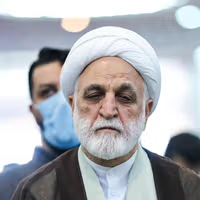
Khamenei to end Eje'i’s judiciary tenure after one term
1
EXCLUSIVE

Khamenei to end Eje'i’s judiciary tenure after one term

2
ANALYSIS

Is Tehran preparing to reinvent the IRGC?

3

Deadly attacks shake northwest Iran as IRGC reports new clashes

4

How Trump decided to strike Iran, new book reveals final hours

5

IRGC moves to seize historic Protestant church in Tehran

Banner
Banner
Banner

Spotlight

  • How Trump decided to strike Iran, new book reveals final hours

    How Trump decided to strike Iran, new book reveals final hours

  • Khamenei to end Eje'i’s judiciary tenure after one term
    EXCLUSIVE

    Khamenei to end Eje'i’s judiciary tenure after one term

  • Iran among top foreign espionage threats to Germany, security report says

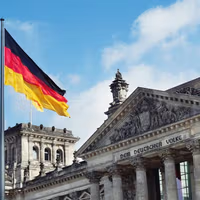
    Iran among top foreign espionage threats to Germany, security report says

  • Two-week banking disruption leaves Iranians struggling to access money
    VOICES FROM IRAN

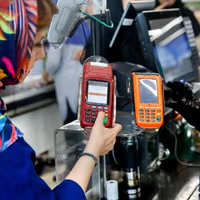
    Two-week banking disruption leaves Iranians struggling to access money

  • Every flare-up narrows space for diplomacy in Tehran
    INSIGHT

    Every flare-up narrows space for diplomacy in Tehran

  • Past funeral disasters cast a shadow over Khamenei's burial
    INSIGHT

    Past funeral disasters cast a shadow over Khamenei's burial

•
•
•

More Stories

Trump says US getting along well with Iran as Doha technical talks end

Jul 1, 2026, 20:26 GMT+1
Trump says US getting along well with Iran as Doha technical talks end
100%
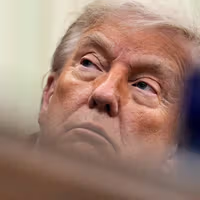
US President Donald Trump speaks at the Oval Office at the White House in Washington, DC, US, June 29, 2026.

Iran said its Doha meetings with mediators had concluded Wednesday as US President Donald Trump said recent meetings in Qatar had been positive and Tehran’s denuclearization was progressing well.

Iran’s Deputy Foreign Minister Kazem Gharibabadi said the Iranian delegation’s talks in Doha had concluded, state news agency IRNA reported. He said the meetings were held with Qatari and Pakistani delegations and without the presence of a US delegation.

Qatar’s Emir Sheikh Tamim bin Hamad Al Thani held talks in Doha on Wednesday with US envoy Steve Witkoff and Jared Kushner on US-Iran negotiations and developments in Lebanon, the Amiri Diwan said.

A source with direct knowledge of the talks earlier told Reuters that indirect technical talks between Washington and Tehran had begun in Doha on Wednesday, mediated by Qatar and Pakistan. A senior Iranian official told Reuters the talks focused on Iran’s frozen assets and the Strait of Hormuz.

Doha talks and de-escalation

Axios reported, citing a US official, that Washington and Tehran had reached an understanding to “keep things quiet” for the coming week to allow progress on the memorandum of understanding “without missiles flying.”

“We have reached an understanding that we will keep things quiet for the coming week, so progress on all aspects of the MOU can be worked on in a productive environment, without missiles flying,” Axios quoted the official as saying.

The official added that Trump had been clear that “every time they shoot, we will shoot more — and at targets that further degrade their position in the Strait.”

Gharibabadi said a communication channel would be established to report and discuss breaches of the memorandum of understanding. He also said part of Iran’s $6 billion in frozen funds would be used to buy goods based on Tehran’s needs.

But Axios cited US officials as denying that any understanding had been reached in Doha on releasing the first tranche of frozen Iranian funds held in Qatar. Israeli outlet i24NEWS also reported, citing a US official, that no Iranian assets would be released unless the conditions of the memorandum of understanding were met.

US Vice President JD Vance said Washington still had “options” if Iran rebuilt its nuclear program, threatened its neighbors or funded terrorism. White House deputy press secretary Anna Kelly said negotiations were continuing toward a final deal to eliminate Iran’s nuclear capabilities, but warned that the United States would fire back if Tehran attacked.

Hormuz remains flashpoint

The Strait of Hormuz remained central to the talks and to the fragile truce. Two senior Iranian sources told Reuters that Tehran was seeking international recognition of its control over the waterway, including the right to charge ships passing through it, and was prepared to use force if needed.

The sources said Iran would not move to other issues in peace talks with the United States until the matter was resolved and planned to begin charging ships for passage in mid-August if the interim agreement expired without an extension.

Shipping employers and unions said they would continue to treat Hormuz as a war zone until at least July 9, keeping double pay and refusal rights for covered seafarers after attacks killed at least 14 seafarers and hit more than 40 ships.

Iranian state TV said a foreign ship had run aground in the Strait of Hormuz after sailing outside a route designated by Iran. Tanker Trackers said the vessel was the Comoros-flagged tanker ARISTA, part of a US-sanctioned network linked to Mohammad Hossein Shamkhani, son of Iran’s slain security chief Ali Shamkhani.

The European Union Aviation Safety Agency warned airlines to continue avoiding airspace over Iran, Iraq and Lebanon and to exercise caution across the wider Middle East, citing uncertainty over the durability of the US-Iran ceasefire.

Israel warns of further Iran strikes

Article 1 of the memorandum of understanding concerns the ceasefire in Lebanon, where Washington has told Tehran it intends to restrain Israel and ensure it abides by the truce.

During the Doha talks, US negotiators told Iran they intended to continue restraining Israel and ensure it abides by the ceasefire in Lebanon, according to a regional source cited by Axios. The source said Washington viewed Israel’s withdrawal from two pilot zones in southern Lebanon as a first step that could lead to further withdrawals if properly implemented.

But on Wednesday Prime Minister Benjamin Netanyahu said Israel would remain in a “protective strip” in southern Lebanon for as long as necessary, while adding that Israel would “do everything” to eventually reach a peace agreement with Lebanon.

Israeli Defense Minister Israel Katz also said Israel had twice carried out “proactive preemptive attacks” against Iran and would strike a third time if necessary.

“We crushed the nuclear program it was advancing and removed an existential threat from over the citizens of Israel,” Katz said.

Netanyahu also said a third confrontation with Iran was possible “if necessary.”

CENTCOM says regional officials discussed Strait of Hormuz commerce

Jul 1, 2026, 19:59 GMT+1

US Central Command chief Adm. Brad Cooper and senior military officials from 11 Middle Eastern countries discussed the regional security environment and ways to strengthen defense cooperation, CENTCOM said on Wednesday.

The officials were from Bahrain, Egypt, Jordan, Kuwait, Lebanon, Oman, Qatar, Saudi Arabia, Syria, the United Arab Emirates and Yemen.

“Leaders underscored their shared commitment to the free flow of commerce through the Strait of Hormuz,” CENTCOM said.

Pezeshkian says he would give IRGC 100m barrels if needed

Jul 1, 2026, 19:48 GMT+1

Iranian President Masoud Pezeshkian defended his administration’s decision to allocate 20 million barrels of oil to the IRGC Aerospace Force, saying he would provide even more if similar circumstances arose again.

“If such conditions arise again, I would put not 20 million barrels, but 100 million barrels at their disposal,” Pezeshkian said, adding that he was proud of the support.

He thanked Iran’s armed forces, security forces, law enforcement and the Basij, saying his administration’s main concern was “the people and the military and security forces” and that defending the armed forces was his duty.

He also said he was ready to be on the “front line” and considered “martyrdom” an honor.

US, Iran reach weeklong de-escalation understanding - Axios

Jul 1, 2026, 18:57 GMT+1

The United States and Iran reached an understanding to “keep things quiet” for the coming week so progress could be made on the Iran-US memorandum of understanding “without missiles flying,” Axios reported, citing a US official.

“We have reached an understanding that we will keep things quiet for the coming week, so progress on all aspects of the MOU can be worked on in a productive environment, without missiles flying,” Axios quoted the unnamed US official as saying.

“The President has been clear that every time they shoot, we will shoot more — and at targets that further degrade their position in the Strait,” the official added.

Two regional sources cited by Axios said meetings in Doha between Trump envoy Steve Witkoff and Jared Kushner and Qatari officials went well and paved the way for technical talks between US and Iranian teams, Axios reported. It was unclear whether Witkoff and Kushner had any direct engagement with Iranian officials.

The main issues discussed in Doha were the Strait of Hormuz, Iran’s frozen assets and the ceasefire in Lebanon, the sources said.

“The Gulf is currently in discussions about how the Strait should be managed after (the MOU expires) and those discussions are converging” with the US-Iran negotiations, a US official said.

“The US message to Iran was ‘Think bigger,’” a US official said, referring to efforts to persuade Tehran that a broader nuclear and regional deal would be more valuable than charging tolls in the strait.

The official said the sums Iran could generate from developing and selling oil and other resources freely, if US sanctions were lifted under a deal, “would be 100 times more valuable to them than using a gangster tactic to try and charge a toll.”

“We are pushing them to think bigger about their potential in the context of a broader nuclear and regional non-intervention deal,” the official said.

A source who spoke to President Donald Trump in recent days said he had been very frustrated by Iranian attacks in the strait last week, the report said. The source and another US official confirmed Trump had asked to be briefed on military options, but was eventually convinced to let negotiations play out.

Axios cited US officials as denying an Al-Arabiya report Wednesday that said the United States and Iran had reached an understanding in Doha on releasing the first tranche of frozen Iranian funds held in Qatar.

Axios cited the US officials as saying said no such understanding had been reached and no funds had been released.

A regional source confirmed the report to Axios, saying the $3 billion would not be transferred to Iran in cash but could be used by Iran’s central bank to buy humanitarian goods, at least some of which would come from the US market.

During the Doha talks, US negotiators told Iran they intended to continue restraining Israel and ensure it abides by the ceasefire in Lebanon, according to a regional source cited by Axios.

The source said the United States stressed that Israel’s withdrawal from two pilot zones in southern Lebanon was a first step and, if properly implemented, could lead to further withdrawals.

US Navy crew member missing after emergency helicopter landing in Arabian Sea

Jul 1, 2026, 18:20 GMT+1

The US Navy said it was searching for a missing aircrew member after an MH-60S Sea Hawk helicopter assigned to the USS George H.W. Bush made an emergency water landing in the Arabian Sea on Wednesday.

US Naval Forces Central Command said there was “no indication” the incident was caused by hostile action.

Three of the helicopter’s four crew members were recovered and were in stable condition aboard the USS George H.W. Bush, the command said, adding that US Navy assets in the region were searching for the fourth crew member.