US military launches strikes near Hormuz - Axios
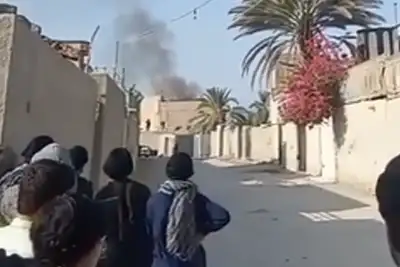
The US military conducted strikes against areas near the Strait of Hormuz, Axios reported citing a US official.







Israeli Prime Minister Benjamin Netanyahu said Friday’s framework agreement between Israel and Lebanon amounted to a “major blow” to Iran, arguing that Tehran had failed to force Israel out of southern Lebanon.
In a recorded statement, Netanyahu said Iran was trying to push Israel to withdraw “by force” from southern Lebanon, but that the agreement sent Tehran a clear message: “This is none of your business.”
He said neither Iran, Hezbollah nor any other “terrorist organization” would have a role in Lebanon under the emerging arrangement.
Netanyahu added that Israel would remain in its security zone in southern Lebanon as long as Hezbollah was not disarmed and continued to pose a threat to Israel.
The new US-Iran memorandum of understanding marks a fundamental shift in Washington's approach to Tehran, replacing years of "maximum pressure" with an effort to use economic incentives to secure nuclear concessions, experts told Iran International.
The agreement could eventually unlock tens of billions of dollars in oil revenue and frozen assets while paving the way for a proposed $300 billion reconstruction program.
Much of that money would depend on further negotiations during a 60-day window, but analysts say the direction of US policy has already changed.
"If the MOU is acted upon based on what we've seen in the text... I fear that we are at risk of moving from maximum pressure to maximum appeasement," he told Eye for Iran.
Economist Mohamad Machine-Chian sees the same policy shift, though he describes it differently.
"To my understanding, it seems like the US administration has concluded it is moving toward a different paradigm," he said.
"Before that they were relying on sanctions and maximum pressure. Now they're trying to provide incentives and basically direct and control using incentives."
The economic package outlined in the MOU has three main components: expanded oil revenue, access to frozen Iranian assets and a proposed reconstruction and economic development plan worth at least $300 billion. Each would operate differently.
According to Meizlish, the biggest immediate change is Treasury's General License X.
The significance of the license, he says, goes far beyond allowing Iran to export oil. It authorizes much of the commercial activity surrounding those exports, including associated financial transactions.
That means Iran is not simply allowed to sell oil. It is allowed to receive and use the proceeds.
"We're talking about potentially tens of billions of dollars in a relatively short period of time," Meizlish said. "It's unconditioned, unrestricted sanctions relief that's going to provide billions of dollars to the regime."
According to Meizlish, the license appears to contain no escrow mechanism or reporting requirements, distinguishing it from previous arrangements in which unfrozen Iranian assets were held in restricted accounts and designated for humanitarian purposes.
Frozen assets
Separate from oil revenue are Iran's frozen assets.
The MOU states that those funds would be made available under procedures to be negotiated during the 60-day talks.
The Trump administration has suggested released assets could be used to purchase humanitarian goods, including American agricultural products.
But Machine-Chian says there is no practical way to guarantee those goods ultimately benefit ordinary Iranians.
"I don't think there's any way to make sure it actually reaches ordinary Iranians," he said.
Even if wheat, medicine or other humanitarian supplies are purchased, he said, Washington has little control over how they are distributed once inside Iran.
The reconstruction fund
The agreement also proposes developing a reconstruction and economic development plan worth at least $300 billion with regional partners.
Exactly how the fund would operate remains unclear. President Donald Trump has repeatedly said US taxpayers would not finance reconstruction, while administration officials have suggested Persian Gulf partners and private investment could provide much of the funding if a final agreement is reached.
Unlike oil revenue, however, the reconstruction plan remains largely conceptual and would require further agreements before any large-scale investment materializes.
Have sanctions really disappeared?
Not entirely.
Machine-Chian cautioned that sanctions relief alone would not fully reconnect Iran to the global economy.
Iranian banks remain largely cut off from the international financial system, and restoring normal banking ties would likely require Tehran to comply with standards set by the Financial Action Task Force (FATF), a politically contentious step that hardline factions have long resisted.
As a result, sanctions relief alone is unlikely to normalize Iran's banking sector.
Who benefits?
The central debate surrounding the agreement is not simply how much money Iran could receive but who ultimately controls it.
Machine-Chian argues Iran's Central Bank is under severe pressure from inflation, a weakening rial and dwindling foreign exchange reserves. Fresh access to foreign currency, he says, could help stabilize the economy and prevent a deeper financial crisis.
"In that regard, these funds are going to help the Islamic Republic immensely," he said.
Whether that ultimately improves life for ordinary Iranians, however, remains uncertain.
Meizlish warns that fresh revenue could help rebuild military infrastructure damaged during the war while flowing into sectors such as oil, construction and petrochemicals, which he argues are deeply connected to the Islamic Revolutionary Guard Corps (IRGC).
"So what has Iran actually done?" Meizlish asked, arguing that reopening the Strait of Hormuz and agreeing to continue negotiations fall well short of the scale of economic relief now being offered.
Whether the strategy succeeds will depend less on the size of the promised economic package than on whether Washington can convert financial incentives into lasting nuclear concessions.
For now, the agreement represents a clear break from the sanctions-first approach that has defined US policy toward Iran for much of the past decade.
You can watch Eye for Iran on YouTube or listen on any podcast platform of your choosing.
Oman’s move to provide vessels with an alternative toll-free route through the Strait of Hormuz angered Tehran and undermined Iran’s control over the passageway, prompting it to act by launching drone attacks on civilian ships, The New York Times reported, citing an unnamed Iranian official.
The official said Iran viewed Oman’s role as a challenge to its authority over the strategic waterway.
According to the report, Tehran decided to respond after concluding that the alternative transit route weakened its leverage over ships passing through the strait.
An economic member of Iran’s negotiating team said Tehran accepted a 60-day suspension of fees on vessels passing through the Strait of Hormuz to secure an agreement, but that collection would resume once the period ends.
Hossein Ghorbanzadeh said charging vessels solely for passing through a natural waterway “has no meaning under international law", and that fees are collected only in return for services provided to ships.
But addressing the suspension of charges on vessels transiting the Strait of Hormuz, Ghorbanzadeh said Tehran had accepted the measure “so that the agreement could be reached.”
“After this period ends, collection of fees from passing vessels will resume,” he said.
IRGC spokesperson Hossein Mohebbi denied what he called US officials’ claims that a direct line had been established between Tehran and Washington over the Strait of Hormuz, saying the report was “a complete lie.”
“This matter is a complete lie and is strongly denied. It has not happened and will not happen,” Mohebbi said.
He added: “The Strait of Hormuz is Iranian territory and has nothing to do with the United States.”