Hezbollah chief says group will resist efforts to disarm
Hezbollah Secretary-General Naim Qassem said the group would resist any attempts by Israel to disarm the "resistance."
“In the face of Israel’s efforts to disarm the resistance, we will confront them with all our strength,” Qassem said in remarks carried by Iran's Tasnim News Agency.
He also said Israel had "no choice" but to fully withdraw from Lebanon.
“With Iran's help, we created deterrence against attacks by the Zionist regime because it wanted to drive us from our homes,” he said.
Iran's Khatam al-Anbiya Central Headquarters warned on Friday that Israeli military aircraft operating in the airspace of neighboring countries toward Iran would be considered a threat to the Islamic Republic.
The military headquarters described such flights as a "dangerous act" and a threat to Iran's security, according to a statement carried by state media.
The statement also said that if the United States was unable to "restrain" or "control" Israel, Iran would not tolerate any threat against itself.
"Iran will not tolerate any threat against itself and considers responding to these dangerous actions its legitimate right," the headquarters said.
Iranian Foreign Minister Abbas Araghchi said Tehran would “neither forget nor forgive” the killing of former Supreme Leader Ali Khamenei, casting his death in Shiite religious terms.
In a post on X, Araghchi compared Khamenei to Hussein, the third Shiite Imam, whose death at Karbala is central to Shiite memory and mourning.
“Imam Hussein is Sayyid al-Shuhada, the lord of those killed, because he sacrificed everything he had on the plain of Karbala,” Araghchi wrote.
“In the same way, we will never forget his killing, nor will we forgive it,” he added.
Israeli Prime Minister Benjamin Netanyahu said Israel would remain in a security zone in southern Lebanon “as long as required,” while Defense Minister Israel Katz warned Iran against responding to Israeli military operations there.
Speaking at a ceremony for new combat officers on Thursday, Netanyahu said Israel had shifted from areas it merely controlled to “commanding terrain” in southern Lebanon, including positions near Beaufort, and would not withdraw.
“We are not going to withdraw from it,” Netanyahu said. “We will protect the residents of the north and all Israeli citizens from there.”
Netanyahu said he and Katz had instructed the Israeli military to act freely against any threat to Israeli troops or communities in northern Israel.
Katz was more explicit in linking Lebanon to Iran. He said Israel would not leave its security zones in Lebanon, Syria or Gaza “without a time limit,” despite pressure, and warned Tehran against treating Israeli action in Lebanon as a trigger for wider escalation.
“If Iran attacks Israel because of our actions in Lebanon, or for any other reason, we will attack it with full force,” Katz said, adding that Israel would make clear what he called the gap in power between the two sides.
Netanyahu also repeated Israel’s red line on Iran’s nuclear program, saying that “with an agreement or without an agreement,” Iran would not be allowed to obtain nuclear weapons while he remained prime minister.
Montenegrin police and the FBI have arrested an Iranian national wanted by the United States over a major hacking campaign that allegedly targeted US universities and benefited Iran’s Revolutionary Guards, Reuters reported.
The 39-year-old man, who holds Iranian and Turkish citizenship, was identified by Montenegrin media as Amir Barati and was arrested in the Adriatic resort town of Kotor, Montenegro’s police directorate said Thursday.
He is wanted by the US District Court for the Southern District of New York on charges including conspiracy to commit computer fraud, hacking and identity theft. The case will now go before a High Court judge in Podgorica for extradition proceedings.
Montenegrin police said the suspect had carried out large-scale cyberattacks from 2013 onward, targeting more than 150 universities in the United States and causing damage estimated at more than $3.4 billion.
Police said the stolen data and access to compromised university accounts were used for the benefit of the Islamic Revolutionary Guard Corps and other Iranian entities, including universities.
Barati’s name does not appear on the FBI’s public list of nine Iranian hackers charged in 2018 over the Mabna Institute campaign, but the allegations described by Montenegrin police closely match that case, including the 2013 start date, the university targets, the IRGC connection and the $3.4 billion damage estimate.
The overlap leaves open the possibility that Barati was tied to the same broader operation or to a related US case, though neither US nor Montenegrin authorities have publicly linked him to the 2018 indictment.
The FBI said in 2018 that the Mabna Institute, an Iran-based company created in 2013, was used to steal access to non-Iranian academic and scientific resources through computer intrusions. US authorities said members of the institute were contracted by the IRGC and other Iranian government clients.
According to the FBI, the campaign compromised about 144 US-based universities and 176 foreign universities in 21 countries. It also targeted private companies, US government entities, the states of Hawaii and Indiana, and the United Nations.
US authorities said the hackers targeted more than 100,000 professor accounts worldwide and successfully compromised about 8,000 of them. They stole more than 30 terabytes of academic data and intellectual property, including journal access, research papers, electronic books and other proprietary academic material.
The campaign relied heavily on spearphishing emails that appeared to come from other academics. Victims were directed to fake university login pages, where their credentials were captured and later used to access library databases and research platforms.
The FBI said the stolen material covered a wide range of fields, including science, technology, engineering, medicine, social sciences and other academic disciplines.
US investigators also said the hackers used password-spraying attacks against companies and government targets, gaining access to email accounts and sensitive data. Victims included academic publishers, media and entertainment companies, technology firms and investment firms.
When the 2018 charges were announced, then-FBI Deputy Director David Bowdich said apprehending the suspects would be difficult but “not impossible,” adding that the defendants could be arrested if they traveled outside Iran.
“Where we can’t apprehend these individuals quickly, we will resort to different methods – naming and shaming, sanctions, and a lot of publicity,” Bowdich said at the time. “We will keep at it, because the FBI and our partners at the Department of Justice have a very long memory.”
The arrest in Montenegro suggests that warning may now be playing out years later, as one suspect allegedly linked to the campaign faces possible extradition to the United States.
The case comes amid renewed US warnings about Iranian cyber operations. In April, US cybersecurity, law enforcement and intelligence agencies warned of escalating Iranian hacking campaigns targeting equipment across critical infrastructure.
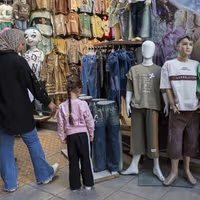
A woman and child look at clothes displayed outside a shop in Tehran, June 11, 2026
Economists and business analysts in Iran say the country's biggest challenges may come after any agreement with the United States, arguing that structural reforms will be as crucial as sanctions relief to achieving a durable economic recovery.
They say Tehran must use the post-war period to impose budgetary discipline, avoid past currency-stabilization mistakes and overhaul its bureaucracy to attract foreign investment, rather than treating the current pause as a short-lived tactical opportunity.
Business strategy consultant Ali Nazemzadeh argued that historical experience—from post-World War II Germany and Japan to Iran's reconstruction after the Iran-Iraq War and the 2008 global financial crisis—suggests economies rarely collapse permanently after major shocks.
Instead, they undergo periods of restructuring and renewal.
Writing in Jahan-e Sanat earlier this week, Nazemzadeh urged business leaders to abandon a passive "waiting mode" and prepare for a post-crisis economy that could unleash pent-up demand and redistribute market share toward the most resilient firms.
Although the 12-day and 40-day wars constrained business decision-making through currency volatility, internet disruptions, the triggering of the UN snapback mechanism, domestic unrest and military tensions, he argued that economic recovery remains historically inevitable.
With its natural resources, strategic location and population of 90 million, "Iran cannot fail to develop after a wartime era," he wrote, describing crises as an "economic sieve" that allows businesses with liquidity, disciplined management and clear strategy to emerge stronger.
Economist Pouya Jabal Ameli echoed that view, arguing that while the interim agreement may not permanently end the cycle of war and ceasefire, it creates a crucial window ahead of the 60-day deadline for negotiating a comprehensive settlement.
He urged policymakers to treat the period not as a tactical pause but as a launchpad for deep structural reforms.
By taking advantage of falling inflation expectations, enforcing budgetary discipline, avoiding historical currency-stabilization traps such as Dutch disease, and preparing a bureaucratic overhaul capable of attracting foreign investment, Iran could shift its global image from conflict toward economic renewal.
Jabal Ameli concluded that Iranian officials should view the memorandum—and any subsequent agreement with the United States—as an opportunity for structural reform rather than a short-term tactical maneuver.
Offering a more optimistic political assessment, pro-reform daily Sharq described the memorandum as "the first direct official agreement between the presidents of Iran and the U.S. in over four decades."
Columnist Abdolrahman Fathollahi argued the agreement could pave the way for a durable ceasefire, economic recovery and the gradual lifting of sanctions while noting that Supreme Leader Mojtaba Khamenei had approved the talks only conditionally and continued to stress distrust of Washington.
He also pointed to repeated warnings from the IRGC and the Supreme National Security Council that Iran had prepared retaliatory measures should the United States fail to honour its commitments.
Despite criticism from a handful of hardline lawmakers, Parliament Speaker Mohammad Bagher Ghalibaf, who also serves as Iran's chief negotiator, declared parliament's backing for the process.
"With the finalization of the memorandum, the difficult path of fulfilling commitments and reclaiming the rights of the Iranian nation has only just begun," he said.
Fathollahi cautioned against excessive optimism, arguing that the agreement's ultimate success "will be determined not in its text, but in the degree of adherence to commitments, the management of regional crises, and the tests ahead."