US lawmaker says Washington 'slow rolling' Minab school strike answers


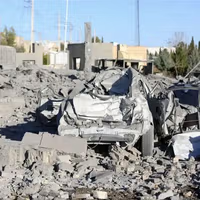
US Representative Jason Crow has renewed calls for answers over the strike on a school in the Iranian city of Minab early in the war, saying it "could be the single largest civilian casualty incident in US military history."
Speaking to CBS, the Colorado Democrat said Congress had yet to receive a full accounting of the incident.
"This could be the single largest civilian casualty incident in US military history. We need facts. We need to make sure that we own up to it, that we take accountability, that we make it right," Crow said.
"We need answers to this. And they're clearly slow rolling us."
In a separate post on X, Crow said it had been four months since the "horrific school bombing" in Iran and criticized President Trump and War Secretary Pete Hegseth for failing to produce answers.


Israeli and Lebanese delegations will resume US-brokered talks in Washington on Friday as negotiations continue over a deal to end fighting in Lebanon, Al Jazeera reported citing a US State Department official.
The official said that representatives from both countries would reconvene after earlier rounds of discussions in the US capital.
The talks are part of a US-led effort to secure a lasting agreement between Israel and Lebanon following months of conflict and repeated ceasefire violations.
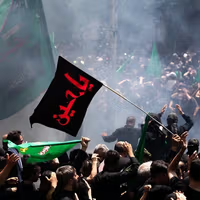
Iran's Ashura commemorations have again become a stage for competing political narratives, with government supporters and opponents alike using Shi'ite mourning rituals to advance sharply different messages.
Every year during the Islamic month of Muharram, millions of Shi'ite Muslims across Iran commemorate the martyrdom of Imam Hussein, the grandson of the Prophet Muhammad who was killed in 680 AD.
Hardliners often invoke his example to argue Iran should continue confronting the United States, while government critics use the same symbolism to condemn injustice at home.
Political messaging also comes through speeches by eulogists (maddahs), who preside over ceremonies recounting Hussein's sacrifice and heroism.
Read the full article here.
A cargo ship was struck by a projectile off the coast of Oman on Thursday, underscoring the fragility of the US-Iran understanding as tensions over navigation through the Strait of Hormuz resurfaced.
The latest incident highlighted the central place of the strategic waterway in the de-escalation agreement, with Iran tightening its warnings to shipping while the United States and Perisan Gulf Arab states insisted any lasting arrangement must guarantee freedom of navigation.
The UK Maritime Trade Operations said the vessel was hit on its starboard side at 2:10 p.m. UTC about 7.5 nautical miles southeast of Dahit, Oman, damaging its bridge. The ship's master reported that all crew were safe and there was no environmental damage.
The Wall Street Journal, citing two senior US officials, reported that Iran's Revolutionary Guards attacked the Singapore-flagged cargo ship in the Strait of Hormuz.
The incident followed warnings by Iran's Persian Gulf Strait Authority that vessels using routes outside its designated framework would not be covered by safe-passage guarantees, insurance protections or related liability arrangements.
"Any consequences arising from unauthorized routing shall be the sole responsibility of the vessel owner, charterer, and master," the authority said on X.
IRGC-affiliated outlets also reported that three tankers attempting to pass through a US-declared corridor in Omani waters turned back after receiving warnings from the Revolutionary Guards.
The vessels were identified as the UAE-owned Blue Star I, Japan's Azumasan and the Japan-managed Omega Trader.
The attack prompted the International Maritime Organization to temporarily suspend its evacuation operation for ships in the Persian Gulf, saying it needed to reassess safety guarantees before continuing.
IMO Secretary-General Arsenio Dominguez said the pause was intended "to reconfirm that the necessary safety guarantees continue to be in place for the ships on our evacuation list and all those in the region."
The developments came as US Secretary of State Marco Rubio and GCC foreign ministers met in Manama and reaffirmed that reopening the Strait of Hormuz to free and unrestricted navigation was essential to regional and global security.
The ministers said any US-Iran de-escalation agreement must guarantee Persian Gulf security and freedom of navigation through the strait. They also rejected any tolls, fees or attempts to assert control over Hormuz, saying transit passage must remain protected under international law.
The GCC added that any regional understanding must take into account the security interests of Persian Gulf states while safeguarding the region's economic and developmental gains.
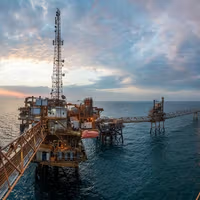
Oil prices rose on Thursday as the latest maritime incident renewed concerns over shipping through one of the world's most important energy corridors.
Brent futures rose just over 2 percent to $75.26 a barrel, according to Reuters, while US West Texas Intermediate rose 2.3 percent to $71.92.
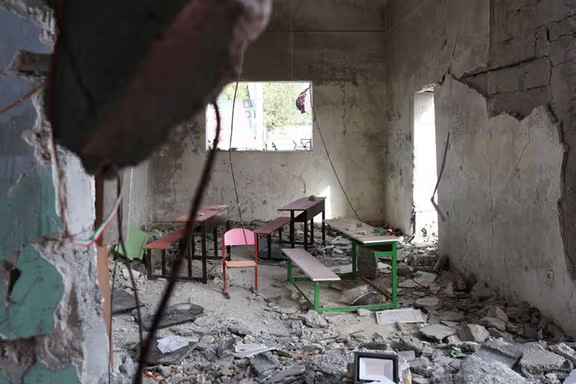
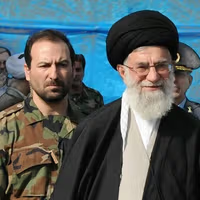
Iranian Foreign Minister Abbas Araghchi compared slain Supreme Leader Ali Khamenei to Imam Hussein in an Ashura message on X, sharing a painting of Khamenei alongside the post.
"Shia Muslims revere Imam Hussein as the Master of Martyrs because he sacrificed everything on the plains of Karbala," Araghchi wrote.
"Likewise, we will never forget nor forgive the martyrdom of Grand Ayatollah Seyed Ali Khamenei as the Master of Martyrs of the Islamic Revolution of Iran," he added.
US President Donald Trump said on Thursday that Washington was negotiating with Iran from a position of "pure strength" and predicted the two sides would "probably make a deal."
Speaking to farmers attending a dinner at the White House, Trump defended his decision to strike Iran during the recent conflict, saying the operation had prevented Tehran from obtaining a nuclear weapon.
"We're negotiating with Iran from pure strength," he said, asserting that the leadership in Tehran now wants a deal "badly" and the the two sides "will probably make a deal."
He added that the US government would soon buy wheat, soybeans and corn from American farmers using Iranian assets that have been frozen under US sanctions.