• العربية
  • فارسی
Brand
  • Iran Insight
  • Politics
  • Economy
  • Analysis
  • Special Report
  • Opinion
  • Podcast
  • Iran Insight
  • Politics
  • Economy
  • Analysis
  • Special Report
  • Opinion
  • Podcast
  • Theme
  • Language
    • العربية
    • فارسی
  • Iran Insight
  • Politics
  • Economy
  • Analysis
  • Special Report
  • Opinion
  • Podcast
All rights reserved for Volant Media UK Limited
volant media logo

Ships face conflicting Iran, US instructions in Strait of Hormuz - FT

Jun 23, 2026, 05:47 GMT+1

Shipowners are facing confusion over the safest route out of the Persian Gulf as Iran, the United States and western insurers issue conflicting guidance on travel through the Strait of Hormuz, the Financial Times reported on Tuesday.

Shipping traffic through the strait has increased, but Iran has warned that vessels could face penalties or be forced to turn back if they do not seek advance permission from Tehran and sail close to the Iranian coast, the report said.

At the same time, the United States and some western insurers are advising ships to use a route protected by US air cover on the Omani side of the strait, the report said, citing three shipping executives.

Continue reading

Most Viewed

Will the Islamic Republic trade with the 'Great Satan'?
1
INSIGHT

Will the Islamic Republic trade with the 'Great Satan'?

2
OPINION

MoU's forgotten casualty is the Iranian people

3
INSIGHT

Iran's postwar rallies become flashpoint in diplomacy debate

4

Lebanon 'deconfliction cell' emerges after intense Switzerland talks

5

Cyber campaign posing as Iran International staff continues

Banner
Banner
Banner

Spotlight

  • Tehran bread prices jump up to 100% in latest increase

    Tehran bread prices jump up to 100% in latest increase

  • Rising gym fees push fitness beyond reach for many Iranians
    VOICES FROM IRAN

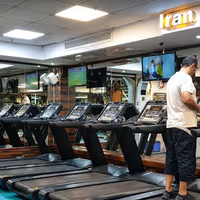
    Rising gym fees push fitness beyond reach for many Iranians

  • Relief or resistance? Tehran dailies offer diverging readings of talks
    INSIGHT

    Relief or resistance? Tehran dailies offer diverging readings of talks

  • Will the Islamic Republic trade with the 'Great Satan'?
    INSIGHT

    Will the Islamic Republic trade with the 'Great Satan'?

  • Iran's postwar rallies become flashpoint in diplomacy debate
    INSIGHT

    Iran's postwar rallies become flashpoint in diplomacy debate

  • MoU's forgotten casualty is the Iranian people
    OPINION

    MoU's forgotten casualty is the Iranian people

•
•
•

More Stories

Ships face conflicting Iran, US instructions in Strait of Hormuz - FT

Jun 23, 2026, 05:27 GMT+1
Ships face conflicting Iran, US instructions in Strait of Hormuz - FT
100%
Ships are seen near the Strait of Hormuz in a handout image released by Iranian state media on June 21, 2026.

Shipowners are facing confusion over the safest route out of the Persian Gulf as Iran, the United States and western insurers issue conflicting guidance on travel through the Strait of Hormuz, the Financial Times reported on Tuesday.

Shipping traffic through the strait has increased, but Iran has warned that vessels could face penalties or be forced to turn back if they do not seek advance permission from Tehran and sail close to the Iranian coast, the report said.

At the same time, the United States and some western insurers are advising ships to use a route protected by US air cover on the Omani side of the strait, the report said, citing three shipping executives.

The conflicting guidance has left shipowners unsure whether to risk possible Iranian interference or ignore advice from insurers and US authorities, it added.

“Shipowners and operators find themselves caught in a difficult position. If they follow the guidance of underwriters and US authorities by navigating closer to Oman, they risk interference, detention or potential hostile action from Iranian authorities,” said Dr SV Anchan, chair of the US shipping company Safesea Shipping.

UN reports first day without cross-border fire in Lebanon since March

Jun 23, 2026, 04:47 GMT+1

The United Nations says its peacekeepers in southern Lebanon recorded the first day without rocket fire or interceptions since fighting between Israel and Hezbollah erupted on March 2.

UN spokesperson Stephane Dujarric told reporters on Monday that peacekeepers observed no trajectories or interceptions on Sunday, marking a rare pause in months of hostilities.

"The lack of activities" continued into Monday morning, Dujarric said.

"We welcome this reduction in hostilities, and we very much hope this trend continues for the sake of people on the ground."

US opens door to Iranian oil in historic sanctions rollback

Jun 23, 2026, 04:18 GMT+1
US opens door to Iranian oil in historic sanctions rollback
100%

The United States on Monday announced a sweeping sanctions waiver for Iran's energy sector, authorizing the sale of Iranian oil, allowing payments to Tehran in US dollars and opening the door for Iranian oil and petroleum products to be imported into the United States.

The move marks one of the most dramatic shifts in US policy toward Iran since the 1979 Islamic Revolution and follows the recently signed US-Iran Memorandum of Understanding.

Treasury Secretary Scott Bessent presented the measure as part of the administration's effort to implement the agreement while negotiations continue toward a broader settlement.

Under the waiver issued by the Treasury Department, Iran will be allowed to produce, sell and transport crude oil, petroleum products and petrochemicals through August 21 while negotiations continue.

Read the full story here.

Relief or resistance? Tehran dailies offer diverging readings of talks

Jun 23, 2026, 04:08 GMT+1
•
Behrouz Turani
Relief or resistance? Tehran dailies offer diverging readings of talks
100%
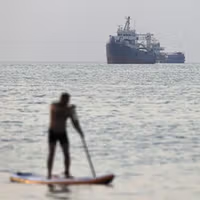
A paddleboarder moves through the waters of the Strait of Hormuz as a tanker sails in the distance, June 21, 2026

While much of Iran's political press focused on the diplomatic drama surrounding the latest round of US-Iran talks in Switzerland, several economic newspapers used Monday's coverage to highlight the country's deeper economic challenges and post-war uncertainties.

The talks ended with a joint statement from mediators Qatar and Pakistan announcing a roadmap toward a final agreement within 60 days, alongside plans for further technical negotiations.

Iranian officials have also highlighted progress on the release of frozen assets and the possibility of expanded trade.

On Monday, Iran's central bank chief Abdolnasser Hemmati said funds released under the emerging agreement would not necessarily be limited to essential goods and could be used to purchase other non-sanctioned products.

Iranian newspapers largely divided along familiar lines, with hardline outlets portraying the talks as a test of national resolve and moderate publications emphasizing the potential economic benefits of diplomacy.

Economic outlets, by contrast, focused on questions of market stability, sanctions relief and the country's long-term structural problems.

The prominent economic daily Donyaye Eghtesad argued that "a 60-day diplomatic stopgap cannot solve deep-seated, post-war structural challenges."

Its editorial noted that "the diplomacy of the mattress in Switzerland cannot mask the reality that a 60-day roadmap is a temporary truce, not a permanent architecture."

It warned that markets had reacted with immediate volatility to the diplomatic developments, underscoring the risks of managing the economy through short-term political decisions.

Oil-export waivers may provide temporary liquidity, the paper argued, but cannot by themselves resolve deeper structural problems or restore long-term confidence.

Resistance versus relief

The dominant hardline narrative remained one of resistance rather than compromise.

Kayhan argued that Iran's temporary reinstatement of restrictions on traffic through the Strait of Hormuz over the weekend had forced the United States "back to reality."

The newspaper wrote that the brief disruption "proved once again that the only language the Western front understands is the language of definitive leverage," adding that Parliament Speaker Mohammad Bagher Ghalibaf's reported walkout from negotiations demonstrated that Iran "does not negotiate under the shadow of social media threats."

Javan urged negotiators to remain cautious, describing the 60-day roadmap as "a tactical pause forced upon the Americans by the operational readiness of our armed forces."

But moderate voices offered a markedly different assessment.

Shargh described the outcome of the talks as "a fragile but essential window of relief," noting that concrete oil and petrochemical waivers had, for the first time, been linked to a diplomatic timetable.

At the same time, it cautioned that "the shadow of Donald Trump's erratic, transactional approach to international relations looms large," urging negotiators to secure technical and economic guarantees before the current opportunity closes.

Etemad focused on the domestic economy, arguing that Iran "desperately requires the structural stability these sanctions waivers promise" and portraying the developments in Switzerland as evidence that a pragmatic diplomatic framework remains viable.


Even a partial US-Iran deal could help restore trade normality - FT

Jun 23, 2026, 03:44 GMT+1

A partial agreement between the United States and Iran may be enough to help global trade return to a more normal footing, even without a comprehensive political settlement, the Financial Times argued in its Trade Secrets newsletter on Monday.

The paper said fears of a prolonged shock to global commerce have eased as oil prices remain well below the levels many analysts predicted during the conflict and shipping through the Strait of Hormuz gradually resumes.

The FT argued that while the emerging US-Iran understanding may fall short of a lasting peace agreement, even a limited arrangement could reduce uncertainty and help stabilize trade flows, energy markets and shipping routes in the months ahead.