• العربية
  • فارسی
Brand
  • Iran Insight
  • Politics
  • Economy
  • Analysis
  • Special Report
  • Opinion
  • Podcast
  • Iran Insight
  • Politics
  • Economy
  • Analysis
  • Special Report
  • Opinion
  • Podcast
  • Theme
  • Language
    • العربية
    • فارسی
  • Iran Insight
  • Politics
  • Economy
  • Analysis
  • Special Report
  • Opinion
  • Podcast
All rights reserved for Volant Media UK Limited
volant media logo

Even a partial US-Iran deal could help restore trade normality - FT

Jun 23, 2026, 03:44 GMT+1

A partial agreement between the United States and Iran may be enough to help global trade return to a more normal footing, even without a comprehensive political settlement, the Financial Times argued in its Trade Secrets newsletter on Monday.

The paper said fears of a prolonged shock to global commerce have eased as oil prices remain well below the levels many analysts predicted during the conflict and shipping through the Strait of Hormuz gradually resumes.

The FT argued that while the emerging US-Iran understanding may fall short of a lasting peace agreement, even a limited arrangement could reduce uncertainty and help stabilize trade flows, energy markets and shipping routes in the months ahead.

Most Viewed

Will the Islamic Republic trade with the 'Great Satan'?
1
INSIGHT

Will the Islamic Republic trade with the 'Great Satan'?

2
OPINION

MoU's forgotten casualty is the Iranian people

3
INSIGHT

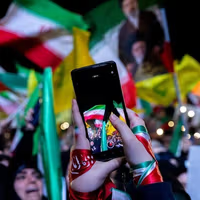
Iran's postwar rallies become flashpoint in diplomacy debate

4

Lebanon 'deconfliction cell' emerges after intense Switzerland talks

5

Cyber campaign posing as Iran International staff continues

Banner
Banner
Banner

Spotlight

  • Tehran bread prices jump up to 100% in latest increase

    Tehran bread prices jump up to 100% in latest increase

  • Rising gym fees push fitness beyond reach for many Iranians
    VOICES FROM IRAN

    Rising gym fees push fitness beyond reach for many Iranians

  • Relief or resistance? Tehran dailies offer diverging readings of talks
    INSIGHT

    Relief or resistance? Tehran dailies offer diverging readings of talks

  • Will the Islamic Republic trade with the 'Great Satan'?
    INSIGHT

    Will the Islamic Republic trade with the 'Great Satan'?

  • Iran's postwar rallies become flashpoint in diplomacy debate
    INSIGHT

    Iran's postwar rallies become flashpoint in diplomacy debate

  • MoU's forgotten casualty is the Iranian people
    OPINION

    MoU's forgotten casualty is the Iranian people

•
•
•

More Stories

Hardline outlet challenges interpretation of Khamenei message on US talks

Jun 23, 2026, 03:26 GMT+1
Hardline outlet challenges interpretation of Khamenei message on US talks
100%

Ultraconservative outlet Raja News says media affiliated with Mojtaba Khamenei has quietly corrected a recent statement in a way that could alter perceptions of his position on the emerging US-Iran agreement.

According to Raja News, media linked to Khamenei issued an explanatory notice apologizing for adding the phrase "[about the memorandum of understanding]" to a recent message from the Iranian leader.

The phrase had been inserted to clarify the meaning of the statement but was not part of Khamenei's original remarks, Raja News said. The outlet reported that all related posts containing the addition were subsequently removed.

Raja News argued that the editorial addition had created the impression that Khamenei's reservations were directed specifically at the text of the memorandum of understanding reached with the United States.

"The addition of this phrase led to misunderstandings regarding the Leader's agreement with the ceasefire and negotiations, and created the impression that his opposition was limited only to the text of the memorandum," the outlet wrote.

By removing the phrase, Raja News suggested, media affiliated with Khamenei implicitly acknowledged that his concerns may have extended beyond the agreement itself and could have encompassed broader issues including the ceasefire and negotiations with Washington.

Iranian MP calls for protest over continued closure of parliament

Jun 23, 2026, 02:30 GMT+1

Iranian lawmaker Kamran Ghazanfari has announced plans for a protest outside parliament, saying a group of MPs will stage a sit-in if the legislature remains closed.

In a post on X titled "Important Notice," the Tehran representative said a number of lawmakers would go to parliament at 8 a.m. on Sunday, June 28.

"I inform the noble people of Iran that a group of members of the Islamic Consultative Assembly will go to parliament at 8 a.m. on Sunday, June 28," Ghazanfari wrote.

"If parliament is closed, we will remain there in a sit-in until it is reopened."

House Foreign Affairs Democrats slam Trump over Iran sanctions relief

Jun 23, 2026, 01:49 GMT+1

Democrats on the House Foreign Affairs Committee have criticized the Trump administration's handling of the emerging agreement with Iran, arguing that Washington is granting sweeping sanctions relief despite previously tying any economic benefits to changes in Tehran's behavior.

"While ending this illegal war is better than disastrously doubling down, the admin's steps are inconsistent with its own rhetoric about how it would approach any deal," the committee Democrats said in a statement posted on X.

The lawmakers noted that Trump officials had repeatedly argued sanctions relief would be contingent on Iran addressing concerns related to its nuclear program and regional allies.

"Neither has been addressed, but the regime has been gifted sweeping sanctions relief it has dreamed of for decades," they said.

US opens door to Iranian oil in historic sanctions rollback

Jun 23, 2026, 01:35 GMT+1
US opens door to Iranian oil in historic sanctions rollback
100%
An engineer watches over a part of Fajr-e Jam refinery in Iran's southern province of Bushehr, February 2026

The United States on Monday announced a sweeping sanctions waiver for Iran's energy sector, authorizing the sale of Iranian oil, allowing payments to Tehran in US dollars and opening the door for Iranian oil and petroleum products to be imported into the United States.

The move marks one of the most dramatic shifts in US policy toward Iran since the 1979 Islamic Revolution and follows the recently signed US-Iran Memorandum of Understanding.

Treasury Secretary Scott Bessent presented the measure as part of the administration's effort to implement the agreement while negotiations continue toward a broader settlement.

Under the waiver issued by the Treasury Department, Iran will be allowed to produce, sell and transport crude oil, petroleum products and petrochemicals through August 21 while negotiations continue.

The authorization also permits payments in US dollars and allows Iranian oil and petroleum products to be imported into the United States. It effectively suspends key restrictions on Iran's energy sector that had been in place for years under both primary and secondary sanctions.

The Treasury Department said the waiver covers shipping, insurance, vessel management, registration and other services necessary to facilitate oil trade, while suspending restrictions under a range of sanctions authorities that have constrained Iran's energy exports for decades.

For years, Iran has built an extensive sanctions-evasion network to keep its oil flowing to international markets. The system relies on a large "shadow fleet" of tankers, ship-to-ship transfers, intermediaries and opaque financial arrangements designed to conceal the origin and destination of Iranian crude.

Oil exports remain the backbone of Iran's economy and a critical source of government revenue. By allowing Iranian crude and petroleum products to be sold more openly and through conventional financial channels, the waiver provides one of the strongest economic incentives yet for Tehran to convert the current understanding into a permanent deal.

Iranian officials portrayed the move as evidence that negotiations were delivering tangible economic benefits.

Parliament Speaker and chief negotiator Mohammad Bagher Ghalibaf said Iran had also secured an agreement on the release of frozen assets.

"In Switzerland we agreed on the release of $12 billion in frozen assets," Ghalibaf said in remarks carried by state media.

He also argued that the negotiations had helped reduce violence in Lebanon, one of the most contentious issues during the talks.

"Since we entered the Swiss negotiations, we have seen that the enemy's fire against Lebanon has stopped and a large part of the people have returned to their homes," he said.

Ghalibaf said Iran would continue pursuing its objectives in Lebanon through the diplomatic process.

"With the decision made in Switzerland, we will achieve the territorial integrity and national sovereignty of Lebanon in these talks, and we will not abandon it until we achieve a result."

His remarks are likely to fuel criticism from opponents of the agreement, who argue Washington has granted sweeping economic concessions before securing major commitments from Tehran on its nuclear program or regional activities.

Critics have pointed in particular to the scale of the sanctions relief and the release of frozen assets, arguing that the administration is moving ahead with incentives while many of the most difficult issues remain unresolved.

Supporters of the agreement, meanwhile, argue that the measures are intended to build momentum for negotiations, secure nuclear inspections and reduce the risk of renewed conflict in the region.


Will the Islamic Republic trade with the 'Great Satan'?

Jun 23, 2026, 01:03 GMT+1
Will the Islamic Republic trade with the 'Great Satan'?
100%

Nearly half a century after Iran's revolutionary government severed ties with Washington, took US diplomats hostage and turned "Death to America" into one of its defining slogans, a new US proposal could see frozen Iranian assets used to purchase American goods.

The proposal points to one of the more striking ironies of the emerging US-Iran agreement: using Iranian assets to buy American products from a country the Islamic Republic has long cast as the "Great Satan" and a threat to the revolution.

Speaking in Switzerland on Monday, US Vice President JD Vance said Washington could agree to unfreeze Iranian assets for purchases of American products such as soybeans, corn and wheat.

"If Iranian assets are ever unfrozen, they're going to go to make American farmers richer and to feed the Iranian people," Vance said, adding that the United States and Qatar would oversee the process.

Read the full article here.