• العربية
  • فارسی
Brand
  • Iran Insight
  • Politics
  • Economy
  • Analysis
  • Special Report
  • Opinion
  • Podcast
  • Iran Insight
  • Politics
  • Economy
  • Analysis
  • Special Report
  • Opinion
  • Podcast
  • Theme
  • Language
    • العربية
    • فارسی
  • Iran Insight
  • Politics
  • Economy
  • Analysis
  • Special Report
  • Opinion
  • Podcast
All rights reserved for Volant Media UK Limited
volant media logo

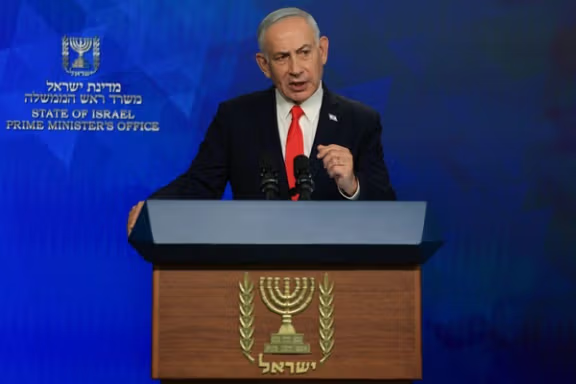
Netanyahu says confrontation with Iran ‘not over’
Jun 23, 2026, 10:50 GMT+1

Israeli Prime Minister Benjamin Netanyahu said Israel’s confrontation with Iran and its allies was “not over,” during a meeting last Thursday with reserve officer cadets in Gush Etzion, Israeli media reported on Tuesday.

“We are now facing Iran and its proxies. We struck them. It is not over yet, but it depends on our strength,” he said, according to the reports.

He said Israel’s position over the next 30 years would depend on its power and that the country was now building “greater strength.”

He also called for reducing dependence on US weapons, while saying he appreciated American support.

“I want arms independence,” he said. “We need an independent arms system of our own. We are producing our own weapons.”


Most Viewed

Will the Islamic Republic trade with the 'Great Satan'?
1
INSIGHT

Will the Islamic Republic trade with the 'Great Satan'?

2
OPINION

MoU's forgotten casualty is the Iranian people

3
INSIGHT

Iran's postwar rallies become flashpoint in diplomacy debate

4

Lebanon 'deconfliction cell' emerges after intense Switzerland talks

5

Cyber campaign posing as Iran International staff continues

Banner
Banner
Banner

Spotlight

  • Tehran bread prices jump up to 100% in latest increase

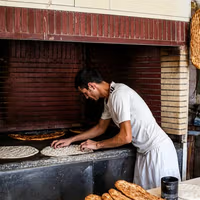
    Tehran bread prices jump up to 100% in latest increase

  • Rising gym fees push fitness beyond reach for many Iranians
    VOICES FROM IRAN

    Rising gym fees push fitness beyond reach for many Iranians

  • Relief or resistance? Tehran dailies offer diverging readings of talks
    INSIGHT

    Relief or resistance? Tehran dailies offer diverging readings of talks

  • Will the Islamic Republic trade with the 'Great Satan'?
    INSIGHT

    Will the Islamic Republic trade with the 'Great Satan'?

  • Iran's postwar rallies become flashpoint in diplomacy debate
    INSIGHT

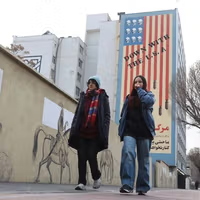
    Iran's postwar rallies become flashpoint in diplomacy debate

  • MoU's forgotten casualty is the Iranian people
    OPINION

    MoU's forgotten casualty is the Iranian people

•
•
•

More Stories

Rising gym fees push fitness beyond reach for many Iranians

Jun 23, 2026, 10:38 GMT+1
•
Saba Heidarkhani
Rising gym fees push fitness beyond reach for many Iranians
100%
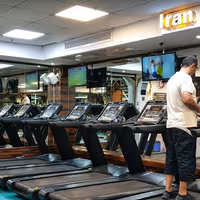
A man adjusts a treadmill at a gym in Iran.

Soaring gym fees and shrinking household budgets are forcing many Iranians to abandon sports and fitness activities, turning what was once a routine part of daily life into an unaffordable luxury, according to messages sent to Iran International.

Monthly gym memberships that were once within reach for many families now cost at least 20 million rials ($12.5) in smaller cities. In some gyms in Tehran and other major urban centers, 12 training sessions can cost as much as 200 million rials ($125). The average wage in Iran is $150.

Gym owners say inflation, rising rents, higher energy bills and the growing cost of imported equipment have left them little choice but to raise fees. For many households, however, food, housing and transportation now take priority over exercise.

Teen athletes forced to quit

Many of the messages received by Iran International on the issue came from teenagers who said financial pressures were disrupting their athletic ambitions.

A 15-year-old taekwondo athlete said she had spent months trying to save enough money to buy a punching bag. A 13-year-old basketball player said he had been forced to stop training indoors because of rising fees.

A university student in Mashhad said gym membership remained out of reach despite a strong interest in fitness.

“Registering at a gym and working out is something I still want to do, but my salary is so low that I cannot afford it,” the student said.

100%

The decline in participation is also hitting gym owners and coaches.

A gym manager in eastern Tehran said the number of clients at his facility had fallen to roughly one-third of previous levels, despite keeping membership fees unchanged.

Coaches in several cities said they had lost most of their students in recent months and lacked both fixed salaries and insurance coverage. Many warned that smaller sports businesses could face closure if the trend continues.

Rising costs beyond membership fees

The financial pressure extends beyond gym subscriptions. Coaches and athletes say the price of protein-rich foods and sports supplements has climbed sharply, making it harder to maintain training programs.

Citizens reported that whey protein now costs around 200 million rials ($125), while a 300-gram container of creatine sells for about 40 million rials ($25).

Football players also pointed to soaring equipment costs, saying cleats priced below 50 million rials ($31) have become difficult to find. One player said football field rental fees can also reach 50 million rials ($31).

Health experts have long warned that lower levels of physical activity can contribute to higher healthcare costs over time. For many Iranians, however, regular exercise is increasingly becoming a financial burden rather than a basic part of a healthy lifestyle.

Oman sultan meets Iran’s Ghalibaf, Araghchi on US talks

Jun 23, 2026, 10:09 GMT+1

Oman’s Sultan Haitham bin Tariq received Iran’s Parliament Speaker Mohammad Bagher Ghalibaf and Foreign Minister Abbas Araghchi at Al Barakah Palace on Tuesday to discuss the latest developments in Iran-US negotiations, the Oman News Agency reported.

The sultan listened to the Iranian side’s explanations on the different tracks of the talks and expressed support for the negotiations.

He voiced hope that the talks would lead to a peaceful and definitive settlement of outstanding issues, including the restoration of safe and unhindered navigation through the Strait of Hormuz, the nuclear file and other related matters.

Iran envoy says asset-use plan involving US crops is unconfirmed

Jun 23, 2026, 09:38 GMT+1

Iran’s ambassador to the United Nations in Geneva said on Tuesday he could not confirm US Vice President JD Vance’s statement that any funds from unfrozen Iranian assets would be used to buy American corn, soy and wheat.

Vance had earlier said any future unfreezing of Iranian assets would be subject to US and Qatari approval and that the money would be used to buy American agricultural goods “for the benefit of the Iranian people.”

"If Iranian assets are ever unfrozen, they're going to go to make American farmers richer and to feed the Iranian people. That's a very, very good and very classic Trump deal," the US vice president said after Iran talks concluded in Switzerland.

He said the money would be used to buy American soy, corn and wheat “for the benefit of the Iranian people.”

Iran says no plan for UN nuclear inspections at bombed sites

Jun 23, 2026, 09:28 GMT+1
Iran says no plan for UN nuclear inspections at bombed sites
100%

Iran said on Tuesday it had no plan for UN nuclear inspectors to visit sites damaged in US and Israeli strikes, rejecting Vice President JD Vance’s statement that discussions on their return could begin as soon as Monday.

"Neither have we had a meeting with the director general of the IAEA, nor is there a plan for agency inspections of Iran's damaged nuclear facilities," Iranian Foreign Ministry spokesperson Esmail Baghai told a news conference.

"There is no protocol for this issue," he said.

Vance said on Monday that talks in Switzerland between US and Iranian officials had laid a "very good foundation" for a final agreement to end the war.

Asked when International Atomic Energy Agency inspectors could return, he said the process would start "at a minimum this week" and that conversations with the agency "could happen as soon as today."

President Donald Trump said on Monday that Iran "will agree to have Major Weapons Inspections."

Iran suspended IAEA access to sites hit during last summer’s 12-day war. The UN nuclear watchdog later withdrew its remaining inspectors from the country.

  • Relief or resistance? Tehran dailies offer diverging readings of talks

    Relief or resistance? Tehran dailies offer diverging readings of talks

Frozen funds and US farm sales

Baghaei also rejected the idea that Iran had agreed to use frozen funds to buy US agricultural goods, after Vance said the issue had come up in the talks.

Vance said the US had asked Qatar to help set up a mechanism to direct the money.

"We could ensure that the money goes where we want it to go," Vance said. "That will obviously be a big part of the negotiation in the days to come."

He said the arrangement would help "American farmers" and the people of Iran, but added that the funds would not be released unless Washington saw further progress.

Baghaei said Iran would decide how to use its assets based on national interests and needs.

"Any decision will be made based on the interests and welfare of the country," he said.

He said Iran’s agriculture ministry and other bodies would decide on purchases based on price and quality.

Missiles outside talks

Baghaei said Iran’s missile and defense capabilities were not part of the negotiations and would not be discussed.

"Iran's defensive and missile capabilities have absolutely not been part of our talks and will never be a subject of negotiation with any party," he said.

He said Iran and the US had no direct contact after the four-party meeting in Switzerland stopped, and that messages continued through mediators Qatar and Pakistan.

"After the decision to stop the four-party negotiations, we had no direct contact with the American side," Baghaei said.

He said the sides had not held detailed talks on nuclear issues in Switzerland.

"Apart from the general presentation of positions by the American side, no detailed discussion on the nuclear issue took place," he said.

  • Hope meets caution as Tehran weighs economic impact of US deal

    Hope meets caution as Tehran weighs economic impact of US deal

Oil waiver

The US Treasury on Monday issued a 60-day license allowing Iran to produce, sell and deliver crude oil and petrochemicals, with related banking, insurance and transport services.

Baghaei said the oil-sale authorization had taken effect and Iran could use released or previously blocked assets to buy goods it needed.

"What is important for us is access to assets that have been unjustly blocked," he said.

Treasury Secretary Scott Bessent said the waiver was linked to Iranian commitments to keep the Strait of Hormuz open and allow IAEA inspectors back into the country.

Lebanon mechanism

Baghai said Iran, the US, Qatar, Pakistan and Lebanon had agreed in principle to a mechanism to oversee the ceasefire in Lebanon and prevent further clashes.

"The details of this mechanism require further examination and work," he said.

Iranian Foreign Minister Abbas Araghchi has said Lebanon would be the first "real test" of the agreement.

Israeli troop withdrawal from Lebanon part of MOU, Iran envoy says

Jun 23, 2026, 09:25 GMT+1

Iran’s ambassador to the United Nations in Geneva said on Tuesday that Lebanon was an “unquestionable” part of the memorandum of understanding with the US and that it included the withdrawal of Israeli troops.

Ali Bahreini said there should be no new Israeli attacks in Lebanon, adding that there had been “some good progress” in US-Iran negotiations in Switzerland.

Bahreini described any further attack in Lebanon, including in Beirut and the south, as Iran’s red line.

He said that if Israel violated the memorandum of understanding in any form, including by attacking Hezbollah, Iran would respond.

He said technical-level talks on Monday had gone “very well” and that two working groups would be formed in the coming days on the removal of sanctions against Iran and Iranian nuclear activities.

The Iranian envoy also said five parts of the memorandum of understanding must be fully implemented before negotiations begin on Iran’s nuclear dossier and the IAEA’s role.

He added that that there had not been any discussions in Switzerland on allowing nuclear inspectors into Iran.

He said Iran would continue to negotiate as long as the United States showed readiness and a constructive approach, but argued that US President Donald Trump’s remarks had put the Swiss talks at very serious risk.

He said the Strait of Hormuz remained open without charges, but what happens after 60 days would depend on the negotiations.

The main talks on the Strait of Hormuz would be between Iran and Oman, followed by parallel discussions with the parties to the memorandum, he said.