Iran MP vows revenge against US over killing of Supreme Leader


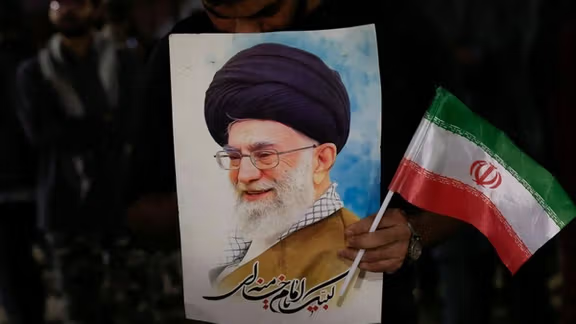
A member of Iran parliament’s national security and foreign policy committee said on Tuesday that Tehran would take revenge against the US over “assassination of our highest political and religious leader.”
“We will not forget this loss and we will take revenge,” Abbas Golrou said, referring to the death of Iran's Supreme Leader Ali Khamenei in US-Israeli strikes in February.
He described the United States as a “rogue state” that killed Iran’s senior military and political officials.


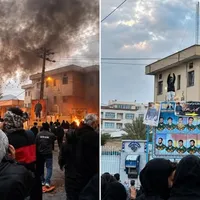
Five people were injured and three buildings were damaged in an explosion in Iran’s western city of Borujerd on Tuesday, said the city’s fire department chief.
Nader Mousavand said the blast took place in a building in the city and caused damage to nearby structures.
He said an initial assessment indicated the explosion was caused by accumulated municipal gas.
Qatar plans to rapidly increase liquefied natural gas production once the Strait of Hormuz reopens, aiming to restore most of its export capacity within two months, Bloomberg reported on Tuesday, citing people familiar with the matter.
QatarEnergy has told buyers it expects to raise output to about 50% of capacity one month after safe passage through the strait is restored and to roughly 80% within two months, the report said.
The remaining capacity, equal to two production trains, will take years to fully restore after damage from Iranian missile strikes in March, according to the report.
A new round of talks between Iran and the United States will begin on Friday in Switzerland, Iranian Foreign Minister Abbas Araghchi said on Tuesday.
Araghchi said Iran considered an end to the war in Lebanon an inseparable part of ending the wider war, adding that any Israeli attack on Lebanon or continued occupation of Lebanese territory would be viewed by Tehran as a violation of the MOU.
“The important point I want to stress here is that, in our view, the two sides of this memorandum of understanding are, on one side, the United States and Israel, and on the other, Iran and Hezbollah,” he said.
The Iranian foreign minister added that, “Ending the war in Lebanon is an inseparable part of ending the war as a whole, and ending the war also includes ending the occupation. Without the withdrawal of Israeli forces from the land they occupied in this war, the war has not fully ended.”
Araghchi said talks with the US would follow a first-stage memorandum of understanding focused on ending the war, the Strait of Hormuz, the maritime blockade and reconstruction issues.
He said the next phase of negotiations would last 60 days and focus on Iran’s nuclear program and sanctions relief.
Israel’s air force was preparing to strike hundreds of targets in Iran during the recent fighting but the operation was halted an hour before launch, the Times of Israel reported on Tuesday, citing a message by Air Force Chief Major General Omer Tischler to soldiers.
Tischler said Israeli aircraft had already struck dozens of targets in Iran in response to Iranian missile fire, causing significant damage to its air defense system and hitting other government-linked components.
“In parallel with the defensive battle, the Air Force launched an offensive 1,500 kilometers [932 miles] from home. Within a few hours, dozens of targets in Iran were struck, significantly damaging the Iranian air defense system and hitting additional regime components,” he wrote, according to the report.
He said that by the afternoon of June 8, the entire air force was ready for a broad strike sortie targeting hundreds of sites in the heart of Iran, but the mission was stopped during squadron briefings.
The strikes were reportedly canceled by Prime Minister Benjamin Netanyahu after US President Donald Trump told him not to escalate the conflict with Iran.
Iran will soon begin connecting its electricity grid with Qatar, Energy Minister Abbas Aliabadi said on Tuesday.
Aliabadi said studies for the project were in their final stage and that Iran was at the start of the implementation phase.
He said Iran was also studying electricity grid connections with other Persian Gulf states.