The public anger from some regime supporters has exposed real divisions within Iran’s political and media establishment. But those divisions appear to be less about whether to preserve the Islamic Republic than about how best to preserve it.
That is the assessment of several Iran experts who spoke to Iran International following the announcement of the US-Iran Memorandum of Understanding.
Hardliners protest the deal
Much of the dissent appears to be coming from the hardline Paydari Front, which sees itself as a guardian of the values of the 1979 revolution that established the Islamic Republic. The faction has long opposed engagement with the West and advocates a more ideological vision of the state rooted in Shia Islamist principles.
Ahead of the signing of the MoU, prominent hardline lawmaker Mahmoud Nabavian warned that accepting the agreement would effectively turn Iran into “a colony of the United States.” He also criticized provisions related to the Strait of Hormuz, arguing they would amount to surrendering one of Iran’s most important strategic levers.
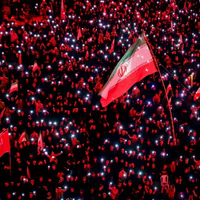
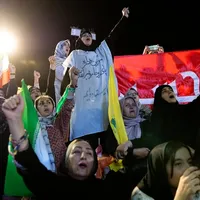
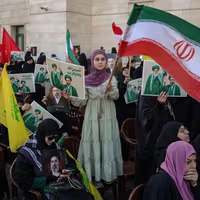
The rhetoric spilled into the streets. At rallies in Tehran over the weekend, protesters called for the resignations of Foreign Minister Abbas Araghchi and Parliamentary Speaker Mohammad Bagher Ghalibaf. Some invoked the memory of the late Supreme Leader, chanting: “Ghalibaf, Araghchi — what about my Leader’s blood?”
Some went even further, calling for their death and execution.
Opponents of the deal have also launched a “we will not accept” campaign.
The question now is whether these internal fractures could eventually weaken a system that, while more resilient than many anticipated, remains under significant strain. For now, experts say the divisions do not appear sufficient to break the system from within.
“The hardliners are loud, but they have a weak case to make,” said Alex Vatanka, a senior fellow at the Middle East Institute.
“This regime has now proven beyond doubt that they’re much more entrenched and resilient than people thought they were. That doesn’t make them nice, just makes them harder adversaries.”
Survival over ideology
Arash Azizi, an Iran analyst and author of What Iranians Want: Women, Life, Freedom, argues that the Islamic Republic is shifting from ideological hardliners toward a more pragmatic — though still authoritarian — collective leadership focused on regime survival.
“They are authoritarian and they’re thugs, to be clear. But they care about keeping their own economic interests, which means social peace as much as they can, and which means deals with the US,” Azizi told Iran International.
In other words, the Islamic Republic is not moderating. It is acting pragmatically — and, as Azizi argues, cynically — to survive.
According to Azizi, the hardliners around Saeed Jalili are important precisely because they have revealed their weakness. They loudly opposed the deal but appear unable to stop it.
Real power, he argues, lies with a collective leadership centered around Ghalibaf, the IRGC leadership and the Supreme National Security Council. That leadership appears to view a deal with Washington as necessary to protect the system.
The deal’s progress, despite Mojtaba Khamenei’s continued absence from public view, has fueled speculation that a new power structure may be consolidating inside the Islamic Republic.
Jason Brodsky, policy director at United Against Nuclear Iran, notes that such divisions are not new.
Similar opposition emerged during the 2013–2015 negotiations that led to the JCPOA, when hardliners attacked then-President Hassan Rouhani and Foreign Minister Mohammad Javad Zarif.
“The Supreme Leader made a decision, and that’s going to carry the day,” Brodsky said.
But Brodsky argues the real struggle may begin if sanctions relief materializes.
“There will be those who want to use resources toward economic rebuilding, but there will be a very hardened IRGC contingent ... who are going to want to rebuild their military, rebuild the nuclear program, and rebuild the terror apparatus.”
Media split reflects political divide
Iran’s media landscape reflects the same tensions.
Hardline newspaper Kayhan has denounced the MoU as surrender to the United States. Khorasan has framed it as a temporary pause rather than peace. Hamshahri has argued that diplomacy was made possible by Iran’s military deterrence.
Meanwhile, reformist and moderate outlets such as Shargh, Etemad and Khabar Online have presented the agreement as a state-backed effort to end the war, ease economic pressure and stabilize the country.
Some supporters of the deal have gone further, arguing that the agreement is superior to the 2015 nuclear accord because Iran has retained strategic leverage, including influence over the Strait of Hormuz.
Government supporters have also pushed back against the Paydari Front, arguing it does not represent ordinary Iranians, many of whom have grown weary of war and economic hardship.
Taken together, the reactions suggest that few inside Iran view the MoU as a peace agreement.
Instead, supporters and critics alike largely see it as a mechanism for preserving the Islamic Republic, though they disagree sharply on what kind of compromise would best serve that goal.
For hardliners, the agreement risks being remembered as a retreat from revolutionary principles. For pragmatists inside the establishment, it is a necessary concession aimed at keeping the system intact.
The domestic battle over the MoU may ultimately prove just as consequential as the negotiations themselves.