Iran's Revolutionary Guards said they struck four key targets at the US Al-Azraq Air Base in Jordan, including what they described as F-35 fighter shelters and a command-and-control center.
In a statement carried by Fars News, the IRGC said the attack was part of a continuing retaliatory operation following earlier strikes by its naval forces on US facilities in the region and the reported downing of a US MQ-9 drone over Bushehr Province.
The Guards said their aerospace force used long-range solid-fuel missiles to target and destroy four sites at the base.
The IRGC warned that Iranian forces remain prepared to deliver a "decisive and crushing response" to any further attacks and said responsibility for the consequences of future military action would rest with the United States.

Iran's Revolutionary Guards said their air defenses shot down a US MQ-9 drone during ongoing aerial confrontations around the Strait of Hormuz.
According to the IRGC, the drone was approaching the battle area from northern Gulf airspace when it was targeted and destroyed over Jam County in Bushehr Province.
The statement said the MQ-9 had intended to "approach and intervene in the battlefield" before it was brought down by what it described as the Guards' modern air-defense forces.
US Central Command said its forces have completed self-defense strikes against Iran ordered by President Donald Trump in response to the downing of a US Army Apache helicopter.
According to CENTCOM, US Air Force and Navy fighter jets struck Iranian air-defense systems, ground-control stations and surveillance radar sites near the Strait of Hormuz using precision-guided munitions.
The military described the operation as a "proportional response" to recent attacks on US forces and international commercial shipping in regional waters.
"CENTCOM forces struck Iranian air defense, ground control stations, and surveillance radar sites near the Strait of Hormuz," the command said in a statement.
Iran's Revolutionary Guards said they carried out a drone attack on the US Navy's Fifth Fleet headquarters in Bahrain in response to what they described as recent hostile actions by the United States.
In a statement carried by Tasnim News Agency, the IRGC said its naval force targeted the Fifth Fleet at 2:30 a.m. local time.
"In response to the enemy's malicious action, fighters of the IRGC Navy attacked the Fifth Fleet in Bahrain with drones at 2:30 a.m.," the statement said.
"The fighting continues and the brave defenders of the Iranian nation are responding to the enemy's aggression," the IRGC warned. "If these hostile actions continue, even heavier responses are on the way."
There was no immediate confirmation from US or Bahraini authorities.
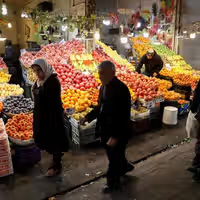
File photo of shoppers browse grocery shelves at a supermarket in Iran as households face rising living costs and inflation. The photo quality was enhanced using AI.
Citizens across Iran say soaring food prices have reduced household diets to the bare minimum needed to stave off hunger, with nutrition and variety increasingly out of reach.
Messages sent to Iran International from cities across the country paint a picture of households slipping steadily down the hierarchy of human needs.
Many say their tables have been reduced to the level of survival, where staying full matters more than quality, variety or nutritional value.
If many families had already removed red meat, fish and even chicken from their diets in recent years, messages received by Iran International suggest that fruit, eggs and dairy products have now also become luxuries for a large share of households.
Instead, they say they rely on filling foods such as pasta, potatoes, onions, bread and plain rice.
One citizen summed up the sense of despair bluntly: "If the Islamic Republic remains, we will be buried in the graveyard of our dreams."
Another said that most days their family eats little beyond potatoes, onions and lentil soup.
The accounts reflect a shift toward the most basic physiological needs required for survival, with little room for long-term health, development or security.
One citizen said that after months of buying food from weekly street vendors because shops had become too expensive, even those purchases are now out of reach.
"I only buy the absolute necessities now, things like potatoes, tomatoes and onions, and even then I buy the lowest-quality produce available," the person said.
File photo of a a woman shopping at a bakery in Tehran, Iran, amid rising food prices and persistent inflation.
A resident of Isfahan said the family's meals now consist largely of potatoes, pasta, or bread and cheese.
Official figures show some food categories rising well into triple digits over the past year while wages have failed to keep pace.
According to Central Bank data for the past month, year-on-year inflation reached 161 percent for milk, cheese and eggs, 267 percent for oils and fats, and 176 percent for meat products.
Citizens reported that lamb currently sells for around 22 million rials ($12.5) per kilogram, while beef costs roughly 15 million rials ($8.5) per kilogram.
Masoud Rasouli, secretary of the Meat Packaging and Protein Industry Association, said in early June that demand for red meat had fallen by about 50 percent compared with the previous year.
Many families told Iran International they had eliminated animal protein entirely from their diets despite warnings from health experts that prolonged protein deficiencies can lead to widespread malnutrition, particularly among children and adolescents.
Doctors have warned that shrinking household food baskets and a shift toward cheaper, lower-quality products could contribute to rising rates of anemia, weakened immune systems and other long-term health problems.
Several citizens said an ordinary package of breakfast cheese now costs around 2 million rials ($1.1).
"Many days our lunch and dinner consist only of bread and cheese," one person said. "But even if you live only on bread and cheese, you would still need about 150 million rials ($85) a month."
Iran's minimum monthly wage currently stands at around 160 million rials ($90).
Citizens reported prices of around 250,000 rials ($0.14) for a single egg, more than 10 million rials ($5.6) for a liter of cooking oil, and about 5 million rials ($2.8) for a 2.5-kilogram container of yogurt.
Many said that salaries which barely reach 200 million rials ($113) a month have left them struggling to secure even protein-free meals.
The messages also point to a more troubling development: the gradual replacement of food with whatever can fill an empty stomach.
A resident of Tabriz said they now buy meat stock instead of meat simply to create the flavor of meat in stews.
A mother from Dehloran in Ilam Province said her children have not eaten meat for months and that even chicken has become unaffordable.
Others described selling household belongings to cover food expenses.
"We have cut costs everywhere possible and there is almost nothing left on our table," one citizen said. "I have not eaten a proper meal in a week. We are reaching a point where we cannot afford three meals a day."
For a growing number of Iranians, the question is no longer how to maintain a standard of living, but how to secure enough food to get through another day.
File photo of a billboard featuring Iran's 10,000-rial banknote is seen behind red traffic lights in Tehran, Iran.