IRGC Navy threatens to hit hostile warships entering Hormuz
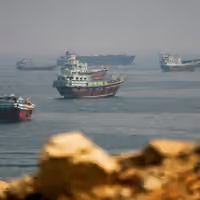
The IRGC Navy said on Monday that any warship from "hostile countries" entering the Strait of Hormuz would be targeted immediately.






Iranian security forces dismantled four operational cells belonging to what authorities described as militant groups in the southeastern province of Sistan and Baluchestan, the semi-official Fars news agency reported on Monday.
Five militants were killed and 19 others arrested before they could carry out attacks, Fars reported, citing Iran's Intelligence Ministry. Authorities said weapons and military equipment were also seized during the operation.
Sistan and Baluchestan, which borders Pakistan and Afghanistan, has long been the scene of clashes between Iranian security forces and militant groups.
A strike on the Karoon Petrochemical complex in southwestern Iran on Monday put the spotlight on a key industrial facility with roles in both civilian production and sectors tied by Israel and Western governments to Iran's military capabilities.
Officials in Khuzestan province said the facility was hit during Israeli attacks, with reports indicating damage to chlorine-related units and storage facilities. Any prolonged disruption could affect both domestic supply chains and exports from one of Iran's most important petrochemical hubs.
Karoon is located in Mahshahr, home to a concentration of petrochemical facilities that form a major pillar of Iran's non-oil economy.
Links to the IRGC
Karoon is owned by Persian Gulf Petrochemical Industries Company (PGPIC), Iran's largest petrochemical holding group.
The United States sanctioned PGPIC and dozens of affiliated companies in 2019, saying the group generated billions of dollars that helped finance the Islamic Revolutionary Guards Corps and its construction arm, Khatam al-Anbiya.
According to the US Treasury, PGPIC subsidiaries worked with Khatam al-Anbiya through engineering, construction and financing contracts worth hundreds of millions of dollars. Washington said revenue from the petrochemical sector provided an important source of funding for the IRGC's military activities.
The Guards have long maintained a significant presence in Iran's energy and industrial sectors through a network of companies, contractors and affiliated organizations that oversee major infrastructure projects and benefit from export revenues.
Role in missile-related industries
Petrochemical facilities are primarily civilian enterprises, but some of their products can have military applications.
Chemical compounds produced in Mahshahr and other petrochemical centers such as Assaluyeh can be used as precursor materials in the production of propellants and other components associated with missile programs.
During previous operations targeting industrial facilities in the Mahshahr area, Israel said sites in the region were involved in producing materials used by Iran's missile program.
Israeli military officials said on Monday that one of their objectives was to destroy infrastructure used to manufacture raw materials essential for ballistic missile production.
The dual-use nature of petrochemical production means facilities can simultaneously support civilian industries while supplying materials that may have military applications.
Critical supplier for domestic industry
Despite scrutiny over military links, Karoon remains one of the most important suppliers to Iran's civilian manufacturing sector.
The company is the region's only producer of isocyanates, advanced chemical compounds used in the production of polyurethane materials.
These products serve as the foundation for a wide range of industrial and consumer goods, including insulation, adhesives, coatings, automotive components, footwear, furniture and household appliances.
Karoon receives feedstock such as benzene and toluene from neighboring petrochemical plants and combines them with chlorine, carbon monoxide and hydrogen to produce isocyanates and related products.
The facility's strategic importance increased after the implementation of the HYCO (Hydrogen and Carbon Monoxide) project, which enabled domestic production of carbon monoxide and hydrogen and reduced dependence on imported supplies.
Impact on supply chains and exports
Industry experts say damage to chlorine production units could have consequences beyond the immediate facility.
Chlorine is essential for the production of phosgene, a key intermediate chemical used in manufacturing isocyanates. Any interruption to chlorine supplies can halt downstream production, affecting multiple industries dependent on polyurethane products.
The effects could extend throughout the Mahshahr industrial zone, disrupting manufacturers that rely on Karoon's output.
Karoon also serves export markets. The company ships products including aniline to India and sells other chemical products to customers in Turkey, Russia and neighboring countries.
Those exports have helped Iran maintain a regional presence in specialty chemical markets while generating valuable foreign currency earnings.
A strategic target
The strike illustrates how Iran's petrochemical sector occupies a position at the intersection of economic and security concerns.
For Tehran, facilities such as Karoon support industrial self-sufficiency, exports and employment. For Israel and Western governments, parts of the sector are viewed as supporting broader military and missile-related capabilities through financial links to the IRGC and the production of dual-use materials.
As a result, major petrochemical complexes have become increasingly significant targets in a confrontation that extends well beyond the battlefield and into the infrastructure underpinning Iran's economy and defense industries.
The latest Houthi threat against maritime operations in the Red Sea is not expected to have a major impact on traffic because most shipping lines were already avoiding the area, shipping executives said, according to the Financial Times.
Yemen’s Iran-backed Houthis on Monday repeated an earlier threat to target all Israeli shipping in the area.
“It doesn’t appear that this escalates the risk for container shipping,” Lars Jensen, chief executive of Vespucci Maritime, said.
Passage through the Bab-al-Mandab Strait was at least 50 per cent below what it was before 2023, according to the report.
The Israeli military said its strike on a petrochemical complex in southwest Iran on Monday targeted infrastructure used to produce raw materials for missile manufacturing.
“The targeted infrastructure produced unique materials that serve as critical components for the development of ballistic missiles, which pose a threat to the State of Israel and its citizens,” the military said.
“These are critical components of the production infrastructure supporting the Iranian terror regime’s missile program,” the IDF added.
Iran is prepared for a prolonged conflict with Israel and for strikes against US interests, with all necessary preparations already in place, Guards-affiliated Tasnim news agency reported on Monday, citing an unnamed military source.
The source said any belief by Israel or the United States that Iran’s response could be contained through a strategy of “controlled escalation” was a miscalculation, adding that Tehran would raise the level of confrontation and punishment until Israel “regrets continuing its crimes.”
The source also said Washington could not distance itself from Israel’s actions and would bear costs for its support, dismissing any portrayal of separate US and Israeli fronts as “propaganda and deception.”