Iran’s nuclear technology and uranium enrichment are part of the country’s national identity and cannot be negotiated away, Mohammad-Mehdi Hosseini Hamedani, the Friday prayer leader of Karaj said.
“Nuclear technology and enrichment are part of our national identity, just like our territorial integrity, and are not subject to negotiation,” Hosseini Hamedani said on Friday. He also added that any Israeli action would carry consequences for the United States.
"Arab countries should know that if they make a mistake or show negligence, Iran will have no friendships or considerations when it comes to protecting its national interests and its people," he said.
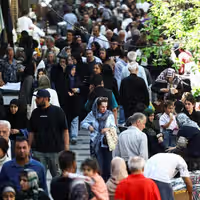
Daily power outages have resumed across parts of Iran, with neighborhoods losing electricity for around two hours a day, citizens told Iran International, adding that blackouts are often imposed between 6 p.m. and 8 p.m., when markets are at their busiest.
“The power cuts have started again. Our neighborhood loses electricity for two hours a day, and they often shut it off between 6 p.m. and 8 p.m., right when shops are busiest,” one resident told Iran International.
“Business is already suffering from inflation and weak purchasing power. Now the outages are driving customers away and making the situation even worse,” the citizen added.
Oman’s state news agency cited Petroleum Development Oman as saying operations at Mina al Fahal, the country’s main crude oil export terminal, are continuing normally.
The statement came after earlier reports of an explosion near the terminal’s offshore mooring area.
Bloomberg reported Friday morning that operations at Mina al Fahal had resumed after oil loading was temporarily halted.
Reuters earlier reported, citing people familiar with the matter, that the explosion occurred near the terminal’s single-buoy mooring berths and was believed to have been caused by a drone attack.
Omani authorities have not provided further details on the incident, its cause or any impact on crude exports.
Hamidreza Haji-Babaei, deputy speaker of Iran’s parliament, said lawmakers have reviewed a plan to regulate ship traffic through the Strait of Hormuz and that a “powerful resolution” would be approved on the issue.
Haji-Babaei said the plan has “various dimensions,” without giving details of its provisions.
He also said Tehran had warned the United States and Israel that if their attacks on Lebanon did not end, Iran would respond and close the Bab el-Mandeb Strait.
More than 50 days into the US blockade of Iran’s southern ports, Iraq’s Umm Qasr has emerged as a new hub for Iran-bound cargo, trade sources say, as Tehran’s first major workaround through Oman’s Khasab grows slower, busier and more expensive.
The Iraqi port is now being used to move some Iran-bound cargo, including cars, after shipments are first transferred from ports in the United Arab Emirates on vessels flying non-Iranian flags, sources with knowledge of the matter Iran International.
The shift adds a new layer to Iran’s effort to keep trade moving through indirect routes after the US blockade, which began on April 13, closed the main passages in the Strait of Hormuz to Iranian ships and vessels linked to the Islamic Republic.
Iran International previously reported that the small Omani port of Khasab, on the Musandam Peninsula near the mouth of the Strait of Hormuz, had become one of the main alternatives for moving goods into Iran.
Cargoes that once moved through standard UAE-Iran channels have been transferred from Emirati ports to Khasab, then loaded onto Iranian vessels bound for ports on Iran’s southern coast.
But trade sources said the route has become slower in recent weeks as demand has risen.
The number of vessels gathering in Khasab has increased, while the port’s limited capacity has made loading and transfers more time-consuming and more expensive than in the first days after the ceasefire, the sources said.
Oman, which had previously imposed limited restrictions or charges on some cargoes, has also introduced new costs for certain goods in recent weeks.
One trade source said some shipments, including cars, are now subject to charges based on the value of the goods.
Against that backdrop, Umm Qasr, Iraq’s main Persian Gulf port, has become a complementary route.
A view of Umm Qasr Port is seen after protesters blocked its entrance, south of Basra, Iraq October 30, 2019.
More than 50 days into the US blockade of Iran’s southern ports, Iraq’s Umm Qasr has emerged as a new hub for Iran-bound cargo, trade sources say, as Tehran’s first major workaround through Oman’s Khasab grows slower, busier and more expensive.
The Iraqi port is now being used to move some Iran-bound cargo, including cars, after shipments are first transferred from ports in the United Arab Emirates on vessels flying non-Iranian flags, sources with knowledge of the matter Iran International.
The shift adds a new layer to Iran’s effort to keep trade moving through indirect routes after the US blockade, which began on April 13, closed the main passages in the Strait of Hormuz to Iranian ships and vessels linked to the Islamic Republic.
Iran International previously reported that the small Omani port of Khasab, on the Musandam Peninsula near the mouth of the Strait of Hormuz, had become one of the main alternatives for moving goods into Iran.
Cargoes that once moved through standard UAE-Iran channels have been transferred from Emirati ports to Khasab, then loaded onto Iranian vessels bound for ports on Iran’s southern coast.
But trade sources said the route has become slower in recent weeks as demand has risen.
The number of vessels gathering in Khasab has increased, while the port’s limited capacity has made loading and transfers more time-consuming and more expensive than in the first days after the ceasefire, the sources said.
Oman, which had previously imposed limited restrictions or charges on some cargoes, has also introduced new costs for certain goods in recent weeks.
One trade source said some shipments, including cars, are now subject to charges based on the value of the goods.
Against that backdrop, Umm Qasr, Iraq’s main Persian Gulf port, has become a complementary route.
How the new route works
Sources told Iran International that cars have been among the cargoes moved from Umm Qasr toward Iran. There is no confirmed information on whether other categories of goods are being transferred through the same route.
In this method, cars or other Iran-bound cargo are first shipped from docks in the UAE, including Dubai, to Umm Qasr under flags other than Iran’s.
From there, the cargo can move into Iran by land or by water.
On the land route, shipments travel from Umm Qasr to Basra, then to Iran's Shalamcheh border crossing, before reaching Khorramshahr and other destinations in Iran.
On the water route, vessels heading for Khorramshahr must enter the Shatt al-Arab, known in Iran as the Arvand River, and continue from there to Iranian piers.
Some cargoes can also move from Umm Qasr through Khor Abdullah toward southern Iranian ports, including Bandar Lengeh, according to the information obtained by Iran International.
Khasab, however, remains attractive to many traders despite congestion and higher costs.
One reason is that goods can reach Oman by both land and sea.
Some shipments can be moved from the UAE into Oman overland, and trade sources say monitoring of certain cargoes traveling by land to Oman is less strict than on fully maritime routes.
The Umm Qasr route is different.
Cargoes moving from the UAE to the Iraqi port generally have to be loaded at official docks in Dubai or other Emirati ports, where trailers and containers pass through scanning systems and face more stringent controls.
Umm Qasr’s location still makes it useful for Iran’s trade network.
The port lies about 60 kilometers south of Basra and is one of Iraq’s most important Gulf terminals. A significant share of Iraq’s imports of basic goods, including grain and sugar, moves through the port, which connects Iraq to Gulf trade routes.
Its proximity to Basra, the Shalamcheh crossing and Iran’s Khuzestan province has made it a practical option for shipments headed toward southwestern Iran.
Iranian local officials had previously referred to the use of this route.
Javad Kazem-Nasab Al-Baji, deputy governor of Khuzestan for economic affairs, said in May during a meeting with the head of Iran’s customs administration that agreements had been reached for the entry of basic goods and relief items through Iraq’s Umm Qasr port.
But the route also carries risks. The IRGC Navy recently targeted a commercial vessel at Umm Qasr, calling it “American-Israeli.” The IRGC said the attack was carried out in retaliation for a US strike on the Iranian vessel Lian Star.
The incident showed that even alternative routes through Iraq are not insulated from the military and security tensions surrounding the blockade.
For traders and transport intermediaries, however, pressure on Iran’s traditional maritime routes has made even more complicated and risky options part of the calculation.