• العربية
  • فارسی
Brand
  • Iran Insight
  • Politics
  • Economy
  • Analysis
  • Special Report
  • Opinion
  • Podcast
  • Iran Insight
  • Politics
  • Economy
  • Analysis
  • Special Report
  • Opinion
  • Podcast
  • Theme
  • Language
    • العربية
    • فارسی
  • Iran Insight
  • Politics
  • Economy
  • Analysis
  • Special Report
  • Opinion
  • Podcast
All rights reserved for Volant Media UK Limited
volant media logo
VOICES FROM IRAN

Citizens report growing use of children in Iran security activities

Jun 4, 2026, 11:45 GMT+1

Iranian authorities are continuing to use children in security-related activities, including checkpoints and participating in military-themed programs, according to messages sent by citizens to Iran International.

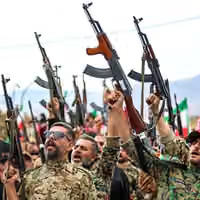
Accounts from several provinces described children and teenagers taking part in checkpoint operations and handling weapons at state-sponsored gatherings, despite international conventions that call on governments to keep minors away from military and security activities.

“Recession, inflation, poverty and hardship are rampant, and this is a sign of economic collapse,” a resident of Fereydunkenar, north of Iran, said. “They have set up checkpoints with children aged 10 to 12 and gather people around city squares with food and payments to show strength.”

Continue reading

Most Viewed

Will Israel's new Mossad chief carry on the push for regime change in Iran?
1
INSIGHT

Will Israel's new Mossad chief carry on the push for regime change in Iran?

2

Mexico visas issued for Iran’s football team, US visas pending - report

3

Alleged mastermind of London attacks met Khamenei before war, indictment says

4
INSIGHT

Calls for diplomacy grow in Tehran amid fresh escalation

5
INSIGHT

Lebanon emerges as new obstacle to Iran-US talks

Banner
Banner

Spotlight

  • Citizens report growing use of children in Iran security activities
    VOICES FROM IRAN

    Citizens report growing use of children in Iran security activities

  • Lebanon emerges as new obstacle to Iran-US talks
    INSIGHT

    Lebanon emerges as new obstacle to Iran-US talks

  • Calls for diplomacy grow in Tehran amid fresh escalation
    INSIGHT

    Calls for diplomacy grow in Tehran amid fresh escalation

  • Will Israel's new Mossad chief carry on the push for regime change in Iran?
    INSIGHT

    Will Israel's new Mossad chief carry on the push for regime change in Iran?

  • Leaked documents link Chinese firms to IRGC missile fuel network
    EXCLUSIVE

    Leaked documents link Chinese firms to IRGC missile fuel network

•
•
•

More Stories

Citizens report growing use of children in Iran security activities

Jun 4, 2026, 09:58 GMT+1
•
Mohsen Moheimany
Citizens report growing use of children in Iran security activities
100%
Children in military-style uniforms and riot gear stand at a checkpoint in Iran. Image quality has been enhanced using AI.

Iranian authorities are continuing to use children in security-related activities, including checkpoints and participating in military-themed programs, according to messages sent by citizens to Iran International.

Accounts from several provinces described children and teenagers taking part in checkpoint operations and handling weapons at state-sponsored gatherings, despite international conventions that call on governments to keep minors away from military and security activities.

“Recession, inflation, poverty and hardship are rampant, and this is a sign of economic collapse,” a resident of Fereydunkenar, north of Iran, said. “They have set up checkpoints with children aged 10 to 12 and gather people around city squares with food and payments to show strength.”

A resident of Tehran province described what he said was the growing presence of minors at checkpoints in Shahriar, near Tehran.

A child dressed in a military-style uniform attends a public gathering in Iran.
100%
A child dressed in a military-style uniform attends a public gathering in Iran.

“Almost all the checkpoints in Shahriar are run by children under 16 holding flashlights. It is truly absurd,” the resident wrote.

Military training at public gatherings

Citizens also described state-organized events where children were given access to firearms and military training activities.

A resident of Tehran said children had been deployed at checkpoints during public events and that authorities had also set up stations distributing tea and refreshments.

Similar accounts emerged from other parts of the country.

“At the entrance to Bastak in Hormozgan province, they hand rifles to children every night,” one resident said.

  • Children as young as 12 can join war support, IRGC says

    Children as young as 12 can join war support, IRGC says

Another citizen from Kelardasht in Mazandaran province reported seeing children being taught how to handle weapons.

Long history of youth mobilization

The use of minors in military and security-related activities has a long history in the Islamic Republic.

During the Iran-Iraq War, thousands of teenagers were sent to the front lines, and many were killed in military operations. In the decades that followed, military-oriented instruction continued through school programs such as “Defensive Readiness” classes and student Basij activities.

File photo showing a child at the front line during the Iran-Iraq War.
100%
File photo showing a child at the front line during the Iran-Iraq War.

Student Basij organizations and university Basij branches have for years operated within educational institutions, recruiting young people into structures linked to the security establishment.

Human rights advocates argue that linking formal education with military and paramilitary activities risks normalizing violence and militarization among children and adolescents.

Iran is a party to the United Nations Convention on the Rights of the Child, which requires states to protect children from involvement in military activities and provide a safe environment for their development and education.

Expansion of military imagery

The reports coincide with a broader increase in the public display of military equipment across Iran.

In recent months, images have circulated showing missiles, military hardware, Revolutionary Guards speedboats and light and heavy weapons displayed in public spaces, schools, state-organized gatherings and media programs.

Child rights advocates view such measures as part of a wider effort to normalize the presence of weapons in children's daily lives and to militarize public space.

  • Child recruit’s death shows Iran prioritizing regime survival over civilians

    Child recruit’s death shows Iran prioritizing regime survival over civilians

The growing involvement of children and teenagers in government-organized activities, checkpoints and military programs may also reflect efforts to cultivate future generations of ideologically aligned supporters and security personnel, according to critics of the policy.

Iranians say wages vanish under rent, food and medical costs

Jun 3, 2026, 10:54 GMT+1
Iranians say wages vanish under rent, food and medical costs
100%
People cross a street in Tehran, with the Alborz mountains visible in the background.

Iranians in several cities described wages being consumed by rent, food and healthcare costs, according to messages received by Iran International on Wednesday.

A government employee in Dorud, in western Lorestan province, said a monthly salary of 20 million tomans, about $115 at the current rate, no longer covered basic needs.

“Half of this wage goes to rent, and the other half goes to medicine and doctors,” the message said. “Nothing is left for food and clothing.”

Another message said a salary below 50 million tomans, about $287, could no longer support a family of four, while one person said only three million tomans, about $17, remained from their monthly pay by the end of the month.

“With this situation, we have to fill ourselves with bread and water,” the message said.

  • Millions face poverty as Iran’s economy reels from war and sanctions

    Millions face poverty as Iran’s economy reels from war and sanctions

Healthcare costs were also cited as a growing burden. A 51-year-old resident of Isfahan said an orthopedic visit cost one million tomans, about $6, and two prescribed scans would have cost four million tomans, about $23, each.

“I did not have the money, so I gave up,” the resident said.

Another message said medicine had become scarce and sharply more expensive, while insurance covered almost none of the costs of visits, treatment or tests. A monthly prescription that previously cost 200,000 tomans, about $1, had risen to 1.35 million tomans, about $8, the message said.

A separate message from Isfahan said most autism centers in the city had raised fees by 80%, leaving them far less crowded.

Others pointed to daily goods becoming unaffordable, citing a simple ice cream at 80,000 tomans, about 46 cents, and a 1.5-liter bottle of water at 35,000 tomans, about 20 cents.

“This is no longer inflation,” one message from Shahreza said. “It is swelling and bruising.”

  • Can Iran’s economy survive a twin squeeze from blockade and blackout?

    Can Iran’s economy survive a twin squeeze from blockade and blackout?

Messages from Iran point to renewed hijab patrols after ceasefire

May 29, 2026, 11:35 GMT+1
Messages from Iran point to renewed hijab patrols after ceasefire
100%

Messages sent to Iran International point to a renewed wave of security and social pressure in several Iranian cities, as prospects for a possible agreement and the continuation of the ceasefire between the Islamic Republic, Israel and the United States have become more serious.

According to the messages, morality patrol activity has resumed in cities including Isfahan, Rasht and Anzali, with officers targeting not only women over mandatory hijab but also men whose clothing is deemed outside official norms, including those wearing shorts.

Several messages said people had been detained and taken to police vans over clothing-related cases. Citizens also reported that officers were photographing people in public spaces.

One person said plainclothes agents in Isfahan had been warning women and girls in the streets over their clothing and putting them under pressure.

In Rafsanjan, one citizen said that after women supporting the government confronted her over hijab, armed officers later went to nearby locations looking for her.

Messages from other areas also pointed to wider controls, including checks of citizens’ mobile phones.

The accounts come alongside reports of shop closures in Rasht over hijab-related cases.

In Arak, a women’s sports club was reportedly sealed after security forces entered the premises and arrested several coaches.

Prisoners wearing ankle tags attended government rallies, messages say

May 29, 2026, 09:47 GMT+1
Prisoners wearing ankle tags attended government rallies, messages say
100%

Iranian authorities have sent some prisoners wearing electronic ankle tags to nightly government rallies, according to messages sent to Iran International.

One person wrote that young and teenage prisoners had been temporarily released with electronic tags to take part in government-organized rallies.

The messages add to earlier accounts from citizens saying people had been paid to attend such gatherings or offered incentives including food items such as cooking oil and rice.

Iran International has received multiple accounts in recent days describing efforts by authorities to increase attendance at nightly pro-government events.

Iranians report deepening hardship as medicine shortages hit patients

May 29, 2026, 07:58 GMT+1

Iranians have sent messages to Iran International describing worsening economic hardship, job losses, stalled trade and shortages of some essential medicines.

One message from Tehran said Jadenu tablets and Novartis-made Desferal injections, key medicines for thalassemia patients, had become unavailable.

The sender said domestic alternatives were low-quality, ineffective and carried serious side effects, warning that without proper medicine, 23,000 thalassemia patients could face heart and liver failure and painful death.

Another person, who said they work in Eshtehard Industrial Town, Alborz province, said many companies had laid off workers, while some had cut wages by half and removed lunch and transport services.

A message from the southern port city of Genaveh said the local market had stalled because traders could no longer bring goods from the UAE.

The sender said stocks of mobile phone accessories, clothes, shoes and other goods usually imported from the UAE were running out.