• العربية
  • فارسی
Brand
  • Iran Insight
  • Politics
  • Economy
  • Analysis
  • Special Report
  • Opinion
  • Podcast
  • Iran Insight
  • Politics
  • Economy
  • Analysis
  • Special Report
  • Opinion
  • Podcast
  • Theme
  • Language
    • العربية
    • فارسی
  • Iran Insight
  • Politics
  • Economy
  • Analysis
  • Special Report
  • Opinion
  • Podcast
All rights reserved for Volant Media UK Limited
volant media logo
VOICES FROM IRAN

Prisoners wearing ankle tags attended government rallies, messages say

May 29, 2026, 09:47 GMT+1

Iranian authorities have sent some prisoners wearing electronic ankle tags to nightly government rallies, according to messages sent to Iran International.

One person wrote that young and teenage prisoners had been temporarily released with electronic tags to take part in government-organized rallies.

The messages add to earlier accounts from citizens saying people had been paid to attend such gatherings or offered incentives including food items such as cooking oil and rice.

Iran International has received multiple accounts in recent days describing efforts by authorities to increase attendance at nightly pro-government events.
Most Viewed

Iran’s partial internet return exposes rift inside ruling system
1

Iran’s partial internet return exposes rift inside ruling system

2

Iran’s lion-and-sun flag at center of FIFA row before 2026 World Cup

3

Iranian students in Canada caught between blackout, debt and fear of return

4
SPECIAL REPORT

Witnesses describe gunfire, blocked exits and deadly market fire in Rasht

5
INSIGHT

How four Khamenei family names map the Islamic Republic’s inner circle

Banner
Banner

Spotlight

  • Iran factions clash over interim US deal as Trump weighs final call
    INSIGHT

    Iran factions clash over interim US deal as Trump weighs final call

  • Names of some Iran protest victims vanish from Tehran cemetery database

    Names of some Iran protest victims vanish from Tehran cemetery database

  • How four Khamenei family names map the Islamic Republic’s inner circle
    INSIGHT

    How four Khamenei family names map the Islamic Republic’s inner circle

  • Witnesses describe gunfire, blocked exits and deadly market fire in Rasht
    SPECIAL REPORT

    Witnesses describe gunfire, blocked exits and deadly market fire in Rasht

  • Iran’s lion-and-sun flag at center of FIFA row before 2026 World Cup

    Iran’s lion-and-sun flag at center of FIFA row before 2026 World Cup

  • Iran’s partial internet return exposes rift inside ruling system

    Iran’s partial internet return exposes rift inside ruling system

•
•
•

More Stories

Iranians report deepening hardship as medicine shortages hit patients

May 29, 2026, 07:58 GMT+1

Iranians have sent messages to Iran International describing worsening economic hardship, job losses, stalled trade and shortages of some essential medicines.

One message from Tehran said Jadenu tablets and Novartis-made Desferal injections, key medicines for thalassemia patients, had become unavailable.

The sender said domestic alternatives were low-quality, ineffective and carried serious side effects, warning that without proper medicine, 23,000 thalassemia patients could face heart and liver failure and painful death.

Another person, who said they work in Eshtehard Industrial Town, Alborz province, said many companies had laid off workers, while some had cut wages by half and removed lunch and transport services.

A message from the southern port city of Genaveh said the local market had stalled because traders could no longer bring goods from the UAE.

The sender said stocks of mobile phone accessories, clothes, shoes and other goods usually imported from the UAE were running out.

Iranians greet internet return with grief, anger and defiance

May 26, 2026, 20:46 GMT+1
Iranians greet internet return with grief, anger and defiance
100%
Schoolgirls attend an online class in Iran / Photo by ISNA

As internet access returned across Iran after nearly three months of disruption, viewers told Iran International the restoration felt less like relief than the overdue return of a basic right after weeks of damage to livelihoods and daily life.

Several viewers said joy was impossible after what the country had endured.

“I am not happy that the internet has been restored, because 40,000 other people will never come online again,” one viewer wrote, referring to the victims of Iran's crackdown on thousands of protesters in January.

Another viewer said the restoration should not erase the memory of those killed.

“We were finally able to connect to the internet after some time, thank God,” the viewer wrote. “In memory of the fallen, whose names live on.”

A third message struck a similar tone: “Now that the internet is back, let’s remember our fallen even more. Hoping for freedom.”

For many, the return of access was framed as a right that should never have been taken away.

“Hello, we're finally connected, but it was not fair to be cut off for 88 days,” one person said.

Another viewer from Mahallat in central Iran wrote: “After 90 days, from Mahallat, we are supposed to get excited about the restoration of something that is every human being’s right.”

A viewer wrote: “Today, after three months, I connected. My dear people, please don’t lose hope. This is not the final battle.”

No favor

Others welcomed the reconnection but rejected any portrayal of it as a government favor.

“People of Iran, the internet is our natural right,” one viewer wrote. “Be happy, but don’t think this is a privilege they have given us. We will not surrender.”

Another message said: “I am pleased that international internet has been restored for the public. This is every citizen’s natural and basic right. Very good and bright things await the Persians and this land. Wait a little. Javid Shah, Payandeh Iran.”

Some viewers said the authorities had failed to use internet access as leverage.

“After several days, they opened the internet again,” one person wrote. “They thought they could fool us with the internet.”

Another message said the connection had returned only partially: “The internet has finally been restored, of course with a thousand hardships and low speed.”

A young viewer described exhaustion with daily life in Iran.

“I was only just able to connect,” the viewer wrote. “I am a girl from the 2010s generation. Even I am tired now. Every day the situation is getting worse and worse. I just hope that in the end all of us will see our Iran free. Long Live the Shah.”

Internet Pro

Several messages focused on the so-called “Internet Pro” plan, a tiered internet access system rolled out during the blackout, praising those who refused to use it despite being able to.

“From Bojnourd: I wanted to send my greetings to everyone who had the option of using Internet Pro but honorably chose not to,” one viewer wrote. “Freedom is your right more than anyone’s.”

“The Internet Pro plan failed. Thanks to those who did not submit to this humiliation and shame, and I feel sorry for those who did," a user wrote.

Another viewer linked the restoration to wider economic pain, using sarcasm to address officials.

“Bless your hand for ordering the international internet to be restored,” the viewer wrote. “Now, if it is not too much trouble, order those whose online businesses were destroyed to return to work, those whose lives fell apart to return to their homes and families, and those who were thrown onto the streets because of rent to go back to their homes.”

Others were skeptical of the motives behind the restoration.

“Don’t be too happy about the internet being restored,” one person wrote. “They restored the internet so they can activate their mining farms, and that means seven or eight hours of power cuts a day.”

For some, the strongest feeling was not relief but a sense of permanent rupture.

“After more than 80 days, we connected with difficulty,” one viewer wrote. “Once again, as always, we realized that no one is thinking about us, and in the end it is just us and ourselves. Even if everything goes back to the way it was, we will not go back.”

Citizens voice anger, distrust over possible US-Iran deal

May 24, 2026, 11:30 GMT+1

Reports of a possible agreement between Washington and the Islamic Republic have triggered anger and frustration among Iranians, with messages sent to Iran International reflecting deep distrust toward both foreign powers and Iran’s ruling establishment.

As speculation over renewed diplomacy between Tehran and Washington intensifies, several citizens described the prospect of a deal not as a path toward stability but as another political arrangement reached at the expense of ordinary Iranians.

“We no longer have hope in Trump… we will finish the job ourselves,” one citizen wrote. Another added: “Trump’s decisions should not matter to us. We ourselves must bring down the Islamic Republic from inside the country.”

Continue reading

Citizens voice anger, distrust over possible US-Iran deal

May 24, 2026, 11:15 GMT+1
Citizens voice anger, distrust over possible US-Iran deal
100%
A street musician plays in a street in Tehran, Iran, May 10, 2026.

Reports of a possible agreement between Washington and the Islamic Republic have triggered anger and frustration among Iranians, with messages sent to Iran International reflecting deep distrust toward both foreign powers and Iran’s ruling establishment.

As speculation over renewed diplomacy between Tehran and Washington intensifies, several citizens described the prospect of a deal not as a path toward stability but as another political arrangement reached at the expense of ordinary Iranians.

“We no longer have hope in Trump… we will finish the job ourselves,” one citizen wrote. Another added: “Trump’s decisions should not matter to us. We ourselves must bring down the Islamic Republic from inside the country.”

The messages come amid continued economic pressure inside Iran, where inflation, unemployment and political repression remain key public grievances.

US President Donald Trump said an agreement involving the United States, Iran and several other countries had been “largely negotiated” and was awaiting finalization.

Opposition to ceasefire, negotiations

Some viewers voiced direct opposition to any temporary ceasefire or agreement involving the Islamic Republic.

“We the people of Iran do not want a 60-day ceasefire or agreement,” one citizen wrote. Another described life in Iran as “impossible” and said they were waiting for “another call from the prince,” referring to exiled opposition figure Reza Pahlavi.

Several messages also urged US President Donald Trump not to strike a deal with Tehran, arguing that the Islamic Republic has systematically deprived citizens of the ability to organize or protest freely over the past decades.

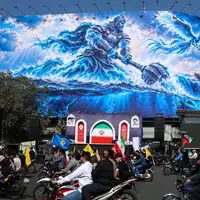
An Iranian man walks next to a mural on a street in Tehran, Iran, May 11, 2026.
100%
An Iranian man walks next to a mural on a street in Tehran, Iran, May 11, 2026.

The comments reflected broader skepticism that outside governments would prioritize the demands of Iranian citizens over regional security concerns or diplomatic interests.

Economic pressure and public exhaustion

Economic hardship emerged as another dominant theme in the messages.

“We are being crushed under inflation,” one citizen wrote, warning that any agreement with the Islamic Republic would amount to “the biggest betrayal” of Iranians.

Others described mounting psychological exhaustion after years of overlapping crises, including economic decline, executions, political crackdowns and regional conflict.

“Every day we struggle with the stress of execution news, depression, poverty and countless other hardships,” one viewer wrote. Another added: “The news about a deal shows that we the people have become victims of politics.”

Fuel shortages and rationing push Iranians into gasoline black market

May 15, 2026, 09:04 GMT+1
•
Saba Heidarkhani
Fuel shortages and rationing push Iranians into gasoline black market
100%
Drivers refuel vehicles at a gas station in Iran

Fuel shortages and tighter rationing are pushing drivers across Iran into a growing gasoline black market, with citizens describing long lines at gas stations and sharply inflated prices in messages sent to Iran International.

The accounts describe growing frustration over restricted access to subsidized gasoline and arbitrary limits imposed by operators, leaving many motorists dependent on costly unofficial sales.

“One day there’s quota left on your card, the next day it says your quota is finished,” one citizen said. “They even steal the few drops of gasoline they give people.”

Iran uses a subsidized fuel quota system controlled through electronic fuel cards. Every private vehicle receives a monthly gasoline allocation at discounted prices, while extra consumption is charged at higher rates.

Under Iran’s latest pricing system introduced in late 2025, the first 60 liters of gasoline each month cost 15,000 rials per liter (about $0.008), the next 100 liters cost 30,000 rials ($0.017), and any amount above 160 liters costs 50,000 rials ($0.028).

Despite heavy fuel subsidies, Iran’s minimum monthly wage is now worth less than $90 because of inflation and the sharp decline of the rial.

  • Iran begins pilot sales of imported gasoline at market price

    Iran begins pilot sales of imported gasoline at market price

Another driver said he could not use his personal fuel card on Wednesday because his monthly allocation had already run out. The station operator, he said, agreed to provide a fuel card only if payment was handed directly to him, and even then limited sales to 15 liters at 70,000 rials ($0.038) per liter.

President Masoud Pezeshkian said in late April that the country faced “some shortages” in sectors including energy and fuel.

On May 9, Esmail Saghab Esfahani, vice president and head of Iran’s Strategic Energy Policy and Management Organization, said damage during the war had affected parts of the country’s gas and fuel infrastructure and disrupted some gasoline production capacity.

He said Iran had “no choice but to conserve” fuel consumption for at least the next 18 to 24 months.

But Oil Minister Mohsen Paknejad said on April 29 there were no concerns over fuel supply or distribution.

File Photo: A worker adjusts fuel pumps at a gas station in Iran
100%
File Photo: A worker adjusts fuel pumps at a gas station in Iran

Black market prices rise

A resident of Bandar Abbas in southern Iran said drivers often wait more than an hour at gas stations, even with personal fuel cards, while gasoline is “widely available” on the black market at 150,000 rials, about $0.08, per liter.

In Zahedan, in southeastern Iran, one resident said gasoline shortages and tighter controls had accelerated illegal fuel sales.

“Everything has been left without oversight,” the resident said. “Sometimes 20 liters of gasoline is sold on the street for 10 million rials ($5.5).”

One driver from Isfahan said operators demanded between 1 million rials ($0.55) and 4 million rials ($2.22) to provide access to only 15 liters.

  • Iran officially rolls out higher gas price under new three-tier system

    Iran officially rolls out higher gas price under new three-tier system

Citizens also described growing congestion at gas stations nationwide, with drivers saying some stations on major routes had limited purchases to 15 liters.

A resident of Sistan and Baluchestan said 70 liters of gasoline now costs around 50 million rials, about $28, while many villagers must drive hundreds of kilometers to reach hospitals or provincial centers.

For many Iranians, the shortages have become less a matter of conservation than another daily pressure in an increasingly strained economy.