Some Iranian hardliners now appear to be distancing themselves from the “extremist” ultraconservatives who have spent recent weeks attacking the president and the nuclear negotiating team.
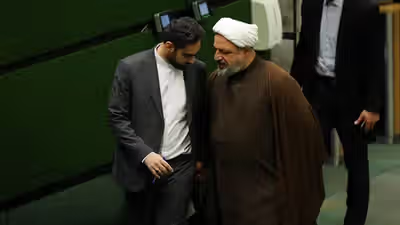
Two prominent conservative figures with longstanding ties to Iran’s security establishment have publicly condemned hardline MP Kamran Ghazanfari after he accused Pezeshkian of undermining the authority of Supreme Leader Mojtaba Khamenei.
The fallout from these interventions, and from the incident itself, points to a visible fracture inside Iran’s right wing. It highlights the growing fragmentation of the hardline camp and the marginalization of its far-right fringe, a dynamic that may inadvertently provide the embattled president with some political breathing room.
In a video clip that went viral last week, Ghazanfari accused the president of bypassing the Supreme Leader, demanding: “Why did you accept the ceasefire without Khamenei’s permission?”
He claimed that the Leader’s silence in public messages signaled disapproval and alleged that Pezeshkian had similarly accepted an unauthorized ceasefire during a previous 12-day conflict.
Ghazanfari argued that by halting military operations, Pezeshkian had effectively “saved America and Israel from the crushing blows of Iran’s missiles and drones” just as they were facing destruction.
Ghazanfari's remarks were criticized by hardline commentator Abbas Salimi Namin in an interview with the pro-reform Rouydad 24 website, and by Abdollah Ganji in an editorial in the IRGC-linked Javan newspaper.
The reactions represented unusually sharp internal pushback from within the broader conservative, or principlist, spectrum.
Their target is the extreme and destabilizing fringe of their own camp.
Salimi Namin warned that “extremism damages the system from within.” He argued that the presence of ultra-radicals like Ghazanfari in the parliament is a disaster that alienates the public and degrades political discourse. He also accused radical hardliners of weakening the Supreme Leader’s authority rather than defending it.
“The presence of people like Ghazanfari in the Majles is a disaster,” Salimi Namin said, adding that such statements, “before being an accusation against Pezeshkian, are an insult to the leadership and the armed forces.”
Ganji, who previously served as managing editor of Javan before moving to Hamshahri, made a similar argument in an editorial titled “The Reckless Ghazanfar(s).” The headline used “Ghazanfar,” a colloquial Persian term for a clumsy teammate who scores an own goal, as a pointed play on the MP’s name.
Ganji reminded the “rogue” ultraconservative lawmaker that under Article 110 of the Constitution, decisions on war, peace and major strategic shifts rest with the Supreme Leader and the Supreme National Security Council, not the president.
He described Ghazanfari’s outbursts as “a psychological pathology rather than legitimate political criticism.” He also accused him of exploiting parliamentary questioning as a legal loophole to smear opponents with labels such as “spy,” “Bahai” or “secular.”
Ganji urged “revolutionary youth and elites” to break their silence and “push back against these reckless figures who drive people away from the revolution.”
He characterized Ghazanfari’s accusations as “so disgusting, illogical, insulting, and slanderous… that at first, I thought it was generated by artificial intelligence.”
Both articles unequivocally condemned Ghazanfari’s conspiratorial attacks on Pezeshkian. They argued that although Ghazanfari claims to defend the Revolution and the Leader, his logic ultimately insults the Leader by implying that a president could easily bypass his authority on matters such as striking Israel or agreeing to a ceasefire.
Both warned against mistaking such toxic behavior for revolutionary zeal.
Together, these interventions expose a major structural tension in Iranian politics: how the system manages a reformist or moderate president operating within a conservative-dominated state.
Pezeshkian entered office on a platform of consensus-building, direct engagement with the West to ease sanctions, and domestic de-escalation. The recent criticism of Ghazanfari suggests that mainstream institutional conservatives recognize that, for the system to function, the president must retain at least a basic level of legitimacy.
By attacking the president over core security decisions, the ultra-radicals disrupt the carefully calibrated systemic harmony engineered by the leadership.
The fact that high-profile conservatives are publicly rebuking an ultra-hardline MP indicates that, at this moment, the establishment is prioritizing state stability over factional purity.