Iran sentences man behind viral protest video to 10 years in prison


Masoud Payahoo, who recorded a viral video of a lone protester sitting before security forces during Iran’s nationwide protests in January, has been sentenced to 10 years in prison on accusations of alleged cooperation with Israel, Tehran-based Emtedad news website reported.
His lawyer, Hassan Aghakhani, said Payahoo had recorded the video spontaneously and had no intention of making it public, adding that he had shared it only with a limited number of friends in a private Instagram story.
The 10-year sentence was upheld by Branch 9 of the Supreme Court and referred for enforcement, Aghakhani said adding that Payahoo must now report to prison.



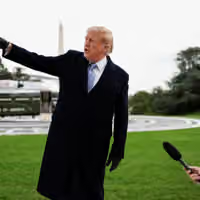

President Donald Trump’s edits to the US-Iran memorandum of understanding included somewhat significant changes related to the Strait of Hormuz and the removal of highly enriched uranium, CBS News reported, citing a source with knowledge of the negotiations.
The broad strokes of the memorandum include a 60-day cessation of violence, clauses calling for reopening the Strait of Hormuz and a framework to reopen negotiations on Iran’s nuclear program, the report said.
The arrangement also involves the potential for waivers or sanctions relief that could allow Iran to access billions in frozen assets depending on the progress of diplomacy, the report added citing multiple sources.
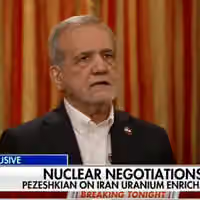
Iranian President Masoud Pezeshkian has submitted an official letter of resignation to the Office of the Supreme Leader, a source familiar with the matter told Iran International.
In the letter sent on Sunday, Pezeshkian stressed that the president and the government have effectively been excluded from major and vital decision-making processes in the country, and that the vacuum created by this situation has enabled hardline factions within the IRGC to take control of affairs, the source said.
Pezeshkian added that under such circumstances he is unable to run the government and carry out his legal responsibilities, and for that reason has requested to step down immediately.
It is not yet clear whether Mojtaba Khamenei will accept the president's resignation, but the contents of the letter point to a deep and unprecedented rift at the highest levels of power.
This comes after months of tensions between the government and the Islamic Republic’s military-security institutions. Iran International previously reported that the IRGC had gradually restricted many presidential powers and effectively taken control of key parts of the government.
According to informed sources, the situation has left Pezeshkian’s administration trapped in a political and executive deadlock, preventing diplomatic negotiations from moving forward and the completion and implementation of desired changes to the cabinet structure.
French President Emmanuel Macron said he had met with Saudi Crown Prince Mohammed bin Salman, Oman’s Sultan Haitham bin Tariq, Emirati President Mohammed bin Zayed and Egyptian President Abdel Fattah al-Sisi to urge a quick agreement between the United States and Iran.
"To all of them, I delivered the same message: it is essential that an agreement between the United States and Iran be reached quickly," Macron said in a post on X.
He said the priority must be a ceasefire and the immediate reopening of the Strait of Hormuz without conditions and in accordance with international law.
Macron said France was ready to help resume maritime traffic, support nuclear talks and contribute to establishing a regional security framework.
Four US service members and three contractors suffered minor injuries related to an Iranian ballistic missile strike on a Kuwaiti air base last week, CBS News reported, citing a US official.
All seven returned to duty within 24 hours, the official was cited as saying.
Iran launched a ballistic missile toward Kuwait at 10:17 p.m. Eastern time on Wednesday, CENTCOM had previously said. The missile was intercepted by Kuwaiti forces.
Iran's Revolutionary Guards said Thursday it had targeted an American base in retaliation for US strikes on the southern part of the country, though it did not specify where the base was.
US Treasury Secretary Scott Bessent said Iran made a "big mistake" by attacking its neighbors in the Persian Gulf, leading regional allies to cooperate more closely with Washington on freezing Iranian funds.
"We had many very good allies who maybe weren't completely transparent with us on the money — Iranian money that was in their banking systems — all of a sudden became very compliant in terms of being willing to turn over accounts or help us freeze block accounts," Bessent told Fox News.
"And then the third part was the incredible blockade. I really think it's the economic blockade of funds and the physical blockade of the ships not going in or out of the Iranian ports," he added.
"Kharg Island is shut down. That's their big oil loading facilities, and that means that they're going to have to start taking down the wells," Bessent said.