Tehran Guards commander says forces at “peak readiness”

The commander of the Revolutionary Guards in Tehran said Iran’s armed forces were at “peak readiness” and had launched new military drills immediately after fighting stopped.
“The mechanisms are designed in a way that allows a response to any enemy action in the shortest possible time,” Hassan Hassanzadeh said on Thursday.
Hassanzadeh also said attacks on Basij centers during the conflict had failed to weaken support for the paramilitary force.





Iran International also searched the cemetery’s public database for the names of dozens of people killed during the January 7 and 8 protests. The searches returned no results, or only unrelated names with different birth and death dates, suggesting that burial details including names, sections, rows and grave numbers have been removed from the system.
Searches for other prominent protesters and executed prisoners killed in earlier years, however, still produced identifiable results in the same database.
It is not clear when the removals took place or whether they affect all those killed in the January protests who were buried at Behesht-e Zahra.
Families report missing records
Some families had already raised the issue on social media. Iranian authorities, including the head of the Behesht-e Zahra Organization, have not publicly explained the missing records.
The family of one person killed wrote on X that a growing number of people had contacted them to say they could no longer find the graves of their loved ones in the Behesht-e Zahra system.
The family said they realized from those messages that the names of several people killed in the protests were no longer listed on the cemetery website.
Comments under the post mentioned other names in a similar situation, saying no information about them appeared in the database.
Some users compared the removals to earlier attempts by the Islamic Republic to conceal information about mass killings, including the 1988 executions.
Echoes of 1988
In the summer of 1988, after the Iran-Iraq War, the Islamic Republic executed thousands of political prisoners. Over several weeks, panels later known as “death committees” sent prisoners to execution, and many were buried in unmarked or mass graves, including in Khavaran, a cemetery area in southeast Tehran.
The comparison has become more frequent as families and activists report attempts to obscure or alter the burial records and graves of those killed in the January protests.
On January 25, Iran International’s editorial board said in a statement that more than 36,500 people had been killed during the suppression of Iran’s national uprising on the orders of Ali Khamenei, then Iran’s ruler.
Damaged graves
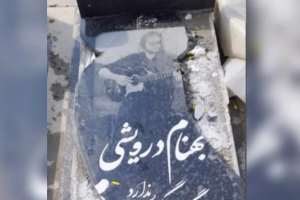
In recent months, Iran International has also received reports showing that headstones of several people killed in the January protests had been damaged, altered or covered with layers of cement.
In some cases, families say authorities objected to words such as javidnam – meaning eternally remembered and widely used for slain protestors – or phrases such as “child of Iran” being inscribed on graves, and threatened to break headstones if the wording was not changed.
These actions have been reported at Bagh-e Rezvan cemetery in Rasht and in parts of Behesht-e Zahra in Tehran, often under pressure or threats from official bodies.
Damage to the graves of protesters and people executed after earlier demonstrations has also been reported in previous years.
There have been reports of damage to the graves of Majidreza Rahnavard, Siavash Mahmoudi, Kian Pirfalak, Zakaria Khial and Aylar Haghi, among others.
For families, the apparent removal of burial records is not only an administrative issue. It deepens fears that the state is trying to control how the dead are remembered, where they can be found and whether their names remain part of the public record.
The poster, announcing a memorial ceremony at the Abdol-Azim shrine in Rey, south of Tehran, lists Zahra Sadat Haddad-Adel, Boshra Hosseini Khamenei, Mesbah al-Hoda Bagheri and Zahra Mohammadi Golpayegani as among the dead.
Each name connects the Khamenei household to one of the families or institutions that have shaped the Islamic Republic’s political, cultural and administrative elite for decades: the parliament, the Supreme Leader’s office, the Supreme Council of the Cultural Revolution, Imam Sadegh University and the network of institutions around the leader’s office.
The ceremony itself is religious and familial. But the names on the poster point to something larger: a closed circle of family relationships through which access, influence and institutional power have long moved inside the Islamic Republic.
The Haddad-Adel connection
One of the most recognizable names is Zahra Sadat Haddad-Adel, wife of Mojtaba Khamenei and daughter of Gholam-Ali Haddad-Adel.
Haddad-Adel served as speaker of Iran’s seventh parliament from 2004 to 2008 and is known as the first non-clerical speaker of the Islamic Republic’s parliament. He also served as a lawmaker in several parliamentary terms and remains head of the Academy of Persian Language and Literature.
His influence extends beyond parliament. He is a member of the Supreme Council of the Cultural Revolution, an adviser to the slain Supreme Leader and founder of the private Farhang school, which critics have described as one of the symbols of special educational access for families close to the ruling system.
For critics, Haddad-Adel’s presence across political, cultural and educational institutions, combined with his family tie to the Khamenei household, reflects the concentration of power within a limited circle of families close to the state.
His name also appears on the US Treasury Department’s sanctions list.
Imam Sadegh University and the Bagheri Kani family
The name Mesbah al-Hoda Bagheri draws attention to another powerful network: the Bagheri Kani family and the institutions around Imam Sadegh University.
Mesbah al-Hoda Bagheri Kani was the husband of Hoda Khamenei, Ali Khamenei’s daughter, and the son of Mohammad-Bagher Bagheri Kani, an influential cleric who served in the Assembly of Experts and headed Imam Sadegh University.
The same family also includes Ali Bagheri Kani, a senior diplomat who has held key posts in Iran’s foreign policy establishment, including political deputy foreign minister, acting foreign minister, senior nuclear negotiator and senior positions in the Supreme National Security Council.
Their uncle, Mohammad-Reza Mahdavi Kani, was one of the Islamic Republic’s most influential clerics. He served as head of the Assembly of Experts, secretary-general of the Combatant Clergy Association, briefly as prime minister in 1981, and for decades as head of Imam Sadegh University.
Imam Sadegh University expanded after the 1979 revolution and became one of the main training grounds for state managers. Many officials in Iran’s political, security, media and diplomatic institutions are graduates of Imam Sadegh University.
Through these links, the Bagheri Kani family connects the Khamenei household to one of the Islamic Republic’s most important pipelines for training and placing loyal officials in diplomacy, security, politics and state administration.
The Supreme Leader’s office
Another name on the poster, Zahra Mohammadi Golpayegani, points directly to the Supreme Leader’s office.
The 14-month-old child was connected to two of the most influential families in the Islamic Republic. On one side, she was the granddaughter of Mohammad Mohammadi Golpayegani, the longtime head of Ali Khamenei’s office. On the other, she was a granddaughter of Ali Khamenei.
Mohammad Mohammadi Golpayegani headed the Supreme Leader’s office since 1989, the year Khamenei became leader. He is one of the most influential but least publicly visible figures in the Islamic Republic’s power structure.
Because of his position, Golpayegani has played a central role in the messages, decisions and administrative machinery of the leader’s office. The US Treasury sanctioned him in 2019 over his role acting on behalf of that office.
His family link to Khamenei, as reflected in the name of Zahra Mohammadi Golpayegani, shows how the leader’s office is not only an institution but also part of a wider web of personal and familial ties.
Boshra Khamenei
The poster also lists Boshra Hosseini Khamenei, Ali Khamenei’s eldest daughter.
Unlike some other members of the Khamenei family, Boshra Khamenei has rarely appeared in public, and little information has been published about her personal life or activities.
In recent weeks, state media have referred to her as “martyr Boshra Khamenei.” Some reports have mentioned her educational background and interest in literature.
Tabnak, in a report framed as a student’s note for “martyr Boshra Khamenei,” referred to her as “Ms. Hosseini” and described her connection to education and literature.
Her presence on the poster alongside the other names brings the focus back to the Khamenei family itself, a household that has remained mostly shielded from public life while remaining central to the structure of power.
A compressed image of power
The memorial poster is striking because it brings together four names that would otherwise appear in different corners of the Islamic Republic’s elite: the Haddad-Adel family, the Bagheri Kani family, the Mohammadi Golpayegani family and the Khamenei household.
Together, they form a compressed image of how power has been organized around the leader’s family and its closest allies.
For critics of the Islamic Republic, the connections point to a familiar pattern: influence concentrated among a small circle of trusted families whose proximity to the leader’s office can open paths across the state.
The memorial in Rey is therefore more than a family or religious ceremony. It offers a glimpse of how, at the top of the Islamic Republic, family names often double as signs of political access, institutional reach and long-standing power.