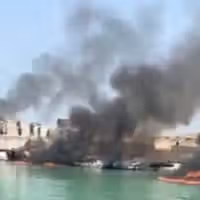
South Korea summoned Iran’s ambassador on Wednesday to protest an attack on a South Korean-operated vessel in the Strait of Hormuz after investigators found the ship was likely hit by Iranian-developed anti-ship missiles, Yonhap reported.
First Vice Foreign Minister Park Yoon-joo said technical analysis showed two unidentified airborne objects that struck the HMM Namu on May 4 were likely Noor-series anti-ship missiles developed by Iran.
The first warhead failed to detonate, while the second exploded on impact, according to the government probe. Park said the missiles are used by Iran’s navy, the Revolutionary Guards and pro-Iran groups.
“Multiple pieces of evidence point toward Iran,” Park said, while adding that Seoul could not confirm the launch site, the exact perpetrator or whether the attack was intentional.
The Panama-flagged bulk carrier HMM Namu, in Guangzhou, Guangdong Province, China January 5, 2026.
South Korea summoned Iran’s ambassador on Wednesday to protest an attack on a South Korean-operated vessel in the Strait of Hormuz after investigators found the ship was likely hit by Iranian-developed anti-ship missiles, Yonhap reported.
First Vice Foreign Minister Park Yoon-joo said technical analysis showed two unidentified airborne objects that struck the HMM Namu on May 4 were likely Noor-series anti-ship missiles developed by Iran.
The first warhead failed to detonate, while the second exploded on impact, according to the government probe. Park said the missiles are used by Iran’s navy, the Revolutionary Guards and pro-Iran groups.
“Multiple pieces of evidence point toward Iran,” Park said, while adding that Seoul could not confirm the launch site, the exact perpetrator or whether the attack was intentional.
The foreign ministry said it summoned Iranian Ambassador Saeed Koozechi to deliver a strong protest and demand responsible measures, including steps to prevent a recurrence.
The attack caused an explosion and fire aboard the HMM Namu, leaving one of the 24 crew members with minor injuries. Iran’s embassy in Seoul has previously denied any military involvement in the incident.
The Iranian envoy expressed regret over the damage to the South Korean vessel.
“I would personally like to express regret over the damage caused to the South Korean ship,” he said.
But when asked whether Iran accepted the findings of South Korea’s investigation or whether Tehran would apologize, he denied involvement, saying people should beware of “false-flag operations by hostile countries.”
Israel could return to military action against Iran if diplomacy with Tehran fails to meet core objectives, Israel’s ambassador to Australia told Iran International in an exclusive interview.
Hillel Newman said Israel supported talks between Iran and the United States, but only if they removed what he described as existential threats from the Islamic Republic.
“We’re in favor... of talks as long as they attain the objectives. We cannot compromise on the objectives,” Newman said.
Iranian President Masoud Pezeshkian said on Wednesday that the economy and people’s livelihood resilience had become the main front in the confrontation with the country’s adversaries.
Speaking at a meeting with members of the Tehran Chamber of Commerce, Pezeshkian called business leaders and traders the front line of what he described as an economic war.
He said the government would not allow the private sector to collapse.
Israel’s Ambassador to Australia Hillel Newman speaks to Iran International in an interview on May 27, 2026.
Israel could return to military action against Iran if diplomacy with Tehran fails to meet core objectives, Israel’s ambassador to Australia told Iran International in an exclusive interview.
Hillel Newman said Israel supported talks between Iran and the United States, but only if they removed what he described as existential threats from the Islamic Republic.
“We’re in favor... of talks as long as they attain the objectives. We cannot compromise on the objectives,” Newman said.
“As I said, the objectives are removal of the nuclear capability, zero enrichment, zero enriched uranium in Iran,” he added. “Also the fact of the ballistic missiles and stopping their support of the proxies which cause unrest in the entire Middle East.”
Newman said Israel was prepared to accept a diplomatic outcome if it achieved those aims.
“If we can attain it through negotiations and diplomatic discussions, fine. If not, we might have to go back to the military campaign in order to attain the objectives, but the objectives must be attained,” he said.
The remarks come as US-Iran talks continue over a possible agreement to end the conflict, with Tehran and Washington still divided over Iran’s highly enriched uranium, sanctions relief, frozen assets and the Strait of Hormuz.
Asked whether Israel would act independently if negotiations produced a ceasefire, Newman said Israel was already giving diplomacy a chance.
“We’re actually now in a kind of a ceasefire which we have declared and accepted because we’re giving a good opportunity in good faith for the discussions, for the diplomatic resolution of the issue,” he said.
Newman said Israel had confidence in US President Donald Trump and described coordination between Washington and Israel as “unprecedented.”
“We have trust, we have confidence in President Trump. We work together closely. There’s coordination,” he said.
He also said any agreement affecting Lebanon would depend on conditions, including whether Iran-backed Hezbollah retreats north of the Litani River.
“We just have to make sure that the Hezbollah terrorists are not launching rockets against Israel and as much as possible not armed and present in the southern part of Lebanon beyond the south of the Litani River,” Newman said. “That’s all we want. We don’t want any territorial aspirations in Lebanon.”
‘Weakening IRGC could open path for Iranians’
Newman said Israel distinguished between the Islamic Republic and the Iranian people, adding that weakening the IRGC, Basij and the ruling establishment could create “a new opportunity” for Iranians.
“In the end, the people of Iran must take their destiny into their own hands,” he said. “By weakening the Basij forces and by weakening the IRGC, by weakening the regime itself, we are opening perhaps a new opportunity for the people of Iran.”
During the Iran war, Israel targeted not only senior commanders and strategic military sites but also checkpoints and street-level security units.
Iran's Supreme Leader Mojtaba Khamenei remains in charge of the country’s overall management and the war effort, his representative dispatched to the southeastern province of Sistan-Baluchestan said.
Mohammad Taghi Vakilpour said in Chabahar that Khamenei was "standing in the field with full force."
Khamenei has not appeared in public, and no image or audio recording of him has been released since his appointment as Supreme Leader.