• العربية
  • فارسی
Brand
  • Iran Insight
  • Politics
  • Economy
  • Analysis
  • Special Report
  • Opinion
  • Podcast
  • Iran Insight
  • Politics
  • Economy
  • Analysis
  • Special Report
  • Opinion
  • Podcast
  • Theme
  • Language
    • العربية
    • فارسی
  • Iran Insight
  • Politics
  • Economy
  • Analysis
  • Special Report
  • Opinion
  • Podcast
All rights reserved for Volant Media UK Limited
volant media logo

Hormuz traffic rises despite US blockade - Lloyd’s List

May 19, 2026, 18:05 GMT+1

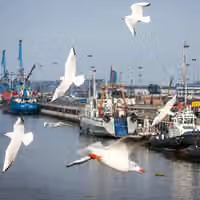
Traffic through the Strait of Hormuz rose sharply last week as Iran-linked trade increased despite the US blockade, Lloyd’s List reported, citing vessel-tracking data.

At least 54 ships transited the strait between May 11 and 17, up from 25 the previous week, according to Lloyd’s List Intelligence.

The vessels included 10 China-owned ships after Tehran said Chinese vessels would be permitted to transit, two LPG carriers leaving the Persian Gulf for India, and an ADNOC-owned LNG carrier entering the waterway via dark transit.

Most Viewed

Iran’s president defends US talks as he lays bare economic strain
1

Iran’s president defends US talks as he lays bare economic strain

2

Pezeshkian says Iranians must accept inflation as country is in war

3

Amnesty says Iran drove global surge in executions in 2025

4

Trump holds off planned Iran strike as Arab allies buy Tehran time

5

IRGC-linked propaganda posts targeted across platforms, Europol says

Banner
Banner

Spotlight

  • Tehran Stock Exchange reopens under tight controls as key firms stay closed
    ANALYSIS

    Tehran Stock Exchange reopens under tight controls as key firms stay closed

  • Tehran and Washington betting the other side blinks first
    INSIGHT

    Tehran and Washington betting the other side blinks first

  • Iran finds a new weapon beneath Hormuz
    ANALYSIS

    Iran finds a new weapon beneath Hormuz

  • Iran state TV rifle displays stir unease over domestic intimidation

    Iran state TV rifle displays stir unease over domestic intimidation

  • Two years after Raisi’s crash: Iran has no sanctuary
    ANALYSIS

    Two years after Raisi’s crash: Iran has no sanctuary

•
•
•

More Stories

Iran finds a new weapon beneath Hormuz

May 19, 2026, 17:57 GMT+1
•
Negar Mojtahedi

Long viewed as merely an oil chokepoint, the Strait of Hormuz is now emerging as a digital flashpoint, after Iran floated “protection fees” for subsea fiber-optic cables crossing the waterway in a move experts warn could give Tehran new leverage.

Ebrahim Zolfaghari, spokesperson for Iran's military command center, wrote on X last week: “We will impose tolls on internet cables.”

Media outlets close to the IRGC have also said companies such as Google, Microsoft, Meta and Amazon must comply with the Islamic Republic’s laws, and that cable-owning companies must pay permit fees for cables to pass through.

Subsea cables carry the overwhelming majority of the global internet and financial traffic, connecting Europe, Asia and the Persian Gulf through a vast underwater network that powers everything from banking systems and cloud computing to government communications and energy markets.

The risk is no longer theoretical. Alcatel Submarine Networks, the world’s largest cable-laying company, has already paused subsea cable repair operations in the Persian Gulf after issuing force majeure notices tied to growing security risks in the region.

“The undersea network of undersea cables, it's not just important, it’s absolutely critical – trillions of dollars of financial transactions take place through these cables,” said Tom Sharpe, who served 27 years as a Royal Navy officer commanding four warships.

“It’s the internet, which of course if enough of that collapses can have a devastating effect," he said.

While these networks are global, experts say the Persian Gulf is uniquely vulnerable because there are fewer redundant cable routes compared to regions like the Atlantic.

“When you go to other places in the world, let’s say the [Persian] Gulf, there are far fewer, and therefore that redundancy becomes less and less, and therefore the vulnerability goes up,” Sharpe explained.

Iranian lawmakers discussed plans last week that could target submarine cables linking Persian Gulf littoral states to Europe and Asia. Iranian state-linked media have also floated proposals requiring foreign operators to comply with Iranian licensing laws and pay fees for maintenance and repair access.

The proposals appear to be part of a broader effort by Iranian hardliners to test how far Tehran can extend its authority over infrastructure crossing the Persian Gulf, even when that infrastructure is privately owned or tied to foreign governments.

Escalate, test, adjust

Sharpe believes Tehran is following a familiar escalation model — gradually testing international reactions before potentially taking more aggressive steps.

“I think, look, it seems to me at the moment we’re in the sort of inject uncertainty phase. Let’s see what the markets do. Let’s see how the companies react. Let’s see what insurers do,” Sharpe said. “They escalate. They test. They adjust.”

According to Sharpe, the strategy mirrors tactics previously employed by Russia around undersea infrastructure and later adapted by the Houthis in the Red Sea.

“They’re very good at escalation management,” he added. “They don’t go straight to the nuclear option and start just snipping cables.”

Charlie Brown, Senior Advisor at United Against Nuclear Iran, who specializes in maritime sanctions enforcement and the tracking of illicit shipping, said the issue extends far beyond internet access alone because submarine cables often cross multiple jurisdictions and are owned by consortiums involving companies and governments from around the world.

“This goes beyond merely the cable itself and the data on it,” Brown told Iran International. “These are cross-jurisdictional issues that affect many people in many different jurisdictions.”

New toll booth under the sea

Brown described the Islamic Republic’s approach as resembling a mafia-style protection racket aimed at controlling — rather than immediately destroying — critical underwater infrastructure.

“Yeah, it’s very interesting. I mean, so this ends up showing that it’s a money-making racket threatening. So it’s basically a gangster move,” Brown said.

“The IRGC is trying to extend their control to include things on the seabed that don’t belong to them,” he added.

Experts say global internet infrastructure has enough redundancy to prevent a total communications collapse, but warn the bigger risk is the normalization of payments to Tehran.

Max Meizlish, Senior Research Analyst for the Center on Economic and Financial Power at Foundation for Defense of Democracies, sees the cable issue as an extension of Iran’s broader attempts to exert control over the Strait of Hormuz.

“I think that this is just another instance of the Iranian regime putting in place essentially a shakedown in the strait,” Meizlish said.

Since the war began, he said, hardline factions within the Islamic Revolutionary Guard Corps (IRGC) have increasingly pushed to expand Tehran’s leverage over both maritime and digital chokepoints.

“We see slowly Iran extending its sphere of influence,” Meizlish said. “The IRGC hardliners want to come out of this conflict actually from a position of relative strength.”

A warning to Washington

Much of what happens next may ultimately depend on enforcement. Existing US sanctions prohibit dealings with the IRGC, meaning companies that pay such fees could expose themselves to secondary sanctions.

But if enforcement weakens, Meizlish warns, firms may gradually begin viewing payments to Tehran as simply another cost of operating in the region.

“Already it’s come out within the shipping sector,” Meizlish told Iran International. “Some ships have made these payments. We’ve seen traffic go through the Tehran toll booth.”

“If the US doesn’t step up pressure and actually actively enforce these sanctions, then some firms will determine that maybe in their risk-based approach, they can go ahead and do this,” he said.

“That would be a strategic error.”

US offers up to $15 million for tips on IRGC financial network

May 19, 2026, 17:41 GMT+1

The US State Department’s Rewards for Justice program on Tuesday said it is offering up to $15 million for information on Iran’s Revolutionary Guards financial network.

“The IRGC uses numerous financial mechanisms to fund its activities, including cryptocurrency accounts, custodians, and front companies,” a notice posted the program's X account said.

“If you have information on the IRGC’s financial network, send it to us via Signal or our Tor-based tip line,” it added.

Those providing information “may be eligible for a reward and potential relocation,” according to the notice.

British prisoner in Iran enters 10th day of hunger strike

May 19, 2026, 17:30 GMT+1

Craig Foreman, a British citizen imprisoned in Iran with his wife for 17 months, has entered the 10th day of a hunger strike in Tehran’s Evin prison to protest being denied phone calls, visits with his wife and access to his lawyer, a source familiar with the case told Iran International.

Foreman, who is consuming only water, sugar and salt, began the strike after prison authorities barred him and his wife, Lindsay Foreman, from contacting or visiting each other following a BBC interview in which they spoke about the difficult conditions faced by many Iranians, the source said.

The source said Foreman was “not in a good condition” after 10 days without food, adding that he was also protesting being prevented from speaking about what he had witnessed in prison, including fellow inmates being transferred for execution.

According to the source, Foreman has repeatedly complained that prison officials and Iran’s judiciary had made “false promises” to him, saying he did not understand why he had to hear “so many lies” from Iranian officials.

The Foremans were sentenced in February to 10 years in prison on espionage charges, which they deny. Britain has condemned the sentences as “totally unjustifiable.”

CENTCOM chief says Iran school was on active missile site

May 19, 2026, 16:20 GMT+1

A US military investigation into a blast at an elementary school in Minab, a city in Iran’s southern Hormozgan province, is “complex” because the school was located on an active Iranian cruise missile site, US Central Command chief Admiral Brad Cooper told Congress on Tuesday.

Reuters previously reported that an initial internal US military investigation found US forces were likely responsible for the destruction of the school in Minab.

Iranian authorities say 168 students, most of them girls, were killed in the Feb. 28 blast, which took place on the first day of the war.

US sanctions Iranian exchange house, shadow fleet vessels

May 19, 2026, 15:56 GMT+1

The United States imposed fresh sanctions on an Iranian exchange house, front companies in several countries and 19 vessels accused of shipping Iranian petroleum and petrochemicals.

The Treasury Department sanctioned Iran-based Amin Exchange and companies it said operated in the UAE, Turkey and Hong Kong on behalf of Iranian banks.

“Iran’s shadow banking system facilitates the illicit transfer of funding for terrorist purposes,” US Treasury Secretary Scott Bessent said.

The sanctions also targeted vessels including the Barbados-flagged LPG tanker Great Sail, the Palau-flagged products tanker Ocean Wave and the Panama-flagged chemical/oil tanker Swift Falcon.