• العربية
  • فارسی
Brand
  • Iran Insight
  • Politics
  • Economy
  • Analysis
  • Special Report
  • Opinion
  • Podcast
  • Iran Insight
  • Politics
  • Economy
  • Analysis
  • Special Report
  • Opinion
  • Podcast
  • Theme
  • Language
    • العربية
    • فارسی
  • Iran Insight
  • Politics
  • Economy
  • Analysis
  • Special Report
  • Opinion
  • Podcast
All rights reserved for Volant Media UK Limited
volant media logo

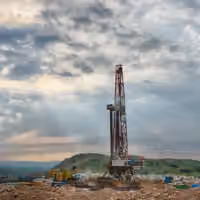
Oil prices fall over 2% after Trump pauses Iran strike plan

May 19, 2026, 02:11 GMT+1

Oil prices dropped more than 2% in early Asian trading on Tuesday after US President Donald Trump said he paused a planned attack on Iran to allow time for negotiations aimed at ending the conflict, according to Reuters.

Brent crude futures for July delivery fell $3.01, or 2.7%, to $109.09 a barrel, while West Texas Intermediate (WTI) crude for June delivery dropped $1.38, or 1.3%, to $107.28. The benchmarks had hit their highest levels since early May and late April in the previous session.

Analysts said markets were watching whether the move signals de-escalation or a temporary reprieve in tensions.

Most Viewed

Iran’s president defends US talks as he lays bare economic strain
1

Iran’s president defends US talks as he lays bare economic strain

2

Pezeshkian says Iranians must accept inflation as country is in war

3

Amnesty says Iran drove global surge in executions in 2025

4

Trump holds off planned Iran strike as Arab allies buy Tehran time

5

IRGC-linked propaganda posts targeted across platforms, Europol says

Banner
Banner

Spotlight

  • Iran finds a new weapon beneath Hormuz
    ANALYSIS

    Iran finds a new weapon beneath Hormuz

  • Iran state TV rifle displays stir unease over domestic intimidation

    Iran state TV rifle displays stir unease over domestic intimidation

  • Two years after Raisi’s crash: Iran has no sanctuary
    ANALYSIS

    Two years after Raisi’s crash: Iran has no sanctuary

  • Can Iran’s economy survive a twin squeeze from blockade and blackout?
    PODCAST

    Can Iran’s economy survive a twin squeeze from blockade and blackout?

  • China’s Iran balancing act grows more costly
    ANALYSIS

    China’s Iran balancing act grows more costly

  • Tehran media sees rising risk of war as US talks stall
    INSIGHT

    Tehran media sees rising risk of war as US talks stall

•
•
•

More Stories

Senator Graham sets conditions for Iran deal, urges congressional approval

May 18, 2026, 22:52 GMT+1

US Senator Lindsey Graham said on Monday any agreement between the United States and Iran must be submitted to Congress for approval, adding it should follow the precedent of the JCPOA under former President Barack Obama.

"As I have said before, President Trump’s position is clear: No enrichment American control of the approximately 900 pounds of highly enriched uranium .The opening of the Strait of Hormuz without interference from Iran. Iran must abandon its long-range ballistic missile program and any effort to develop a nuclear weapon. Iran must end its support for all terrorists proxies in the region. But to say that I am skeptical that Iran will actually agree to the things necessary to make the deal substantially different than the JCPOA or enter into a deal that will withstand the test of time is an understatement. Time will tell," Graham posted on X.

Trump says Iran talks ongoing as he repeats threat of military action

May 18, 2026, 22:50 GMT+1
Centre for Medicare & Medicaid Services Administrator Dr Mehmet Oz, Heidi Overton and Mark Cuban listen as US President Donald Trump delivers remarks about health care costs and affordability from an auditorium on the White House campus in Washington, DC, US, May 18, 2026
100%
Centre for Medicare & Medicaid Services Administrator Dr Mehmet Oz, Heidi Overton and Mark Cuban listen as US President Donald Trump delivers remarks about health care costs and affordability from an auditorium on the White House campus in Washington, DC, US, May 18, 2026

US President Donald Trump said the United States confronted Iran because it was determined to prevent it from acquiring a nuclear weapon, adding that Washington “ended up destroying” Iranian forces after encountering resistance.

"I said, we're going to take a little excursion down to the Middle East, and we're going to confront Iran, because they are desperate to have a nuclear weapon, and the only reason they wanted is to use it, and I said that's I hate to do this because we're doing so well, but this is the most important thing we can do. We can't let Iran have a nuclear weapon, so we did that, and when we did that, we were met with a little force, and we ended up destroying them. We now have a tremendous, we built really a steel wall where no boats, the blockade, where no boats are able to, not one boat has been able to get through our blockade. Look, our military is the greatest military anywhere in the world. I just left China, and I will say, President Xi was very, very complimentary of our military. He was amazed, actually, at our military. We have the greatest military in the world. We're not going to let Iran have a nuclear weapon, so I was called by these three countries, plus others, and they're dealing directly with our people, and right now Iran, and there seems to be a very good chance that they can work something out. If we can do that without bombing the hell out of them, I'd be very happy," Trump said.

Iran’s military ‘virtually destroyed’ in US actions, Trump says

May 18, 2026, 22:47 GMT+1
Centre for Medicare & Medicaid Services Administrator Dr Mehmet Oz and US Health and Human Services Secretary Robert F. Kennedy Jr. stand behind US President Donald Trump as he points while delivering remarks about health care costs and affordability from an auditorium on the White House campus in Washington, DC, US, May 18, 2026
100%
Centre for Medicare & Medicaid Services Administrator Dr Mehmet Oz and US Health and Human Services Secretary Robert F. Kennedy Jr. stand behind US President Donald Trump as he points while delivering remarks about health care costs and affordability from an auditorium on the White House campus in Washington, DC, US, May 18, 2026

US President Donald Trump said the United States “virtually destroyed” Iran’s military capability, adding the country no longer has an effective navy or air force and that its leadership has been significantly weakened.

"We've taken a country that was going to have a nuclear weapon, and we've virtually destroyed its military. They have no navy, they have no air force, they've been every.. they've been virtually destroyed militarily. That's a lot. That's a big.. we could leave right now. Would take them 25 years to rebuild that the last thing they're thinking about, I think, is nuclear. Now they have to put it down in writing, but when you say nothing, we've, we've totally destroyed, excuse me, from CNN, we've totally destroyed their military, we've destroyed their leadership, as you know, their leaders are gone, their leaders are gone at the first level, the second level, we're dealing with half of the third level, and I think we've made a lot of progress, and it's very simple, you know, we don't want to go through this," Trump said.

Countries urged delay of planned ‘very major attack’ as Iran, Trump says

May 18, 2026, 22:40 GMT+1

US President Donald Trump said on Monday several countries, including Saudi Arabia, Qatar and the United Arab Emirates, urged him to delay what he described as a planned “very major attack,” saying they believed a nuclear-related deal with Iran was close.

"Well, other countries have come to me, and they've said we were getting ready to do a very major attack tomorrow. I put it off for a little while, hopefully maybe forever, but possibly for a little while, because we've had very big discussions with Iran, and we'll see what they amount to. I was asked by Saudi Arabia, Qatar, UAE, and some others if we could put it off for two or three days, a short period of time, because they think that they are getting very close to making a deal, and if we can do that, where there's no nuclear weapon going into the hands of Iran, I think, and if they're satisfied, we will be probably satisfied also. We've informed Israel, we've informed other people in the Middle East that have been involved with us, and it's a very positive development, but we'll see whether or not it amounts to anything. We've had periods of time where we had, we thought, pretty much getting close to making a deal, and didn't work out, but this is a little bit different. Now we're already going tomorrow, very big, and not something I wanted to do, but we have no choice, because we cannot let Iran have a nuclear weapon," Trump said.

Trump holds off planned Iran strike as Arab allies buy Tehran time

May 18, 2026, 22:27 GMT+1

US President Donald Trump said Monday he had halted a strike on Iran planned for Tuesday after Arab states including Tehran’s new foe the UAE urged him to allow more time for talks, even as reports said Tehran’s latest proposal had fallen short of US expectations.

Trump said Qatar’s emir, Saudi Crown Prince Mohammed bin Salman and UAE President Mohammed bin Zayed asked him to delay the attack, which he said had been planned for Tuesday, because they believed a deal could be reached that would be “very acceptable” to the United States, the Middle East and beyond.

“This Deal will include, importantly, NO NUCLEAR WEAPONS FOR IRAN!” Trump said in a post on Truth Social.

He said he instructed Defense Secretary Pete Hegseth, Joint Chiefs of Staff Chairman Gen. Daniel Caine and the US military not to carry out the strike, but warned that the order could be reversed if talks fail.

“I have further instructed them to be prepared to go forward with a full, large scale assault of Iran, on a moment’s notice, in the event that an acceptable Deal is not reached,” Trump said.

The diplomatic push came as details emerged about Tehran’s latest proposal to Washington.

Earlier in the day, Reuters reported, citing a senior Iranian source, that Tehran’s latest proposal calls for a permanent end to the war, sanctions relief, the release of all frozen Iranian funds and the reopening of the Strait of Hormuz, while leaving nuclear talks for later stages.

The source said Washington had so far agreed only to unfreeze 25% of Iran’s funds on a phased timetable, but had shown flexibility over limits on Tehran’s nuclear work.

Reconstruction fund for Iran

Iran's Revolutionary Guards-affiliated Tasnim news agency separately reported, citing a source close to Tehran's negotiating team, that Washington had proposed establishing a reconstruction and development fund and had accepted suspending Iran’s oil sanctions during negotiations through temporary waivers issued by the US Treasury’s Office of Foreign Assets Control.

Tasnim also said major gaps remained between the two sides, particularly over the release of frozen Iranian funds and Tehran’s demand for compensation over the war.

The source said Iran rejected linking an end to the conflict to nuclear commitments and insisted Tehran would “by no means agree to ending the war in exchange for nuclear commitments.”

The claims of sanctions relief were quickly disputed in Washington. CNBC reporter Megan Cassella said a US official denied the report, saying Iranian state media claims that Washington had agreed to lift oil sanctions during talks were false.

Axios also reported, citing a senior US official and a source briefed on the issue, that Iran’s updated proposal was insufficient because it lacked detailed commitments on suspending uranium enrichment or handing over its stockpile of highly enriched uranium.

The US official cited by Axios said no sanctions relief would happen “for free” without reciprocal action by Iran, warning that talks may otherwise continue “through bombs.”

Trump later told the New York Post he was “not open” to concessions to Tehran and suggested Iran understood the risk of further US action.

“I can tell you they want to make a deal more than ever, because they know we’re—what’s going to be happening soon,” Trump said.