Mahmoud Mirlohi, a former deputy interior minister, said Iran’s state broadcaster has failed to reflect the diversity of Iranian society, instead operating as though the entire country shares the views of radical ultraconservative factions.
His remarks come as speculation intensifies over possible leadership changes at the Islamic Republic of Iran Broadcasting (IRIB), whose chief, Payman Jebelli, is nearing the end of his five-year term.
Iranian media in recent weeks have floated several possible successors, including former IRIB deputy Ali Darabi and former state TV chief Ezatollah Zarghami—figures who, despite their roots in the system, are now often seen as more pragmatic and more responsive to public opinion.
The debate comes as signs of diplomatic progress between Tehran and Washington have fueled cautious optimism about a possible de-escalation after weeks of conflict. But mistrust between the two sides remains deep, and hardliners in both countries continue pushing rhetoric that risks undermining negotiations.
IRIB, which holds a monopoly over terrestrial radio and television and still exerts broad influence across Iran’s media landscape, has long faced accusations of functioning as a platform for the ultraconservative Paydari Party.
Under Jebelli, much of the broadcaster’s programming has been shaped by his deputy Vahid Jalili, brother of hardline politician Saeed Jalili. Both are associated with Paydari’s ideological camp.
Over the past week, IRIB has prominently featured commentators advocating confrontation both at home and abroad.
Some warned Iranians against protesting rising prices, while one guest called for the execution of former president Hassan Rouhani and former foreign minister Mohammad Javad Zarif.
Others attacked Iran’s chief nuclear negotiator and parliament speaker Mohammad Bagher Ghalibaf, exposing widening fractures even within conservative circles.
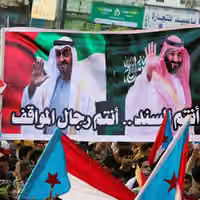
Several hardline figures also escalated rhetoric against the United Arab Emirates.
Paydari-aligned lawmakers Ali Khezrian and Alaeddin Boroujerdi called for the UAE’s destruction, with Khezrian threatening to “force the Emirates back to the age of camel riding.”
Mirlohi warned that such rhetoric undermines national cohesion at a time when authorities are attempting to project wartime unity.
Even Iranians attending nightly pro-government gatherings, he argued, do not necessarily share the ideological views promoted by state television.
He warned that treating those gatherings as proof of broad support for hardline ideology risked further alienating the public.
The criticism has not been limited to establishment insiders.
Reformist commentator Abbas Abdi wrote in Etemad Online that constant propaganda about Iran’s “victory” in the war rang hollow amid worsening economic conditions, arguing that genuine success would require stabilizing the country’s economy rather than relying on slogans.
Commentator Nasrin Zamiri wrote on the Asr Iran website that state television has failed to properly inform the public about the country’s real conditions and challenges.
She noted that no traditional or social media platform in Iran rivals IRIB’s reach, particularly in smaller towns and rural areas, making its editorial choices especially consequential.
The criticism reflects growing concern among even some establishment figures that IRIB’s increasingly ideological tone may alienate parts of the public at a moment when the state is trying to project national unity.