• العربية
  • فارسی
Brand
  • Iran Insight
  • Politics
  • Economy
  • Analysis
  • Special Report
  • Opinion
  • Podcast
  • Live TV
  • Iran Insight
  • Politics
  • Economy
  • Analysis
  • Special Report
  • Opinion
  • Podcast
  • Live TV
  • Theme
  • Language
    • العربية
    • فارسی
  • Iran Insight
  • Politics
  • Economy
  • Analysis
  • Special Report
  • Opinion
  • Podcast
  • Live TV
All rights reserved for Volant Media UK Limited
volant media logo

Iranian papers cast Hormuz escalation as display of power

May 5, 2026, 13:17 GMT+1
A woman walks past an anti-US billboard depicting US President Donald Trump and the Strait of Hormuz, in Tehran, Iran, May 4, 2026.

Iranian newspapers reacted to the latest escalation in the Strait of Hormuz and attacks on the United Arab Emirates with a tone of pride and vindication, presenting the crisis as proof that Tehran can set the rules in the Persian Gulf.
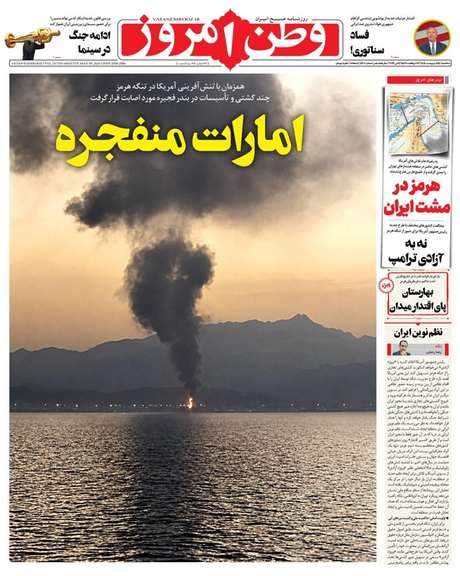
The coverage followed UAE accusations that Iran launched missile and drone attacks, including on Fujairah, as the United States moved to escort ships through the strait under President Donald Trump’s “Project Freedom.”

Some papers in Iran went beyond portraying the escalation as leverage and treated it as a moment of humiliation for the UAE.

The most striking example came from the ultraconservative daily Vatan-e Emrooz, which used a macabre pun to turn the UAE’s Persian name into a taunt.

100%
The front page of Vatan-e Emrooz

Instead of Emarat-e Mottahedeh-ye Arabi – the United Arab Emirates – it wrote Emarat-e Monfajereh, roughly “the Exploded Arab Emirates:” a wordplay that treats an attack on a neighboring country as a punchline and a boast.

Hardline Kayhan carried the message beyond the Persian Gulf, with a threat by its editor Hossein Shariatmadari: “Europe knows that we can, and we will strike.”

Javan, affiliated with the Revolutionary Guards, published a photo of the strait alongside an image of Alireza Tangsiri, the former Guards navy commander killed in March, with a quote attributed to him: “Because we are a superpower.”

JameJam, linked to Iran’s official broadcaster, used a cartoon of Trump trapped in the strait and struggling to open it. Its headline read: “Hormuz dead end.” The image captured a theme repeated across several papers: the United States as stuck, and Iran as the actor controlling the passage.

100%
The front page of JameJam paper

Other newspapers used more formal language but carried the same message. Sobh-e No and Ettela’at ran headlines such as “Iranian order in the strait” and “Iran’s show of power in the Strait of Hormuz.”

Ettela’at wrote that any foreign armed force, especially the US military, would be attacked if it tried to enter the strait, and that only vessels coordinating with Iranian forces would be allowed to pass safely.

Farhikhtegan gave the confrontation an economic frame. Under the headline “Iran’s $30 billion is no longer hostage to the UAE,” the paper argued that the collapse of trade and currency ties with the Emirates could create opportunities for Iran.

The framing appeared to respond to reports that the UAE was considering freezing billions of dollars in Iranian-linked assets and targeting the shell companies and exchange networks that have helped connect Iran to foreign currency and global trade.

The paper described the UAE as a former “golden corridor” for bypassing sanctions, but said it had become a full adversary after the war. It also said that more than 80 percent of Iran’s currency settlements had been conducted through the Emirati dirham.

That framing is central to the front pages. The UAE is not portrayed merely as a neighboring country pulled deeper into the war. It is presented as the closest and most exposed partner of Washington in the Persian Gulf – a place through which Tehran can send a message to the United States, Israel, Europe and regional governments at once.

There were some more cautious voices. Donya-e Eqtesad set out possible scenarios ranging from a prolonged standoff to direct military confrontation or renewed diplomacy.

Yet even that more analytical treatment reflected the same basic reality: Hormuz has become the Islamic Republic’s main card in a war already extending beyond Iran, the United States and Israel.

Most Viewed

Tehran gas stations run dry as fuel price hike fears mount
1
VOICES FROM IRAN

Tehran gas stations run dry as fuel price hike fears mount

2

Iran campaign urges people to fund sacrifice of 10,000 sheep for Khamenei’s health

3

Luxury Tehran property asking prices surpass Munich and Sydney

4

An Iranian film broke every taboo. Viewers say society broke them first

5

Pezeshkian admin says infiltration bill violates rights, could drive brain drain

Banner
Banner
Banner

Spotlight

  • UAE trade halt threatens one of Iran’s remaining economic lifelines
    ANALYSIS

    UAE trade halt threatens one of Iran’s remaining economic lifelines

  • Can Iran's fragile economy survive Trump's 'Economic D-Day'?
    ANALYSIS

    Can Iran's fragile economy survive Trump's 'Economic D-Day'?

  • The unlikely return of European diplomacy in the Iran-US conflict
    ANALYSIS

    The unlikely return of European diplomacy in the Iran-US conflict

  • For Iranian journalists, exile can last a lifetime
    OPINION

    For Iranian journalists, exile can last a lifetime

  • Seven months on, January protests still shape Iranians’ lives
    VOICES FROM IRAN

    Seven months on, January protests still shape Iranians’ lives

  • Forced to serve in the IRGC, now fighting to stay in Canada
    INSIGHT

    Forced to serve in the IRGC, now fighting to stay in Canada