Iran must abandon nuclear weapon ‘in meaningful and verifiable ways,’ Hegseth says


US Secretary of War Pete Hegseth said Iran must abandon any pursuit of a nuclear weapon “in meaningful and verifiable ways,” warning that Washington would maintain pressure if it does not.
“All they have to do is abandon a nuclear weapon in meaningful and verifiable ways,” Hegseth told a Pentagon briefing, adding Iran has “an important choice, a chance to make a deal, a good deal, a wise deal.”
He said the United States is “not anxious for a deal,” and warned Tehran could instead face “the regime’s fragile economic state collapse under the unrelenting pressure of American power… a blockade as long as it takes.”
Hegseth said US forces had already seized two Iranian “dark fleet” ships in the Indo-Pacific, adding: “They thought they’d made it out just in time. They did not… we will seize more.”
He added the blockade was expanding globally, saying “34 total non-Iranian vessels are allowed to transit,” while warning “the clock is not on their side.”
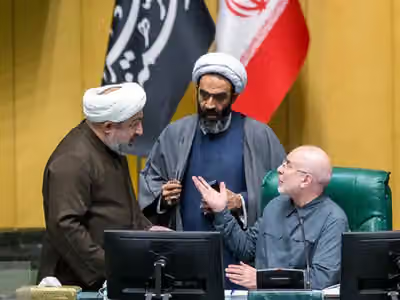



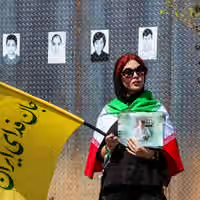


A senior Iranian cleric said no one in the country is pursuing an agreement with the United States, reflecting hardline opposition to negotiations.
“No one is even talking about an agreement with America,” Ahmad Alamolhoda, a senior cleric in Mashhad, said, adding that talks had proven “useless and fruitless.”
He said any decision rests with the leadership and dismissed the idea of concessions, saying no official would agree to give up enriched uranium, dismantle nuclear technology or limit missile capabilities.
A journalist from LBC was offered payment by an alleged Iran-linked contact to carry out a street-level act of vandalism within hours of contact, the British broadcaster reported on Friday.
The undercover reporter, engaging with a Telegram channel advertising “high-paid” work, was instructed to burn images of Donald Trump and Benjamin Netanyahu in a London street and send video proof in exchange for cryptocurrency.
“This is the first step in building trust, and I will pay for it,” the account wrote, presenting the task as an entry point to further assignments.
Matt Jukes, the deputy commissioner of the Met Police, has warned that proxies being asked to act on behalf of Iran are easily expendable and will be dropped by their handlers as soon as police get involved.
“You’re going to prison if you do that,” Jukes said. “We are going to catch you because London, this fantastic city, is on the lookout for you.”
Recruitment mirrors known playbooks
Jonathan Hall KC, the UK’s independent reviewer of state threats legislation, said the exchange reflected patterns seen in earlier foreign-directed cases.
“It looks straight from that sort of recruitment playbook,” Hall said. “The individual is being asked to do something that you might think is fairly minor and trivial… but presumably once you’ve done that and proved yourself, this is just the beginning.”
Security specialists said the model reflects a broader shift toward outsourcing operations to individuals motivated by money rather than ideology.
Officials warn of broader pattern
The outreach surfaced alongside recent arson attacks targeting Jewish-linked sites in London, increasing concern among officials about coordinated intimidation efforts.
Prime Minister Keir Starmer said he was “increasingly concerned” about foreign states using proxies for criminal acts, pledging to accelerate legislation addressing the issue.
Stephen Silverman of Campaign Against Antisemitism said the findings point to foreign-linked disruption. “By getting this to take root and getting people to act on it and spread fear and alarm, they are working to undermine our everyday lives,” Silverman said.
Authorities said the exchange has been passed to counter-terrorism police, underscoring warnings that seemingly minor tasks can serve as gateways to more serious criminal activity.
Iran will resume some international flights from Tehran’s Imam Khomeini Airport from Saturday, authorities said.
Flights to Istanbul and Muscat are set to restart as airspace reopens, with several Iranian carriers expected to operate the routes.
Passenger departures and arrivals have also resumed, with further flight schedules to be updated as new approvals are issued.
The US State Department said it is offering a reward of up to $10 million for information on Hashim Finyan Rahim al-Saraji, leader of the Iran-aligned militia Kata’ib Sayyid al-Shuhada (KSS).
In a notice issued through its Rewards for Justice program, the department said al-Saraji, also known as Abu Ala al-Wala’i, heads the group, which it accused of attacks on US personnel and facilities in Iraq and Syria, as well as violence against Iraqi civilians.
The notice said individuals providing information could be eligible for relocation and financial compensation.
Iranian officials rushed to present a unified front after US President Donald Trump questioned who leads the Islamic Republic, highlighting sensitivities over internal divisions and uncertainty at the top of the political system.
Trump wrote on Truth Social on Thursday that Iran was struggling to determine its leadership, pointing to what he described as infighting between “hardliners” and “moderates.”
“Iran is having a very hard time figuring out who their leader is! They just don’t know!” Trump wrote, adding that internal divisions were “crazy” and tied to battlefield losses and political rivalries.
The remarks came as the continued absence of new Supreme Leader Mojtaba Khamenei from public view and reported disputes over engagement with Washington have drawn scrutiny to internal dynamics within the Islamic Republic.
Officials project unity after remarks
An account attributed to Mojtaba Khamenei reposted part of his Nowruz message warning of “enemy psychological operations” aimed at undermining national unity and security.
Senior officials echoed similar messaging in coordinated posts. President Masoud Pezeshkian and parliament speaker Mohammad Bagher Ghalibaf wrote that distinctions between political factions were invalid.
“In Iran there are no ‘hardliners’ or ‘moderates’… We are all Iranians and revolutionaries,” they wrote, adding that unity and obedience to the Supreme Leader would ensure victory.
Judiciary chief Gholamhossein Mohseni Ejei described such labels as “fabricated and baseless,” saying all factions operate cohesively under the leadership.
Other figures, including senior military commanders and advisers, issued similar statements stressing allegiance to “one leader,” in what appeared to be a coordinated response.
Divisions persist over policy and negotiations
Despite the messaging, recent developments suggest internal disagreements remain. In March, Pezeshkian apologized for attacks attributed to Iranian forces on neighboring countries, attributing them to actors operating independently, drawing criticism from military-linked figures.
Conflicting signals also emerged last week over maritime policy, when Foreign Minister Abbas Araghchi announced the reopening of the Strait of Hormuz before the Islamic Revolutionary Guards Corps indicated renewed restrictions due to ongoing pressures.
Reports have also pointed to disputes over nuclear negotiations with the United States. According to information received by Iran International, disagreements between officials aligned with the government and figures linked to Mojtaba Khamenei disrupted plans for talks in Islamabad.
Sources familiar with the matter said negotiators were instructed not to engage on the nuclear file, prompting Araghchi to describe participation as “essentially futile” and warning that such a stance would end the process.
Earlier reporting also indicated that Ghalibaf criticized opponents of a deal with Washington in internal discussions, describing them as contributing to the country’s decline.


