Iran to resume some international flights from Tehran airport
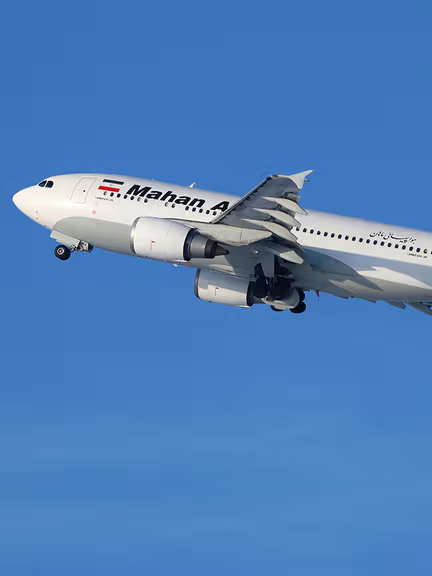

Iran will resume some international flights from Tehran’s Imam Khomeini Airport from Saturday, authorities said.
Flights to Istanbul and Muscat are set to restart as airspace reopens, with several Iranian carriers expected to operate the routes.
Passenger departures and arrivals have also resumed, with further flight schedules to be updated as new approvals are issued.







The US State Department said it is offering a reward of up to $10 million for information on Hashim Finyan Rahim al-Saraji, leader of the Iran-aligned militia Kata’ib Sayyid al-Shuhada (KSS).
In a notice issued through its Rewards for Justice program, the department said al-Saraji, also known as Abu Ala al-Wala’i, heads the group, which it accused of attacks on US personnel and facilities in Iraq and Syria, as well as violence against Iraqi civilians.
The notice said individuals providing information could be eligible for relocation and financial compensation.
Iranian officials rushed to present a unified front after US President Donald Trump questioned who leads the Islamic Republic, highlighting sensitivities over internal divisions and uncertainty at the top of the political system.
Trump wrote on Truth Social on Thursday that Iran was struggling to determine its leadership, pointing to what he described as infighting between “hardliners” and “moderates.”
“Iran is having a very hard time figuring out who their leader is! They just don’t know!” Trump wrote, adding that internal divisions were “crazy” and tied to battlefield losses and political rivalries.
The remarks came as the continued absence of new Supreme Leader Mojtaba Khamenei from public view and reported disputes over engagement with Washington have drawn scrutiny to internal dynamics within the Islamic Republic.
Officials project unity after remarks
An account attributed to Mojtaba Khamenei reposted part of his Nowruz message warning of “enemy psychological operations” aimed at undermining national unity and security.
Senior officials echoed similar messaging in coordinated posts. President Masoud Pezeshkian and parliament speaker Mohammad Bagher Ghalibaf wrote that distinctions between political factions were invalid.
“In Iran there are no ‘hardliners’ or ‘moderates’… We are all Iranians and revolutionaries,” they wrote, adding that unity and obedience to the Supreme Leader would ensure victory.
Judiciary chief Gholamhossein Mohseni Ejei described such labels as “fabricated and baseless,” saying all factions operate cohesively under the leadership.
Other figures, including senior military commanders and advisers, issued similar statements stressing allegiance to “one leader,” in what appeared to be a coordinated response.
Divisions persist over policy and negotiations
Despite the messaging, recent developments suggest internal disagreements remain. In March, Pezeshkian apologized for attacks attributed to Iranian forces on neighboring countries, attributing them to actors operating independently, drawing criticism from military-linked figures.
Conflicting signals also emerged last week over maritime policy, when Foreign Minister Abbas Araghchi announced the reopening of the Strait of Hormuz before the Islamic Revolutionary Guards Corps indicated renewed restrictions due to ongoing pressures.
Reports have also pointed to disputes over nuclear negotiations with the United States. According to information received by Iran International, disagreements between officials aligned with the government and figures linked to Mojtaba Khamenei disrupted plans for talks in Islamabad.
Sources familiar with the matter said negotiators were instructed not to engage on the nuclear file, prompting Araghchi to describe participation as “essentially futile” and warning that such a stance would end the process.
Earlier reporting also indicated that Ghalibaf criticized opponents of a deal with Washington in internal discussions, describing them as contributing to the country’s decline.
Pakistan’s capital remains under tight security lockdown despite no clear sign of imminent US-Iran talks, officials told Reuters, as authorities keep preparations in place for a possible meeting at short notice.
“We have been told that the talks could be held any day,” one official said.
Large parts of Islamabad, including key government areas, have been sealed off for a second week, disrupting transport, food supplies and daily life for residents.
The city was first locked down for an earlier round of talks that ended without a deal, and officials say the restrictions will remain in place as Pakistan awaits a second round that has yet to materialise.
Two men accused of carrying out surveillance on Jewish and Israeli-linked sites in London on behalf of Iran are due to appear at the Central Criminal Court on Friday for a preliminary hearing.
Nematollah Shahsavani, 40, and Alireza Farasati, 22, face charges under the UK’s National Security Act of engaging in conduct likely to assist a foreign intelligence service. Prosecutors allege the activity was carried out for Iran.
The pair are accused of conducting reconnaissance of multiple locations, including a synagogue, a Jewish community centre and sites linked to Israeli interests in London. The alleged surveillance is said to have taken place over several months.
Friday’s hearing before Mrs Justice Cheema-Grubb is procedural rather than substantive, meaning the court will not rule on guilt or innocence. Instead, it is expected to address case management issues, including how the trial will proceed, disclosure of evidence and the timetable for future hearings.
The defendants previously appeared at Westminster Magistrates’ Court, where the charges were first presented. Because the offences are indictable-only due to their seriousness, the case was referred to the Crown Court. Both men remain in custody and their cases are being heard together, indicating the allegations arise from closely linked facts.
Iran plans to include the recent war with the United States and Israel in school textbooks, the education minister said, referring to what officials call the “third imposed war,” the latest conflict now under a ceasefire extended by US President Donald Trump.
“We will try to ensure that the memory of the martyrs and the strength of the Islamic Republic in the third imposed war are properly reflected in our textbooks,” he said.
He added that a working group has been formed to incorporate accounts of the conflict, saying: “We are carrying out special work to include narratives… from parts of the third imposed war and the martyrdom of the leader.”
“We will present this history using all available capacities and pass it on to the new generation,” he said.
The move builds on an expanding state-led effort to shape war narratives in education. Last year, authorities introduced new curriculum materials portraying a previous conflict with Israel as a national success, aiming to strengthen unity, patriotism and deterrence among students.
Those materials included lessons linking military strength with national identity and encouraging students to engage with themes of defense, science and resistance, reflecting a broader push to embed state ideology and wartime messaging in classrooms.