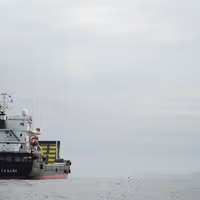
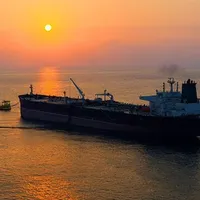
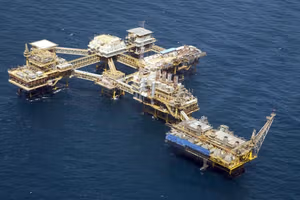
The blockade, targeting Iranian ports and imposing partial restrictions in the Strait of Hormuz, took effect at 10 a.m. Eastern Time.
Iran’s heavy reliance on southern shipping lanes leaves its economy exposed to maritime disruption, with more than 90% of its $109.7 billion annual trade passing through the Strait of Hormuz.
The blockade is expected to cut off nearly all of Iran’s seaborne trade, wiping out an estimated $435 million in daily economic activity and forcing oil field shutdowns within weeks.
A blockade would effectively zero out Iran’s export revenues within days and trigger cascading effects across its financial system.
Oil exports would be hit first
Crude oil shipments would be the first and most severe casualty. Iran has been exporting roughly 1.5 million barrels per day, generating about $139 million daily based on wartime pricing assumptions.
Nearly all of that volume departs via Kharg Island, which handles over 90% of crude exports and lacks viable alternative routes outside the Persian Gulf.
A blockade would eliminate these flows almost immediately, cutting off the Islamic Republic’s primary source of foreign currency earnings.
Petrochemicals and non-oil trade
Petrochemical exports, valued at roughly $54 million per day based on recent trade data, would also be halted. Facilities at Assaluyeh, Imam Khomeini, and Shahid Rajaei ports all sit within the Persian Gulf and depend on uninterrupted maritime access.
Non-oil exports – including minerals and metals – would see similar disruption. Of approximately $88 million in daily shipments, around 90% would be blocked, removing another $79 million a day in revenue.
Ports play a central role in this vulnerability. Shahid Rajaei alone handles more than half of Iran’s cargo operations, while Imam Khomeini is a key entry point for basic goods imports.
Bushehr ports handled about 57 million tons of cargo last year, underscoring how deeply Iran’s trade is concentrated in southern waters.
Limited alternatives beyond the region
Efforts to develop alternative export routes appear insufficient to offset losses.
The Jask terminal, designed as a bypass to Hormuz, operates far below its intended capacity, with effective throughput estimated at around 70,000 barrels per day.
Chabahar port and Caspian Sea facilities handle only a fraction of the volumes moved through Persian Gulf ports.
Combined, these routes could replace less than 10% of current volumes.
Imports and inflation pressures intensify
On the import side, Iran brings in about $159 million in goods daily, including industrial inputs, machinery, and food.
Disruptions to these flows would likely accelerate inflation, which has already surged. Food prices have risen sharply, with staple items such as rice increasing up to sevenfold in recent months.
Any interruption to imports would deepen supply shortages and place further strain on household purchasing power.
Storage limits create shutdown risk
A critical constraint lies in Iran’s oil storage capacity.
Iran has approximately 50–55 million barrels of onshore oil storage capacity, about 60% of which is already filled. Spare capacity stands at around 20 million barrels.
With surplus production of 1.5 million barrels per day that is normally exported, this capacity would be filled in about 13 days. After that, Iran would be forced to shut in oil wells.
This is highly significant because when mature oil wells are shut, water from below can intrude into the reservoir – a process known as “water coning.”
In this situation, some of the oil becomes permanently trapped within rock pores and can no longer be recovered. Iran’s oil fields are already declining at a rate of 5–8% per year.
Forced shutdowns could permanently eliminate 300,000 to 500,000 barrels per day of production capacity – equivalent to $9–15 billion in annual revenue lost forever.
Currency faces renewed pressure
The loss of export revenues would also affect Iran’s currency markets.
The rial has already weakened sharply, trading near 1.6 million per dollar in unofficial markets, with inflation running close to 50%.
A halt in foreign exchange inflows would likely intensify depreciation, further limit access to cash, and could push the currency toward hyperinflation.
Banks have already imposed withdrawal limits, reflecting existing financial strain.
Economic pressure builds rapidly
Taken together, the figures suggest a blockade would impose roughly $13 billion in monthly economic damage, combining export losses and disrupted imports.
Iran’s economic structure, heavily dependent on the Persian Gulf transit routes and energy exports, makes continued resistance economically impossible under the US naval blockade.
The figures show how quickly pressure could build if shipping lanes are closed, with immediate fiscal impacts followed by longer-term damage to production capacity and financial stability.