FILE PHOTO: Luojiashan tanker sits anchored in Muscat, as Iran vows to close the Strait of Hormuz, amid the US-Israeli conflict with Iran, in Muscat, Oman, March 7, 2026
Iran’s plans to reduce its reliance on the Strait of Hormuz appear to have delivered little practical change so far, according to tanker-tracking data from Kpler obtained by Iran International.
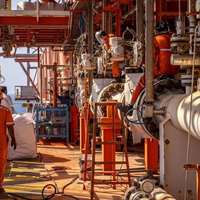
For more than a decade, Tehran has invested heavily in the Jask oil terminal, a project designed to shift part of its crude exports to the Gulf of Oman and create an alternative export route outside the Persian Gulf in times of crisis. Yet the data suggests the terminal has so far played only a marginal role in Iran’s export system.
According to Kpler data, Iran loaded an average of about 1.84 million barrels per day (bpd) of crude during the first 25 days of March. The contribution of the Jask terminal remained minimal.
Average loadings from Jask stood at roughly 81,000 bpd during this period—less than 5% of Iran’s total crude exports.
Historical patterns suggest this limitation may be structural. Iran first initiated exports from Jask in October 2024 amid heightened military tensions with Israel. Even then, volumes remained modest at around 77,000 bpd. In March 2025, exports from the terminal averaged roughly 54,000 bpd.
This is despite the fact that Jask is connected to Iran’s main oil-producing regions through a pipeline stretching nearly 1,000 kilometers, an infrastructure investment intended to enable significant export capacity outside the Persian Gulf.
In practice, Iran’s dependence on Kharg Island remains overwhelming.
Kpler data indicates that more than 84% of Iran’s oil exports in March were loaded from Kharg, while Jask accounted for just 4.4%. Another roughly 10% originated from the Soroush and South Pars terminals in the Persian Gulf.
Such concentration creates a clear strategic vulnerability: any disruption at Kharg could severely cripple Iran’s oil exports.
The question has gained renewed relevance as the war between Iran and the United States and Israel has intensified. The Strait of Hormuz—through which roughly a fifth of global oil trade passes—has become a central point of tension, with Tehran periodically restricting maritime traffic.
At the same time, reports have emerged of expanding US military operations in the region, including contingency planning involving strategic islands near the Strait of Hormuz that could be used to control access to the waterway.
In such a scenario, Iran’s continued reliance on export infrastructure concentrated around Kharg would leave its oil trade exposed to disruption.
Overall, the export data underscores a fundamental reality: despite years of investment, Iran has not succeeded in meaningfully reducing its dependence on the Strait of Hormuz—or, more critically, on the Kharg export hub.
In a volatile regional environment, that dependence represents a significant structural weakness.
Former Iranian diplomats are warning that the war between Iran, the United States and Israel could fundamentally reshape the Middle East’s security order, with some predicting a prolonged conflict and deeper regional instability.
The comments come as U.S. President Donald Trump said Thursday he would pause planned strikes on Iran’s energy infrastructure for 10 days until April 6, saying the move followed a request from Tehran and that negotiations were continuing.
Iranian officials have confirmed receiving proposals for talks but say they are reviewing them while insisting Iran will not accept ultimatums.
The war, now entering its fourth week, has already drawn in multiple regional actors and heightened tensions around strategic chokepoints such as the Strait of Hormuz, raising concerns that a wider confrontation could disrupt global energy flows and destabilize the region further.
Saba Zanganeh, a former diplomat close to the office of Iran’s Supreme Leader, told the moderate outlet Fararu on March 25 that the conflict should prompt regional governments to reconsider their security policies and alliances.
He said regional governments have often acted as secondary players under foreign influence, worsening conflicts rather than resolving them. The current war, he added, offers a stark lesson that continuing the existing model will deepen regional crises.
He argued that decades of instability stem from what he described as “a flawed strategic paradigm shared by regional states and external powers,” which he said has repeatedly produced destruction and fragmentation in countries including Iraq, Syria, Lebanon, Libya, Sudan, Somalia and Yemen.
Hossein Mousavian, Iran’s former ambassador to Germany, offered a more confrontational assessment.
Speaking to Etemad Online, he said Iranian officials increasingly view Persian Gulf Arab states as partners in the conflict, sharing what he described as a common objective of the “complete destruction of Iran.”
Mousavian said Tehran is preparing for the possibility of a broader confrontation involving the United States and its regional allies.
Another former diplomat, Kourosh Ahmadi, suggested the conflict may last far longer than initially expected.
Speaking to Fararu, he noted that both Trump and Israeli Prime Minister Benjamin Netanyahu first suggested the war might last only four to seven days before revising their estimates to several weeks. Even those expectations may prove unrealistic, he said.
Ahmadi pointed to Iran’s ability to restrict or control shipping in the Strait of Hormuz as a decisive factor in prolonging the conflict. As long as Tehran maintains that leverage over one of the world’s most critical energy chokepoints, he argued, the war is unlikely to end quickly.
“Israel seeks the collapse and incapacitation of Iran, not merely political concessions,” he said, arguing that Washington’s goals were more limited and often diverged from that of Israel.
Despite their different emphases, the three former diplomats share a similar underlying assessment: the current conflict risks evolving into a prolonged regional crisis whose consequences could reshape the Middle East for years.
President Donald Trump said Thursday that the United States is engaged in serious negotiations with officials in Tehran, but vowed to keep striking Iran for the time being.
“We have very substantial talks going on with respect to Iran, with the right people,” Trump told reporters at a Cabinet meeting, signaling that diplomatic channels remain open despite the ongoing conflict.
The president pointed to what he described as a recent gesture involving oil tankers in the Strait of Hormuz as evidence that the interlocutors involved in the discussions hold influence inside Iran’s leadership.
“They said, to show you that we’re real and solid and we’re there, we’re going to let you have eight boats,” Trump said, referring to oil tankers transiting the strategic waterway.
He added that the number later increased to 10 vessels, suggesting to him that those involved in the talks had the authority to deliver concrete steps.
Steve Witkoff, the US envoy involved in the diplomatic effort, said Washington has presented Iran with a 15-point framework for a potential peace agreement, describing it as the basis for ongoing discussions.
Witkoff said the proposal had been circulated through intermediaries and that talks were producing what he called “strong and positive messaging,” though he said the administration would keep the details confidential.
Iranian officials have confirmed that they have received proposals from the United States and said they are reviewing them, though they have not publicly described the terms or acknowledged direct negotiations.
The diplomatic signals come against the backdrop of continued military escalation. Friday will mark four weeks since the United States and Israel launched strikes on Iran, after negotiations that Witkoff said on Thursday had been going nowhere.
It also marks the end of a five-day extension announced by Trump this week to his deadline for Tehran to reopen the Strait of Hormuz or face airstrikes on Iranian power plants.
When asked whether the deadline remained in effect through Friday, Trump declined to give a clear answer.
Efforts to arrange another round of talks also appear uncertain.
Pakistan’s foreign minister said Thursday that expectations for negotiations in Islamabad this weekend may be premature, cooling speculation that the two sides could meet there in the coming days.
Pentagon officials have confirmed that additional troops are being moved into the Middle East, and Axios reported Thursday that Trump has been presented with military options that include strikes on Iranian targets and the potential seizure of strategic islands.
Trump did not rule out further escalation when asked about the possibility of taking control of Iranian oil resources, similar to what the United States attempted in Venezuela.
Brief concern in Turkey this week over a halt in Iranian gas flows quickly gave way to official reassurances, but the episode exposes deeper limits in Iran’s ability to sustain exports even to key regional partners.
On March 24, reports indicated that Iran had suspended natural gas exports to Turkey following damage to facilities at the South Pars gas field after a March 18 strike. The disruption affects flows that accounted for roughly 14% of Turkey’s gas supply in 2025.
While Ankara’s response was swift and reassuring—with officials stressing that storage, diversification, and system flexibility prevented supply problems—the episode reveals a deeper issue on the Iranian side.
The halt is not simply a temporary interruption; it reflects structural constraints within Iran’s gas sector that limit its ability to sustain exports even to key regional partners.
A system under strain
The disruption originates from damage to South Pars, the world’s largest gas field and the backbone of Iran’s energy system. Because most of its output is consumed domestically, Iran operates with minimal export flexibility. Even limited disruptions can force immediate cuts to external deliveries.
Despite holding the world’s second-largest gas reserves, Iran has struggled to translate resource abundance into export capacity due to sanctions, underinvestment, and rising domestic demand.
As a result, exports to Turkey via the Tabriz–Ankara pipeline have often been inconsistent, with repeated disruptions over the past decade linked to technical issues and winter shortages.
In practice, Iran’s gas exports function less as a strategic tool than as a residual output constrained by domestic priorities.
Asymmetry
Energy relations between Iran and Turkey have long been framed as mutually beneficial: Iran gains export revenue while Turkey secures relatively affordable pipeline gas. In reality, the relationship is asymmetrical.
Iranian gas typically accounts for around 7–8 billion cubic meters annually. It is an important but non-dominant share of Turkey’s supply mix. Turkey’s broader portfolio, including Russia, Azerbaijan and LNG imports, limits dependence on any single supplier.
For Iran, by contrast, Turkey represents one of the few stable export outlets available under sanctions.
This imbalance becomes clear during disruptions. While Turkey can replace lost volumes through alternative sources, Iran cannot easily offset lost exports or the reputational damage that follows.
The timing is also significant. Turkey’s long-term gas contract with Iran is due to expire in mid-2026, and renegotiation was already expected to involve reduced volumes. Repeated supply interruptions are likely to strengthen Ankara’s bargaining position and further weaken Iran’s leverage.
Credibility and market impact
Turkey’s ability to absorb the disruption reflects years of diversification. The country consumes more than 50 bcm of gas annually and can draw on multiple pipeline suppliers as well as LNG imports.
Substitution, however, carries economic costs. Iranian pipeline gas has historically been cheaper than spot LNG, meaning replacement supplies raise import expenses.
Spot LNG prices in the Mediterranean have already risen amid broader geopolitical tensions, implying higher energy bills for Turkey if the disruption persists.
Yet these dynamics also underline Iran’s limited influence. Supply interruptions may impose short-term costs, but they do not create dependency. Instead, they highlight Turkey’s ability to adapt while reducing Iran’s strategic relevance over time.
In energy markets, credibility is as important as capacity. Repeated disruptions—whether caused by infrastructure damage, domestic shortages, or external shocks—undermine confidence in Iran as a dependable supplier.
Unlike major exporters such as Qatar or the United States, which maintain surplus capacity and flexible supply chains, Iran operates with structural constraints that limit responsiveness.
Turkey’s gas disruption therefore reveals more about Iran than about Turkey. Despite vast reserves, Iran lacks the infrastructure, investment and flexibility needed to turn those resources into consistent geopolitical influence.
Rather than demonstrating strength, the episode highlights constraint. Turkey’s ability to adapt reduces Iran’s leverage, while recurring supply interruptions erode its credibility as a regional energy partner.
In today’s energy landscape, influence depends not only on resources but on reliability—and that is where Iran continues to fall short.
Iranian police said on Thursday they had blocked 61 bank accounts belonging to users of Starlink satellite internet in the central city of Yazd, as part of a broader crackdown on unauthorized connectivity.
A local police commander said six Starlink devices were seized and six people detained following searches carried out with judicial approval.
Authorities accused the suspects of trading access to the service, sharing information with foreign-based outlets and engaging in activities deemed hostile. The individuals were referred to prosecutors, police said.
The move comes amid a broader wave of arrests across Iran, with authorities detaining dozens in recent days on security-related charges, including alleged links to militant activity, contacts with foreign media and online activity. Officials have also reported seizing weapons, explosives and Starlink devices in multiple provinces.
Starlink is banned in Iran, where authorities have imposed a near-total internet blackout during the war. Monitoring group NetBlocks says connectivity has dropped to around 1% of normal levels, leaving satellite services among the few ways to access the global internet.
Iran’s economy is no longer merely experiencing high inflation; it is exhibiting the structural symptoms of a nation losing faith in its own currency and facing a shift in its monetary regime.
Over the past year, a pattern has emerged across markets, policy decisions and price behavior pointing to the early stages of de facto dollarization.
In April 2025, when a “five-dollar pizza” shop opened in Tehran’s affluent Niavaran neighborhood, many dismissed the fixed dollar price as a marketing gimmick. At the time, one pizza cost roughly 5 million rials, with inflation reportedly above 40%.
Less than a year later, on the eve of the current war, the same pizza was priced at 8.6 million rials, while officials acknowledged inflation exceeding 70%. What initially appeared symbolic began to look practical.
The shift was not confined to niche businesses and high-end stores. Informal dollar transactions, once largely limited to luxury goods or services aimed at foreign customers, steadily expanded.
In the months leading up to the 12-day war, despite the departure of many foreign nationals, dollar-pegged property sales and rentals increased noticeably. While upscale properties led the trend, mid-range apartments also entered the market with dollar-based pricing.
By the end of 2025, the US dollar had climbed to 1,430,000 rials, up from 800,000 in January of the same year. The volatility hit the automotive market hard. With car production concentrated among three major state-linked manufacturers and supply unable to meet demand, the price of second-hand cars in rial terms outpaced the increase in the dollar exchange rate.
Media headlines read, “The dollar is in the driver’s seat,” and traders increasingly priced vehicles in dollars. In December, automobile market expert Abdollah Babaei warned that if current trends continued, car transactions would effectively become dollarized.
Economists began warning of a structural shift. Former Tehran Stock Exchange chief Hossein Abdeh Tabrizi cautioned that Iran "will enter the stage of dollarization" if 60% inflation and government overspending continued.
he statement went viral, and many echoed the growing concern that “Iran’s economy is on a dangerous path,” with the rial losing its function both as a store of value and as a unit of account.
Government policy after the 12-day war reinforced these anxieties.
The administration’s 2026–2027 budget introduced three pivotal shifts. First, gasoline subsidies moved from a liter-based rationing system to cash transfers. Second, an inflation coefficient was added to the pricing formula of Iran’s key commodity anchor. Third, the preferential exchange rate was abruptly removed in December, converting the government’s largest dollar commitment into rial-based direct subsidies.
Perhaps most striking was the historic decline in oil revenue’s share of the budget—from about 32% in 2025–2026 to just 5% in 2026–2027, the lowest level since the 1960s.
To compensate, taxes were increased by more than 60%. Across these measures, the common denominator was clear: the state systematically reduced its foreign-currency and commodity obligations, converting them into rial-based commitments. The administration that campaigned on taming inflation now appeared increasingly reliant on inflationary financing to navigate wartime pressures.
In February, before the outbreak of the second war, average inflation for basic necessities reached triple digits, estimated between 105% and 115%. Reacting to these concerns, the administration pushed to remove four zeros from the rial, presenting it as a technical reform to simplify calculations.
In reality, redenomination in a high-inflation environment is an expensive cosmetic surgery on a patient on his deathbed—an adjustment that quickly loses meaning as prices continue to rise.
During the second war, market closures, the suspension of price discovery in the exchange market, and reduced demand slowed money circulation and provided short-term inflationary relief. At the same time, large banks halted operations, increasing demand for physical cash.
The Central Bank responded by issuing a 10-million-rial banknote—raising the highest denomination one hundredfold from 100,000 rials—a step it had resisted for years.
But such pauses rarely eliminate underlying pressures. When markets fully reopen and normal trading resumes, deferred demand for foreign currency is likely to return. A similar pattern followed the 12 day war, when pent-up demand translated into a rapid adjustment in prices once restrictions eased.
Even under conservative assumptions, inflation could move decisively into triple-digit territory if monetary expansion continues. At that point, the shift toward dollar pricing would no longer be limited to select sectors. It would spread more systematically across contracts, wages and savings behavior.
Dollarization rarely begins with legislation; it begins with economic self-preservation. It starts with a pizza menu, moves to apartment contracts and car listings, and eventually reshapes fiscal expectations.
If post-war reopening triggers another inflationary wave, the timeline may not be measured in years but in quarters. Under such conditions, the transition toward de facto dollarization would become increasingly difficult to reverse.