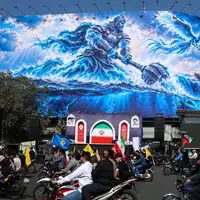
Over 4,700 security forces killed in US-Israeli strikes on Iran


At least 4,770 members of the IRGC, Basij, and police have been killed since the start of the war in attacks by Israel and the United States, Iran International has learned.
The sources said 20,880 others have also been injured.







Serious disagreements have emerged between Iran’s President Masoud Pezeshkian and IRGC chief-commander Ahmad Vahidi over how to manage the war and its damaging impact on people’s livelihoods and the economy, sources with knowledge of the matter told Iran International.
Pezeshkian has criticized the approach of the Islamic Revolutionary Guard Corps regarding escalating tensions and continuing attacks on neighboring countries, warning about the economic consequences of the situation, according to the sources who spoke on condition of anonymity.
He has stressed that without a ceasefire, Iran’s economy could face total collapse within three weeks to one month, the sources said.
On March 7, Pezeshkian in a video message apologized for what he called “fire at will” attacks by the country’s armed forces on neighboring countries and instructed them to stop such attacks.
However, the attacks continued shortly after the release of his message.
Call for restoration of executive power
Informed sources told Iran International that Pezeshkian has called for executive and managerial powers to be returned to the administration, a demand that has been firmly rejected by Vahidi.
In response to the criticism, the IRGC commander blamed the current situation on the government’s failure to implement structural reforms before the conflict began, the sources said.
In recent days, Israeli media have also reported signs of divisions within Iran’s ruling system. The Times of Israel, citing a senior Israeli official, wrote: “There are signs of cracks in the Iranian regime. We are now creating conditions for its overthrow, but ultimately everything depends on the Iranian people.”
The Israeli outlet Ynet also reported similar internal divisions earlier this month.
Economic impacts
As the war enters its fifth week, its economic effects are increasingly visible. Reports from major cities indicate that many ATMs are out of cash, not functioning, or physically inaccessible, while online banking services for several major banks, including Bank Melli, are periodically disrupted.
Government employees have told Iran International that salaries and benefits for large segments of workers have not been paid regularly over the past three months.
In February, before the outbreak of the ongoing war, average inflation for basic necessities reached triple digits, estimated between 105% and 115%.
Masoud Pezeshkian appointed Mohammad Bagher Zolghadr as secretary of Iran’s Supreme National Security Council under direct pressure from senior commanders of the Islamic Revolutionary Guard Corps, including newly installed IRGC chief Ahmad Vahidi, according to informed sources.
The sources, who spoke on condition of anonymity due to the sensitivity of the matter, said the appointment was imposed on Pezeshkian and other members of the council amid intensifying internal struggles within the Islamic Republic’s new leadership and as part of the IRGC’s effort to consolidate full control over power.
According to the sources, following the killing of Ali Larijani—and with no visible sign of Mojtaba Khamenei participating in decision-making—the IRGC selected Zolghadr as the new secretary of the Supreme National Security Council.
Despite opposition from some remaining senior officials and Pezeshkian’s own dissatisfaction, the Guards compelled the president to issue the appointment decree.
Mehdi Tabatabaei, deputy for communications and information at Pezeshkian’s office, confirmed the appointment on Tuesday in a post on X, writing: “With the opinion and approval of the esteemed leader of the Islamic Revolution, and by decree of President Masoud Pezeshkian, Mohammad Bagher Zolghadr has been appointed secretary of the Supreme National Security Council.”
Sources told Iran International that the move reflects the diminishing role of Pezeshkian’s government and other power centers within the Islamic Republic’s highest security decision-making body.
It also highlights the IRGC’s expanding dominance over the country’s power structure, particularly over the Supreme National Security Council.
Mohammad Bagher Ghaziani, better known as Mohammad Bagher Zolghadr, currently also serves as secretary of the Expediency Council. In 2021 he replaced Mohsen Rezaei in that position by decree of Sadegh Amoli Larijani.
Following the killing of Mohammad Pakpour, Ahmad Vahidi was introduced as commander-in-chief of the IRGC, although no formal appointment decree signed by Mojtaba Khamenei—the Islamic Republic’s new leader and commander-in-chief—has been made public.
Vahidi Shahcheraghi, known as Ahmad Vahidi, had previously been appointed deputy commander of the IRGC by former Supreme Leader Ali Khamenei on December 27, 2025, replacing Ali Fadavi. After Hossein Salami was killed during the 12-day war, Ali Khamenei had named Mohammad Pakpour as IRGC commander-in-chief.
Despite the absence of any publicly released decree signed by Mojtaba Khamenei, Vahidi has now been introduced as commander-in-chief of the IRGC.
At the same time, Mohsen Rezaei, a former IRGC commander, has reportedly been appointed as Mojtaba Khamenei’s military adviser under a decree attributed to the new leader.
Since Mojtaba Khamenei was introduced as the Islamic Republic’s third supreme leader, he has not appeared in public, and only a few written messages attributed to him have been released.
US President Donald Trump and senior members of his administration—including Vice President J.D. Vance and Defense Secretary Pete Hegseth—have said Mojtaba Khamenei is alive but seriously wounded. They have also emphasized that there is no sign of him actively exercising authority in the Islamic Republic.
Senior Israeli officials, including Prime Minister Benjamin Netanyahu, have likewise reported that Mojtaba Khamenei was injured and warned that there is no guarantee he will survive.
Staff of an Iranian hospital in Dubai have vacated accommodation linked to the facility after an order by authorities in the United Arab Emirates, Iran International has learned.
Residents were initially given one month to leave, but the deadline was cut to one week after the hospital was shut. Doctors, nurses and other staff living in the housing began leaving on Tuesday, and the evacuation was completed on Wednesday.
The visas of some employees whose residency was tied to the hospital were canceled. Those affected have had to return to Iran through third countries, including Afghanistan.
Earlier, housing linked to Iranian schools in Dubai was also vacated after those schools were shut, and staff returned to Iran.
A missile fired from Iran struck Lebanon’s coast hours after Beirut expelled Tehran’s ambassador, sources told Iran International, contradicting earlier reports that it had been intercepted.
The projectile was not intercepted in Lebanese airspace and instead landed on the coast, according to Iran International sources, disputing earlier reporting by Reuters.
The strike came shortly after Lebanon declared Iran’s ambassador to Beirut, Mohammad Reza Raouf Sheibani, persona non grata and ordered his expulsion.
Lebanese Foreign Minister Youssef Raggi said on X that the decision had been formally communicated and that the envoy must leave the country by March 29.
Lebanon also recalled its ambassador from Tehran for consultations, accusing Iran of violating diplomatic norms and established protocols between the two countries.
Israel’s military said that, based on its assessments, a ballistic missile launched from Iran fell in Beirut around the same time as missile attacks targeting Israel. In a statement, the army said the projectile was fired by the “Iranian regime” and landed inside Lebanon.
Diplomats from several Persian Gulf states told Iran International on Tuesday that Tehran was acting like a “runaway horse,” warning that attacking another Arab country crossed a new red line and would not be tolerated.
According to Iran International sources, since the start of the current conflict following US and Israeli strikes in early March, Iran has targeted at least 12 countries in the region. Lebanon is now the 13th.
Reactions to Lebanon’s move were swift. Israel’s President Isaac Herzog called the expulsion a “very courageous decision,” according to Israeli media. Foreign Minister Gideon Sa'ar welcomed the move, describing it as “justified and necessary” in response to Iran’s actions in Lebanon, including its backing of Hezbollah.
Israeli Defense Minister Israel Katz said Israel would continue its attacks against Iranian positions “with full force.”
Hezbollah condemned the decision, warning it could undermine national unity and deepen internal divisions.
Meanwhile, Bloomberg reported on Tuesday that Saudi Arabia and United Arab Emirates are growing increasingly impatient after attacks on energy infrastructure and airports, and could join US- and Israeli-led strikes if Iran targets critical facilities.
Several safe houses in Tehran were targeted in attacks early on Monday, according to reports received by Iran International, as security deployments intensified across the country.
The strikes hit locations in multiple parts of the capital, including Aghdasieh, Majidiyeh and Chizar. It was not immediately clear who had been staying at the sites at the time of the attacks.
The strikes came as eyewitness accounts described a growing security presence nationwide from late Sunday into early Monday, with Basij patrols and checkpoints reported in several cities.
In Tehran, security forces were seen stationed in Park-e Shahed, while witnesses reported the movement of vehicles marked as “Basij Patrol,” contributing to a heavy security atmosphere.
Checkpoints were also reported at the entrances to the industrial town of Arak and across the northern city of Rudsar, while in Sari, witnesses said IRGC forces and equipment had been repositioned within the city.