Strikes hit Tehran safe houses as checkpoints spread nationwide

Several safe houses in Tehran were targeted in attacks early on Monday, according to reports received by Iran International, as security deployments intensified across the country.

Several safe houses in Tehran were targeted in attacks early on Monday, according to reports received by Iran International, as security deployments intensified across the country.
The strikes hit locations in multiple parts of the capital, including Aghdasieh, Majidiyeh and Chizar. It was not immediately clear who had been staying at the sites at the time of the attacks.
The strikes came as eyewitness accounts described a growing security presence nationwide from late Sunday into early Monday, with Basij patrols and checkpoints reported in several cities.
In Tehran, security forces were seen stationed in Park-e Shahed, while witnesses reported the movement of vehicles marked as “Basij Patrol,” contributing to a heavy security atmosphere.
Checkpoints were also reported at the entrances to the industrial town of Arak and across the northern city of Rudsar, while in Sari, witnesses said IRGC forces and equipment had been repositioned within the city.





Cases tied to the January protests have been reviewed, with some reaching final verdicts and now being carried out, Iran’s judiciary said on Monday, warning that those convicted would face no leniency.
“The cases of enemy terrorist elements and the January unrest protesters have been reviewed. Some of these cases have resulted in final verdicts and are being carried out, and several have been implemented in recent days, with further information to be announced.” the first deputy judiciary chief said.
Hamzeh Khalili said those convicted would not receive any clemency and added that the judiciary would deal harshly with people the judiciary has accused of collaborating with the enemy.
In recent weeks, Iranian authorities have stepped up executions and security measures linked to the January protests, drawing criticism from rights groups and foreign governments.
On March 19, three protesters – Mehdi Ghasemi, Saleh Mohammadi and Saeed Davoudi – were executed after being accused of killing two police officers during protests in Qom earlier in the year, according to the judiciary-linked Mizan news agency. Authorities also alleged the three had links to Israel and the United States, a recurring accusation against protesters.
A day earlier, Mizan reported the execution of Kourosh Keyvani, a Swedish-Iranian dual national convicted of espionage for Israel. Swedish Foreign Minister Maria Malmer Stenergard said a Swedish citizen had been executed and criticized the legal process as falling short of due process standards.
The crackdown has extended beyond the courtroom. Iran has been under a nationwide internet blackout lasting more than three weeks, with international connectivity largely unavailable to the public, according to NetBlocks, limiting access to information during the ongoing crisis.
The executions follow a broader and far deadlier wave of repression. Documents reviewed by Iran International show that more than 36,500 people were killed during a two-day crackdown on protests on January 8–9, in what would mark the deadliest protest suppression in modern history.
Reports and evidence also point to extrajudicial killings of detainees, including cases in which wounded individuals were allegedly shot while receiving medical treatment.
More than 1,400 civilians have been killed in Iran during the first three weeks of the war with the United States and Israel, according to figures compiled by the rights group HRANA.
The Iran-focused Human Rights Activists News Agency (HRANA) said in a report on Sunday that it had confirmed at least 1,407 civilian deaths since the war began on Feb. 28, including at least 214 children.
Iran International could not independently verify the figures.
HRANA said the numbers are based on incidents documented across the country and compiled through the organisation’s network of field sources, local contacts and publicly available evidence such as images and videos.
HRANA has documented human rights abuses and state repression in Iran for more than a decade through a network of activists and researchers.
Military officials in Washington say Iranian forces have increasingly launched missiles and drones from populated areas, putting civilians at risk.
US Central Command chief Vice Adm. Brad Cooper told Iran International on Sunday that the Islamic Republic could end the war at any time if it chose to do so.
Tehran province accounted for the largest share of recorded incidents, according to HRANA’s preliminary analysis, with about 39 percent of attacks, followed by Hormozgan province on the shores of the Persian Gulf.
The organization also recorded 657 deaths whose status could not yet be determined—military or civilian.
Iran’s health ministry said around 210 children have been killed and that more than 1,500 people under the age of 18 have been injured. It also said 300 health and emergency facilities had been damaged during the fighting.
Some of the damaged sites appeared to fall under categories protected by international humanitarian law, including residential buildings, sports facilities and power plants, according to HRANA.
In several cases, the damage appeared to have been caused by nearby strikes or secondary effects rather than direct targeting.
Human rights groups say the true toll of the war may be significantly higher, as ongoing hostilities, communication disruptions and restricted access to affected areas have made it difficult to verify casualties in real time.
An Israeli security insider says Iran could be weeks away from reaching conditions for an uprising, as the US and Israel may soon judge the Islamic Republic weak enough to call on Iranians to take to the streets.
The current trajectory of the US-Israeli war against the Islamic Republic is rapidly weakening the regime, said Brigadier General (res.) Amir Avivi, CEO of the Israel Defense and Security Forum, an influential body that advises the Israeli government on security matters.
“It’s a matter of weeks until the US and Israel will assess that this regime is weak enough,” Avivi told Eye for Iran podcast.
“And then there will be a call to the Iranian people to go to the streets and take over the country.”
“And when they will do that,” he added, “above their heads, there will be Israeli drones and American capabilities defending them from the air — and any attempt to hit the Iranian people will be met by an attack.”
From containment to collapse
Avivi described the war as unfolding in stages — from Hamas, to Hezbollah, to the fall of Assad's Syria and the Houthis — and now entering what he called its decisive phase: Iran itself.
Earlier stages focused on weakening those forces. Now, he said, the objective has shifted.
“This is about bringing down the Iranian regime.”
He pointed to the scale of the ongoing campaign, saying tens of thousands of targets have been struck, including air defenses, missile systems and naval assets — alongside sustained pressure on the regime’s internal enforcement arms.
“We are now attacking in Tehran Basij forces who are standing in junctions, monitoring society,” he said. “We’re dismantling all the Basij bases and the Revolutionary Guards.”
Breaking the regime’s grip
According to Avivi, the key to creating conditions for an uprising lies in dismantling the regime’s ability to control and repress its population.
“It’s about destroying the command and control of the Revolutionary Guards and the Basij forces,” he said. “Eliminating their motivation to fight.”
He said there are already signs of strain within the system.
“We see defection in many units. Some units you have 90 percent defection,” Avivi said.
At the same time, he pointed to deepening economic pressure.
“There is a siege on Iran. They are not trading. How long can a country continue with no import, no export?” he said. “The currency is broken… it’s obvious where this is going.”
Larijani’s killing sends a signal
Avivi said the killing of Ali Larijani sends a clear message about the endgame — rejecting any scenario in which figures from within the Islamic Republic remain in power under a rebranded system.
He said the issue had come up directly in a recent high-level conversation.
“I met this week with a very, very prominent diplomat who asked me at length whether maybe Larijani will be the solution,” Avivi said — referring to the idea that a figure seen by some as more “moderate” could emerge as a compromise.
Avivi dismissed that notion outright.
“The guy is not moderate at all — not at all,” he said.
He argued that targeting Larijani underscores a broader objective.
“None of these leaders in this vicious regime can be rulers the day after,” he said. “Iran needs completely different leadership… a more open, more liberal country.”
He framed the strategy as one in which Israel and the United States set the conditions — but the decisive moment must come from within.
“Changing the regime is up to the Iranian people,” he said.
Signs of strain — but not collapse yet
That assessment is partially echoed by investigative journalist David Patrikarakos, who told Eye for Iran that sources describe a regime under pressure, with its security apparatus showing signs of disarray.
“They paint a picture of a regime in disarray,” he said, citing what he described as the “surgical decapitation” of layers of the security structure.
But he cautioned that internal fractures remain limited for now.
“We’re hearing reports… in the dozens… of people being killed for disobeying orders, people trying to defect,” he said. “I’ve not been told that it’s on a big scale.”
Patrikarakos said the real test will come later.
“To judge the success of this campaign, we’ve got to see what happens when the shooting stops — and what happens inside Iran.”
Washington’s next phase: the nuclear question
Investigative journalist Jay Solomon said sources in Washington suggest the next phase may focus on ensuring Iran cannot rebuild its nuclear program.
That includes concern over highly enriched uranium believed to be hidden in deeply buried sites such as Pickaxe Mountain.
“If they really decide they want to go in and secure that material, I don’t think there’s any other way,” Solomon said — referring to the possibility of US special forces entering underground facilities, an operation he described as “extremely dangerous.”
He also pointed to potential operations targeting Kharg Island, a key oil export hub tied to IRGC revenues.
But Solomon raised a critical concern: what comes after military success.
“The military side has been planned,” he said. “The post-conflict side is still very much up in the air… and that’s a concern.”
Despite those uncertainties, Avivi was unequivocal about where he believes events are heading.
“I foresee a change of regime,” he said. “This regime is not going to stay.”
And for Avivi, the broader objective goes far beyond Iran itself.
“The goal is clear,” he said. “To dismantle our enemies and change completely the Middle East for generations to come.”
The commander of US Central Command said Iran has increasingly targeted civilian sites across the Middle East out of "desperation" as its military capabilities deteriorate in the third week of the war.
"They're operating in a sign of desperation... In the last couple of weeks, they've attacked civilian targets very deliberately, more than 300 times," Adm. Brad Cooper said in an interview with Iran International.
Cooper also said Iran’s strain has reduced the volume of its attacks.
“At the beginning of the conflict, you saw large volumes in the dozens of drones and missiles. You no longer see that. It’s all one or two at a time,” Cooper said this in his first interview since the start of the war between Iran and the United States on Feb. 28.
Iranian officials have vowed to sustain a prolonged conflict and deny that their military capabilities are fading.
In one of its most severe attack on Israel to date, Iran targeted the Israeli towns of Arad and Dimona on Saturday, leaving dozens of people injured, according to Israeli authorities.
'Hormuz is physically open'
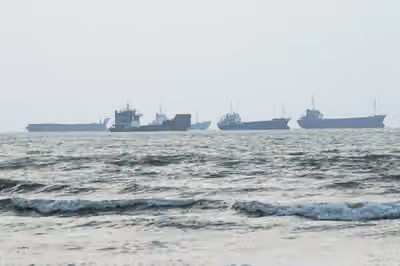
US and allied forces are working to secure shipping lanes in the Strait of Hormuz—through which about a fifth of the world’s oil passes—by weakening Iran’s naval capabilities, Cooper said.
He added that coalition operations have sunk or severely damaged about 140 vessels since the start of the campaign.
“The Strait of Hormuz is physically open to transit,” he said. “The reason ships are not transiting right now is because the Islamic Republic is shooting at them with drones and missiles.”
President Donald Trump warned on Saturday that the United States could strike Iran’s power plants within 48 hours if Tehran does not fully open the waterway.
Iranian officials have warned such a move would trigger retaliation against energy and water systems across the region.
'Ahead or on plan'
Cooper blamed Tehran for the continued conflict, saying it was putting the lives of civilians at risk.
“They could stop this war right now, absolutely, if they chose to do so,” he said, "They need to stop putting the wonderful Iranian people at risk by firing missiles and drones from inside populated areas... They need to stop immediately attacking civilians throughout the Middle East region."
US and Israeli forces launched strikes on Iran as the two sides failed to reach an agreement over the Tehran’s nuclear program.
Cooper said the military campaign was progressing faster than expected. US forces were “ahead or on plan” in efforts to dismantle Iran’s military assets used to project power beyond its borders.
"We're also going after the manufacturing," he said. "So it's not just about the threat today. We're eliminating the threat of the future, both in terms of the drones, the missiles, as well as the navy."
He added that it would be up to Trump to decide how and when the war ends.
The United States and its allies in the region have established “the largest umbrella of air defense in the Middle East history,” Cooper said, adding that there is now “a very thick defensive umbrella” over countries across the region.
He also pointed out that Israel has played an important role in countering Iranian threats against neighboring countries: "Israel is attacking drones and ballistic missiles that are aimed at Arab countries, attacking and defeating them."
Commanders in safe bunkers
Cooper said there was a sharp contrast between Islamic Republic officials, who remained in safe bunkers, and the soldiers who bore the brunt of the war.
"I'd like everyone to note is I've watched this over the last week, this extraordinary contrast between the comfort and protection that you're seeing with the senior generals in the Islamic Republic, at least those that are still alive, who are up in deep bunkers and facilities in and around Tehran. And contrast that with the soldiers who are down on the ground who are unprotected. The generals are protected. The soldiers are not protected."
Cooper warned Iranian civilians to exercise caution, saying the government did not care about their safety.
"They're launching missiles and drones from populated areas and you need to stay inside for right now," he said. "There will be a clear signal at some point, as the President has indicated, for you to be able to come out."
Tehran signalled on Sunday that it would not back down after President Donald Trump threatened to strike Iran’s electricity grid within 48 hours, warning that it would retaliate by targeting regional infrastructure if such an attack takes place.
The exchange of threats marks a sharp escalation in the three-week-old war and raises the prospect of tit-for-tat strikes on civilian infrastructure across the region.
“If Iran’s fuel and energy infrastructure is attacked by the enemy, all energy infrastructure, as well as information technology and water desalination facilities belonging to the United States and the regime in the region will be targeted,” Iranian military spokesman Ebrahim Zolfaqari said, according to state media.
Much of the region depends heavily on energy-intensive desalination plants for drinking water, including systems that supply all potable water in Bahrain and Qatar and the majority of water used in the United Arab Emirates.
Iran’s parliament speaker Mohammad Baqer Ghalibaf warned on X that attacks on Iranian power plants could lead to the “irreversible destruction” of energy facilities across the Middle East.
Foreign minister Abbas Araghchi struck a softer tone, saying that Tehran had not yet moved to choke off global shipping through the Strait of Hormuz.
“The Strait of Hormuz is not closed,” he wrote on X. "hips hesitate because insurers fear the war of choice you initiated—not Iran."
Iran’s Revolutionary Guards also warned that the Strait of Hormuz — the route through which roughly a fifth of global oil and liquefied natural gas normally passes — would remain shut until Iranian power plants damaged in the conflict are rebuilt.
The escalating rhetoric comes as fighting between Iran and Israel continued overnight.
Dozens were reported injured in Iranian missile strikes on the southern towns of Arad and Dimona on Sunday night.
The rising threats have prompted diplomatic intervention.
In a call with Saudi Crown Prince Mohammed bin Salman, France’s President Emmanuel Macron urged all sides to halt attacks on energy and civilian infrastructure and called on Iran to restore freedom of navigation in the Strait of Hormuz.
“It is more essential than ever that all parties agree to establish a moratorium on energy and civilian infrastructure,” Macron said in a post on X.
More than 2,000 people have been killed since the United States and Israel launched attacks on Iran on February 28, a conflict that has rattled global markets, pushed up fuel prices and raised fears of a broader regional war.