• العربية
  • فارسی
Brand
  • Iran Insight
  • Politics
  • Economy
  • Analysis
  • Special Report
  • Opinion
  • Podcast
  • Iran Insight
  • Politics
  • Economy
  • Analysis
  • Special Report
  • Opinion
  • Podcast
  • Theme
  • Language
    • العربية
    • فارسی
  • Iran Insight
  • Politics
  • Economy
  • Analysis
  • Special Report
  • Opinion
  • Podcast
All rights reserved for Volant Media UK Limited
volant media logo
OPINION

Unlocking Iran's potential: a trillion-dollar opportunity for America in a free Iran

Saeed Ghasseminejad Shervin Pishevar
Saeed Ghasseminejad ,
Shervin Pishevar
Mar 30, 2026, 00:32 GMT+1Updated: 02:28 GMT+1
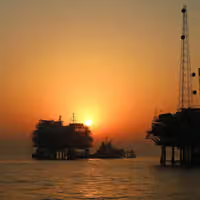
An Iranian offshore oil rig in the Persian Gulf, undated file photo

The United States can seize the moment to support regime change and forge a strategic partnership with a democratic Iran that could yield over $1 trillion in revenue for American firms over the next decade.

This is not wishful thinking; it's a conservative estimate grounded in Iran's untapped potential, benchmarked against its neighbors like Turkey, the UAE, and Saudi Arabia.

A free Iran represents the single largest untapped pro-American economic opportunity of the 21st century. Conservative modeling shows over $1 trillion in US export revenues, millions of American jobs, decisive energy-price stabilization, and the permanent collapse of the world’s most dangerous state sponsor of terrorism, without US occupation or nation-building.

Iran is the last large greenfield market opportunity in the world. It combines industrial sophistication, underinvestment, labor arbitrage, and a large population base. We can turn the North Korea of the Middle East into the South Korea of the region.

What makes Iran different is the rare convergence of scale, capability, and readiness. Iran is not a fragile post-conflict state; it is a compressed modern economy held back by ideology, not capacity.

It graduates roughly 250,000 engineers annually, with STEM penetration rivaling that of advanced industrial nations, and has a global diaspora poised for immediate reverse brain drain. Its 90-million-plus, urbanized population sits in a demographic sweet spot, young, educated, and consumer-ready, creating instant market scale.

Geographically, Iran is a natural Eurasian bridge, linking the Caspian Sea to the Persian Gulf and serving as a credible alternative logistics corridor between East and West.

Unlike hydrocarbon-only economies, Iran combines energy abundance with deep industrial and manufacturing capability, enabling it to build, not merely extract.

Finally, Iran’s vast diaspora is highly productive and skilled economically and professionally. In America alone, Iranian Americans have helped create trillions of dollars in value and millions of jobs via such companies. We estimate that millions in the diaspora will return at least part-time and invest in the vast potential to rebuild Iran into an economic powerhouse.

For 47 years, the Islamic Republic has squandered Iran's vast resources on terrorism, proxy wars, and nuclear ambitions, leaving its economy in ruins and its infrastructure crumbling. But imagine a free Iran—a secular, democratic nation restored to its pre-1979 glory as a US ally, recognizing Israel, and joining an expanded Abraham Accords, perhaps rebranded as the Cyrus Accords in honor of ancient Persian tolerance.

Under a committed, democratic Iranian government, anchored by investment protections and US-approved financing, the country would embark on a "catch-up" phase of massive modernization. Half of that $1 trillion in US sales could materialize in the first five alone, concentrated in high-value sectors that create millions of American jobs.

Take aviation, where Iran's fleet is a relic of sanctions and neglect. Replacing at least 250 wide-body jets, narrow-body aircraft, infrastructure upgrades, and maintenance services, could generate $150 billion over a decade. This isn't charity; it's smart business, revitalizing an industry starved of growth.

The transportation and automotive sectors offer another $150 billion. With demand for a million electric vehicles, think Tesla, plus passenger cars, trucks, agricultural machinery, and EV charging networks, American innovators stand to dominate. Iran's roads and farms have been starved of investment; a free market would unleash pent-up demand for quality US products.

Even in military and security, opportunities abound for $250 billion modernization: command systems, ISR technology, training, and sustainment. A post-regime Iran would pivot from sponsoring Hezbollah and Hamas to partnering against terrorism, creating long-term contracts for US defense firms while bolstering regional stability.

The energy sector alone could deliver $300 billion in non-ownership revenues through services, reconstruction, equipment, and technology licensing. Upstream drilling tech, midstream pipelines, downstream refining upgrades, and risk-management services would flow to companies like ExxonMobil and Halliburton. Iran's reserves are among the world's largest; a reliable, transparent supplier could help stabilize global prices and reduce dependence on adversaries such as Russia.

Beyond these, additional sectors from water infrastructure and AI networks to biotechnology, healthcare, finance, and entertainment could add $350 billion. U.S. firms in IT, pharmaceuticals, and consumer goods would tap into an educated, 90+ million-strong market eager for American products. Tourism could boom with resorts and hotels, while mining critical minerals would secure supply chains for American tech. Wall Street could be the main driver of many of the deals, which will generate significant fees and other services revenue.

Iran's prolonged underinvestment means explosive growth post-opening, outpacing even the post-Soviet Eastern Europe boom. Unlike risky ventures elsewhere, this would be backed by vast natural resources and a government that prioritizes U.S. ties and includes safeguards against corruption.

Critics will cry "interventionism," but the Iranian people are already fighting—with bare hands against foreign mercenaries like Hezbollah, Hashd al-Shabi, and Fatemiyoun. They need the regime’s killing capacity neutralized—its surveillance, command nodes, and imported mercenaries degraded—so civil resistance can succeed.

A free Iran isn't just good for Iranians; it's the biggest strategic global win for America since winning WWII and defeating the Soviet Union. It offers the largest economic and peace dividend since the fall of the Soviet Union. It would dismantle the axis of evil, secure the Middle East, and deliver prosperity that echoes and expands the pre-Khomeini era when Iran was a pillar of peace. Iran can catch up on what it lost in 47 years in just 10 years.

The regime is a rotting corpse; let's bury it and build a future where Iran and America thrive together. The opportunity is here; let’s seize it.

Most Viewed

Iran's carpet exports collapse from $2.5 billion to near zero, official says
1

Iran's carpet exports collapse from $2.5 billion to near zero, official says

2

Iran has failed to export crude oil by sea for 28 days - TankerTrackers

3

Iran executes man over accusations of spying for Israel

4

Australia sanctions Iranian officials, entities over crackdown and destabilizing activity

5
SPECIAL REPORT

How one Tehran hospital became a window into Iran’s January massacre

Banner
Banner

Spotlight

  • Tehran and Beijing close ranks as Trump heads to China
    INSIGHT

    Tehran and Beijing close ranks as Trump heads to China

  • Cambridge probes Iran scholar over alleged fabricated interviews

    Cambridge probes Iran scholar over alleged fabricated interviews

  • Iran looks to China for guarantees in future US deal
    INSIGHT

    Iran looks to China for guarantees in future US deal

  • How one Tehran hospital became a window into Iran’s January massacre
    SPECIAL REPORT

    How one Tehran hospital became a window into Iran’s January massacre

  • Iranians told to post pro-government content to regain internet access
    VOICES FROM IRAN

    Iranians told to post pro-government content to regain internet access

  • Fog of war meets fog of law in the Strait of Hormuz
    OPINION

    Fog of war meets fog of law in the Strait of Hormuz

•
•
•

More Stories

'Iran’s threat is global': Experts call Diego Garcia strike a wake-up call

Mar 27, 2026, 20:56 GMT+0
•
Negar Mojtahedi

Iran’s recent attempted strike on a joint UK–US military base in the Indian Ocean, some 4,000 km from its territory, marks more than an escalation — it is a wake-up call for the West, experts told Iran International.

On March 20, Iran fired two long-range ballistic missiles at the Diego Garcia base, a target long considered beyond its declared range of around 2,000 kilometers.

Iran’s attempted long-range strike — which US officials say did not hit its target — marks the first time Tehran has demonstrated the ability to reach as far as Diego Garcia.

For years, Iran claimed its missile range was capped at around 2,000 kilometers. That claim now appears increasingly untenable.

The attempted strike exposes a reality that can no longer be ignored, experts told this week's episode of Eye for Iran: Tehran’s missile capabilities extend far beyond the Middle East, its hardened arsenal has withstood sustained US and Israeli strikes, and the conflict is now colliding with critical global pressure points — from the Strait of Hormuz to the growing likelihood of a broader military phase.

A threat no longer abstract

Iran’s ballistic missile threat is no longer abstract — it is real and expanding.

Both Janatan Sayeh, an Iran expert at the Foundation for Defense of Democracies (FDD), and Farzin Nadimi, a defense and military expert with the Washington Institute for Near East Policy, warned on the Eye for Iran podcast that Tehran’s capabilities now extend far beyond previously stated limits — potentially reaching as far as the United Kingdom.

“This should not come as a surprise,” Sayeh said. He noted that Iranian missiles and drones have already been used on European soil through Russia.

“The difference now is that the regime itself can launch them directly from Iranian territory," said Sayeh.

The shift marks a critical evolution — from indirect projection of force to direct long-range capability — underscoring the growing reach of Iran’s arsenal.

Even if unsuccessful, the Diego Garcia strike signals a move from regional containment to global reach — with direct implications for Europe and beyond.

In his State of the Union address last month, President Donald Trump cautioned that Iran’s missile program could soon put the United States within reach — a claim that, in light of recent developments, is no longer theoretical.

Missile cities: A durable arsenal

That expanded reach is underpinned by an infrastructure designed not just to deter — but to endure.

Nadimi said Iran has long possessed the technical ability to extend the range of its missiles, including through payload modification and dual-use space-launch technology.

More significantly, he described a vast network of hardened underground facilities — some “the size of a small city” — buried deep beneath mountainous terrain and reinforced structures, making them extraordinarily difficult to destroy.

These so-called “missile cities” are often positioned near — and in some cases beneath — civilian infrastructure, including residential neighborhoods and public spaces, complicating targeting while increasing their survivability.

“Many of these missile bases are so deep that even the most powerful bunker-buster bombs cannot reach them… some are as deep as 500 meters and the size of a small city," Nadimi told Eye for Iran.

Strait of Hormuz: Global Stakes

The implications extend far beyond military capability.

The Strait of Hormuz — through which roughly one-fifth of the world’s oil supply passes — has emerged as a central pressure point in the conflict.

Disruptions tied to the war have already rattled global energy markets, with prices reacting to uncertainty around shipping routes and potential escalation.

Joel Rubin, former Deputy Assistant Secretary of State in the Obama administration, warned on Eye for Iran that Iran’s actions reflect a broader strategic calculus.

“This is how Iran behaves,” he said. “They are willing to disrupt and destroy the global economy to protect themselves.”

Dr. Walid Phares, foreign policy expert, advisor to past US presidents and author, described the Strait not as a theoretical chokepoint, but as an active military theater — where Iranian missile systems along the coastline could trigger direct US intervention to secure global shipping lanes.

President Donald Trump has repeatedly said the United States would reopen the Strait “with or without” allied support — underscoring the scale of the economic stakes.

“Which tells me that ground forces, limited special forces, Marines, now we understand, may be used," said Phares, author of Iran: An Imperialist Republic and US Policy.

Talks as strategy, not solution

Even as diplomatic efforts continue, both sides appear to be using negotiations as part of a broader strategic game.

Rubin pointed to a narrowing political and economic window in Washington, suggesting the US is unlikely to sustain prolonged negotiations as domestic pressure builds.

Phares also framed talks not as a pathway to de-escalation, but as part of a parallel track where diplomacy unfolds alongside active military preparation.

In this environment, negotiations are not replacing escalation — they are occurring within it.

Toward escalation: troops and targets

On the ground, signs of a deeper military phase are becoming more pronounced.

The Pentagon is weighing sending up to 10,000 additional ground troops to the Middle East, according to reporting by The Wall Street Journal and Axios — a move that would significantly expand US combat presence in the region.

The deployment would include infantry and armored units, adding to thousands of Marines and paratroopers already moving into position.

Officials say forces could be staged within striking distance of Iran, including near Kharg Island, a critical oil export hub that handles the vast majority of the country’s crude exports.

Military planners are also reportedly developing options for a “final blow,” including a large-scale bombing campaign and the potential use of ground forces.

No final decision has been made — but the scale and positioning of forces point toward preparation, not restraint.

A region already shifting

At the same time, regional dynamics are beginning to shift.

The United Arab Emirates has publicly warned — in a Wall Street Journal op-ed by its ambassador to Washington — that a simple ceasefire is not enough, signaling growing alignment among US partners around the need for a more decisive outcome.

In Lebanon — long considered firmly within Iran’s sphere of influence — mounting pressure on Hezbollah, moves to marginalize IRGC influence, and the withdrawal of Iran’s ambassador from Beirut point to potential cracks in Tehran’s regional posture.

For many observers, the attempted strike toward Diego Garcia marks a turning point because of what it revealed: the range and the probable intent, all are now visible.

Iran still depends on Hormuz despite years of workarounds

Mar 27, 2026, 01:45 GMT+0
•
Dalga Khatinoglu

Iran’s plans to reduce its reliance on the Strait of Hormuz appear to have delivered little practical change so far, according to tanker-tracking data from Kpler obtained by Iran International.

For more than a decade, Tehran has invested heavily in the Jask oil terminal, a project designed to shift part of its crude exports to the Gulf of Oman and create an alternative export route outside the Persian Gulf in times of crisis. Yet the data suggests the terminal has so far played only a marginal role in Iran’s export system.

According to Kpler data, Iran loaded an average of about 1.84 million barrels per day (bpd) of crude during the first 25 days of March. The contribution of the Jask terminal remained minimal.

Average loadings from Jask stood at roughly 81,000 bpd during this period—less than 5% of Iran’s total crude exports.

Historical patterns suggest this limitation may be structural. Iran first initiated exports from Jask in October 2024 amid heightened military tensions with Israel. Even then, volumes remained modest at around 77,000 bpd. In March 2025, exports from the terminal averaged roughly 54,000 bpd.

This is despite the fact that Jask is connected to Iran’s main oil-producing regions through a pipeline stretching nearly 1,000 kilometers, an infrastructure investment intended to enable significant export capacity outside the Persian Gulf.

In practice, Iran’s dependence on Kharg Island remains overwhelming.

Kpler data indicates that more than 84% of Iran’s oil exports in March were loaded from Kharg, while Jask accounted for just 4.4%. Another roughly 10% originated from the Soroush and South Pars terminals in the Persian Gulf.

Such concentration creates a clear strategic vulnerability: any disruption at Kharg could severely cripple Iran’s oil exports.

The question has gained renewed relevance as the war between Iran and the United States and Israel has intensified. The Strait of Hormuz—through which roughly a fifth of global oil trade passes—has become a central point of tension, with Tehran periodically restricting maritime traffic.

At the same time, reports have emerged of expanding US military operations in the region, including contingency planning involving strategic islands near the Strait of Hormuz that could be used to control access to the waterway.

In such a scenario, Iran’s continued reliance on export infrastructure concentrated around Kharg would leave its oil trade exposed to disruption.

Overall, the export data underscores a fundamental reality: despite years of investment, Iran has not succeeded in meaningfully reducing its dependence on the Strait of Hormuz—or, more critically, on the Kharg export hub.

In a volatile regional environment, that dependence represents a significant structural weakness.

Iran’s reported gas halt to Turkey exposes limits of its energy power

Mar 26, 2026, 16:59 GMT+0
•
Umud Shokri

Brief concern in Turkey this week over a halt in Iranian gas flows quickly gave way to official reassurances, but the episode exposes deeper limits in Iran’s ability to sustain exports even to key regional partners.

On March 24, reports indicated that Iran had suspended natural gas exports to Turkey following damage to facilities at the South Pars gas field after a March 18 strike. The disruption affects flows that accounted for roughly 14% of Turkey’s gas supply in 2025.

While Ankara’s response was swift and reassuring—with officials stressing that storage, diversification, and system flexibility prevented supply problems—the episode reveals a deeper issue on the Iranian side.

The halt is not simply a temporary interruption; it reflects structural constraints within Iran’s gas sector that limit its ability to sustain exports even to key regional partners.

A system under strain

The disruption originates from damage to South Pars, the world’s largest gas field and the backbone of Iran’s energy system. Because most of its output is consumed domestically, Iran operates with minimal export flexibility. Even limited disruptions can force immediate cuts to external deliveries.

Despite holding the world’s second-largest gas reserves, Iran has struggled to translate resource abundance into export capacity due to sanctions, underinvestment, and rising domestic demand.

As a result, exports to Turkey via the Tabriz–Ankara pipeline have often been inconsistent, with repeated disruptions over the past decade linked to technical issues and winter shortages.

In practice, Iran’s gas exports function less as a strategic tool than as a residual output constrained by domestic priorities.

Asymmetry

Energy relations between Iran and Turkey have long been framed as mutually beneficial: Iran gains export revenue while Turkey secures relatively affordable pipeline gas. In reality, the relationship is asymmetrical.

Iranian gas typically accounts for around 7–8 billion cubic meters annually. It is an important but non-dominant share of Turkey’s supply mix. Turkey’s broader portfolio, including Russia, Azerbaijan and LNG imports, limits dependence on any single supplier.

For Iran, by contrast, Turkey represents one of the few stable export outlets available under sanctions.

This imbalance becomes clear during disruptions. While Turkey can replace lost volumes through alternative sources, Iran cannot easily offset lost exports or the reputational damage that follows.

The timing is also significant. Turkey’s long-term gas contract with Iran is due to expire in mid-2026, and renegotiation was already expected to involve reduced volumes. Repeated supply interruptions are likely to strengthen Ankara’s bargaining position and further weaken Iran’s leverage.

Credibility and market impact

Turkey’s ability to absorb the disruption reflects years of diversification. The country consumes more than 50 bcm of gas annually and can draw on multiple pipeline suppliers as well as LNG imports.

Substitution, however, carries economic costs. Iranian pipeline gas has historically been cheaper than spot LNG, meaning replacement supplies raise import expenses.

Spot LNG prices in the Mediterranean have already risen amid broader geopolitical tensions, implying higher energy bills for Turkey if the disruption persists.

Yet these dynamics also underline Iran’s limited influence. Supply interruptions may impose short-term costs, but they do not create dependency. Instead, they highlight Turkey’s ability to adapt while reducing Iran’s strategic relevance over time.

In energy markets, credibility is as important as capacity. Repeated disruptions—whether caused by infrastructure damage, domestic shortages, or external shocks—undermine confidence in Iran as a dependable supplier.

Unlike major exporters such as Qatar or the United States, which maintain surplus capacity and flexible supply chains, Iran operates with structural constraints that limit responsiveness.

Turkey’s gas disruption therefore reveals more about Iran than about Turkey. Despite vast reserves, Iran lacks the infrastructure, investment and flexibility needed to turn those resources into consistent geopolitical influence.

Rather than demonstrating strength, the episode highlights constraint. Turkey’s ability to adapt reduces Iran’s leverage, while recurring supply interruptions erode its credibility as a regional energy partner.

In today’s energy landscape, influence depends not only on resources but on reliability—and that is where Iran continues to fall short.

Dollar-pegged pizza in Tehran points to a different kind of regime change

Mar 25, 2026, 20:17 GMT+0
•
Mohamad Machine-Chian

Iran’s economy is no longer merely experiencing high inflation; it is exhibiting the structural symptoms of a nation losing faith in its own currency and facing a shift in its monetary regime.

Over the past year, a pattern has emerged across markets, policy decisions and price behavior pointing to the early stages of de facto dollarization.

In April 2025, when a “five-dollar pizza” shop opened in Tehran’s affluent Niavaran neighborhood, many dismissed the fixed dollar price as a marketing gimmick. At the time, one pizza cost roughly 5 million rials, with inflation reportedly above 40%.

Less than a year later, on the eve of the current war, the same pizza was priced at 8.6 million rials, while officials acknowledged inflation exceeding 70%. What initially appeared symbolic began to look practical.

The shift was not confined to niche businesses and high-end stores. Informal dollar transactions, once largely limited to luxury goods or services aimed at foreign customers, steadily expanded.

In the months leading up to the 12-day war, despite the departure of many foreign nationals, dollar-pegged property sales and rentals increased noticeably. While upscale properties led the trend, mid-range apartments also entered the market with dollar-based pricing.

By the end of 2025, the US dollar had climbed to 1,430,000 rials, up from 800,000 in January of the same year. The volatility hit the automotive market hard. With car production concentrated among three major state-linked manufacturers and supply unable to meet demand, the price of second-hand cars in rial terms outpaced the increase in the dollar exchange rate.

Media headlines read, “The dollar is in the driver’s seat,” and traders increasingly priced vehicles in dollars. In December, automobile market expert Abdollah Babaei warned that if current trends continued, car transactions would effectively become dollarized.

  • Stealth austerity: Tehran seeks fuel price hike without a reckoning

    Stealth austerity: Tehran seeks fuel price hike without a reckoning

Economists began warning of a structural shift. Former Tehran Stock Exchange chief Hossein Abdeh Tabrizi cautioned that Iran "will enter the stage of dollarization" if 60% inflation and government overspending continued.

he statement went viral, and many echoed the growing concern that “Iran’s economy is on a dangerous path,” with the rial losing its function both as a store of value and as a unit of account.

Government policy after the 12-day war reinforced these anxieties.

The administration’s 2026–2027 budget introduced three pivotal shifts. First, gasoline subsidies moved from a liter-based rationing system to cash transfers. Second, an inflation coefficient was added to the pricing formula of Iran’s key commodity anchor. Third, the preferential exchange rate was abruptly removed in December, converting the government’s largest dollar commitment into rial-based direct subsidies.

Perhaps most striking was the historic decline in oil revenue’s share of the budget—from about 32% in 2025–2026 to just 5% in 2026–2027, the lowest level since the 1960s.

To compensate, taxes were increased by more than 60%. Across these measures, the common denominator was clear: the state systematically reduced its foreign-currency and commodity obligations, converting them into rial-based commitments. The administration that campaigned on taming inflation now appeared increasingly reliant on inflationary financing to navigate wartime pressures.

  • Capital flees Tehran stocks as geopolitical tensions deepen

    Capital flees Tehran stocks as geopolitical tensions deepen

In February, before the outbreak of the second war, average inflation for basic necessities reached triple digits, estimated between 105% and 115%. Reacting to these concerns, the administration pushed to remove four zeros from the rial, presenting it as a technical reform to simplify calculations.

In reality, redenomination in a high-inflation environment is an expensive cosmetic surgery on a patient on his deathbed—an adjustment that quickly loses meaning as prices continue to rise.

During the second war, market closures, the suspension of price discovery in the exchange market, and reduced demand slowed money circulation and provided short-term inflationary relief. At the same time, large banks halted operations, increasing demand for physical cash.

The Central Bank responded by issuing a 10-million-rial banknote—raising the highest denomination one hundredfold from 100,000 rials—a step it had resisted for years.

100%

But such pauses rarely eliminate underlying pressures. When markets fully reopen and normal trading resumes, deferred demand for foreign currency is likely to return. A similar pattern followed the 12 day war, when pent-up demand translated into a rapid adjustment in prices once restrictions eased.

Even under conservative assumptions, inflation could move decisively into triple-digit territory if monetary expansion continues. At that point, the shift toward dollar pricing would no longer be limited to select sectors. It would spread more systematically across contracts, wages and savings behavior.

Dollarization rarely begins with legislation; it begins with economic self-preservation. It starts with a pizza menu, moves to apartment contracts and car listings, and eventually reshapes fiscal expectations.

If post-war reopening triggers another inflationary wave, the timeline may not be measured in years but in quarters. Under such conditions, the transition toward de facto dollarization would become increasingly difficult to reverse.

Why Iran’s ‘no imminent threat’ claim rings hollow in the region

Mar 25, 2026, 17:14 GMT+0
•
Sarah bin Ashoor

From the vantage of the region’s coastal states, where these waters have long mirrored both promise and peril, the current chorus of criticism directed at the United States–Israeli campaign against Iran strikes a discordant note.

“No imminent threat,” declare the sceptics. “An illegal war,” they insist. Such phrases betray a profound misunderstanding of history and responsibility. They treat sovereignty as a shield for aggression and “imminence” as a stopwatch that only starts once the warhead is in flight. We in the region’s Arab states—Saudi Arabia, the United Arab Emirates, Bahrain, Kuwait, Qatar and Oman—ought to know better. We have lived with the Iranian threat for forty-seven years.

Since the 1979 revolution, the Islamic Republic has pursued a doctrine of exportable upheaval with methodical persistence. It has armed, trained and directed a transnational network of proxies that stretches from the Levant to the Horn of Africa, from the streets of Baghdad to the tri-border region of South America, and onward into Asia.

Hezbollah in Lebanon, the Houthis in Yemen, the various militias of Iraq’s Hashd al-Shaabi, and a constellation of smaller but lethal affiliates have served not as rogue actors but as calibrated instruments of Tehran’s will.

These groups have sown chaos on a truly global scale: the 1983 bombings of the U.S. Embassy and Marine barracks in Beirut, which killed 304 people—including 241 American servicemen and 58 French paratroopers—in the deadliest terrorist attack on Americans until 9/11; the 1992 bombing of the Israeli Embassy in Buenos Aires and the 1994 truck-bomb attack on the AMIA Jewish community centre, which together claimed more than 114 lives in Argentina’s deadliest terrorist outrage; the 1996 Khobar Towers bombing in Saudi Arabia that killed 19 American airmen; the supply of explosively formed penetrators that killed and maimed hundreds of U.S. and coalition troops in Iraq after 2003; the 2011 plot to assassinate the Saudi Ambassador in Washington; the 2019 Aramco strikes; and the relentless campaigns against international shipping in the Red Sea and the Gulf of Oman.

These are not isolated incidents but chapters in a single, uninterrupted strategy of regional domination and global subversion.

Qassem Soleimani, slain Quds Force commander and architect of the “Axis of Resistance,” openly boasted of this empire. In a message to his American counterpart he declared: “Dear General Petraeus, you should know that I, Qassem Soleimani, control the policy for Iran with respect to Iraq, Lebanon, Gaza and Afghanistan.” That assertion, with the regime’s repeated claims of commanding an “Axis of Resistance” spanning multiple Arab capitals, reveals Tehran’s long-standing ambition for hegemony across the region and into the eastern Mediterranean.

To dismiss this record as lacking “imminence” misunderstands the concept in the nuclear age. A responsible leader does not wait until the missile is on the launch pad and the warhead mated. As former Israeli Prime Minister Naftali Bennett observed in his recent interview with Christiane Amanpour, “responsible leaders… if you wait for the threat to be imminent, it is too late.”

Ethically, this position is anchored in the just war tradition. As Michael Walzer demonstrates in his seminal work Just and Unjust Wars, states—like individuals—have the moral right to defend themselves against violence that is imminent but not yet actual. “For aggression often begins without shots being fired or borders crossed. Both individuals and states can rightfully defend themselves against violence that is imminent but not actual.” Waiting for the first blow when an adversary possesses both declared intent and advancing nuclear capability is not moral prudence; it is moral abdication.

Iran possesses both the technical capability—advanced uranium enrichment, ballistic-missile production lines, and a clandestine weapons programme long documented by the IAEA—and the explicit intent, voiced repeatedly by its supreme leader and Revolutionary Guard commanders. Add to this an extensive missile arsenal capable of reaching every capital of the surrounding region and beyond, and the calculus changes. Imminence, in the nuclear age, is not a matter of hours but of irreversible momentum.

Nor is the charge of illegality sustainable. Critics invoke Article 51 of the UN Charter, which authorises self-defence “if an armed attack occurs.” Yet the Charter itself describes this right as “inherent,” a pre-existing principle of international law that has always encompassed anticipatory action when the necessity is clear and the danger existential.

The classic precedent remains the 1962 Cuban Missile Crisis. President Kennedy imposed a naval quarantine on Cuba to prevent Soviet nuclear missiles from becoming operational—acting before any launch, not after. No credible legal authority has ever branded that decisive intervention unlawful. The same logic governs here. Iran’s decades-long pattern of armed attacks, direct and by proxy, combined with its nuclear advances, satisfies every test of necessity and proportionality under international law.

General Jim Mattis, in his Firing Line interview, dismantled the illegality argument with the clarity of a commander who confronted this threat for decades: one could “probably never make a charge that this is an illegal war” given Iran’s long pattern of direct and proxy assaults on its neighbours, on American forces and on allied interests across the region.

These are not hypothetical grievances; they are a documented record of aggression that previous administrations, through sanctions that proved porous and diplomacy that proved naïve, allowed to fester. The result was not peace but emboldenment.

We in the region did not seek this war, nor did we initiate it. For years we counselled against military confrontation, exercising a restraint that has exceeded even our critics’ expectations. We did so not from illusion but from a pragmatic assessment of the risks: the sudden collapse of the current theocracy, absent any ready alternative, could plunge Iran into civil war, unleashing waves of refugees, radicalism and instability across our borders. Its ballistic-missile arsenal and deeply entrenched proxy networks might fracture into even more dangerous splinter groups, turning a contained threat into a hydra of uncontrolled violence.

Today, we absorb provocations — drone swarms, missile barrages, economic sabotage — against a history of flagrant aggression that had justified retaliation long ago. Yet we are pursuing every diplomatic channel precisely to avert such chaos.

Nonetheless, let there be no mistake: when the Islamic Republic turned its weapons directly and unprovoked against neighbouring territory, our shipping lanes and our citizens, the calculus shifted. Unlimited restraint is no longer prudence; lest it be confused with surrender. The gloves have come off because the alternative — endless appeasement of an aggressor that has already crossed every red line — poses the greater peril.

The campaign now under way is neither precipitous nor unlawful. It is the overdue correction of a strategic imbalance that earlier hesitancy only worsened. It is unfashionable, in some quarters, to acknowledge that President Trump has done what multiple preceding administrations—Republican and Democrat alike—would not or could not. Decades of half-measures allowed Iran’s nuclear programme to advance, its proxy empire to entrench itself, and its ideology of resistance to metastasise.

The cost has been borne disproportionately by the peoples of the region, by the Lebanese and Yemenis caught in proxy crossfire, and by Israelis living under the perpetual shadow of annihilation. To pretend otherwise is to rewrite history in real time.

The states of the region stand ready, as always, for a stable and prosperous Middle East free of hegemonic ambition. We seek no wider conflagration. But we will not feign blindness to the threat that has defined our security landscape for nearly half a century.

True legality and true responsibility lie not in waiting for the perfect casus belli to arrive gift-wrapped in a mushroom cloud, but in acting when the evidence of capability, intent and historical conduct is overwhelming. Iran’s revolution exported war; the present campaign seeks, at long last, to contain it. The states of the region understand this. The world ought to listen.