Capital flees Tehran stocks as geopolitical tensions deepen
A file photo shows the trading floor of the Tehran Stock Exchange in Tehran.
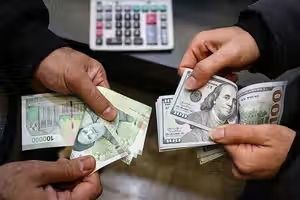
More than 107.8 trillion rials ($66.5 million) in retail money has flowed out of the Tehran Stock Exchange over the past 24 trading sessions, marking what analysts describe as a new phase of liquidity depletion driven by political uncertainty and fears of military escalation.
Habib Arian, a financial markets researcher, told ISNA that the turning point came on January 10, when the market recorded a one-day outflow of 9.4 trillion rials ($5.8 million), at the time the largest daily withdrawal of individual investor funds.
“That figure showed that trust, which is the main asset of the capital market, had been severely damaged,” Arian said. “From that date onward, the Tehran bourse was unable to return to an upward trajectory, and any positive fluctuation was treated as an opportunity to exit.”
Outflows accelerated as regional tensions intensified and speculation grew about possible confrontation between Iran and the United States. Investors shifted from equities toward hard assets, pushing the dollar above 1,650,000 rials and lifting domestic gold prices sharply.
Between January 8 and February 21, the benchmark index fell 15% while 18-karat gold posted a 33% gain over the same period. Gold-backed funds rose 20%, emerging as a primary destination for funds exiting equities.
“The 48-percentage-point gap between gold and stocks explains why liquidity has fled the equity market at this speed,” Arian said.
On Sunday alone, the main index shed another 103,000 points as retail investors pulled out a record 41 trillion rials ($25.3 million) in a single session, according to market data cited by Arian.
He said the stock market was now driven less by economic fundamentals than by political risk. “The market today is more hostage to political tensions and the shadow of war than to economic variables,” he said. “As long as geopolitical risks do not subside, the capital market will continue to act as a liquidity provider for parallel markets.”
The exodus from stocks comes against a backdrop of broader capital flight and currency weakness.
The rial has traded around 1,630,000 per dollar in recent weeks, reflecting deep structural imbalances, falling oil income and persistent uncertainty surrounding nuclear negotiations and sanctions.
Analysts say the combination of record outflows from equities, a weakening currency and rising demand for gold shows the erosion of investor confidence, with households and businesses seeking safety in assets perceived as more resilient to inflation and political shocks.
“In this environment, investors prefer the security of gold and dollar-linked assets to the ambiguity of shares,” Arian said.
Russian President Vladimir Putin, Abbas Araghchi, Iran’s foreign minister, and Kazem Jalali, Tehran’s ambassador to Moscow
Iran has agreed a secret €500 million arms deal with Russia to acquire thousands of advanced shoulder-fired missiles in a major effort to rebuild air defenses damaged during last year’s war with Israel, the Financial Times reported on Sunday.
The agreement, signed in Moscow in December, commits Russia to deliver 500 man-portable Verba launch units and 2,500 9M336 missiles over three years, the FT reported, citing leaked Russian documents and several people familiar with the deal.
The Verba is described as one of Russia’s most modern shoulder-fired, infrared-guided air defense systems, capable of targeting cruise missiles, low-flying aircraft, and drones. Operated by small mobile teams, it allows forces to create dispersed defenses without relying on fixed radar installations, which are more vulnerable to strikes, the report said.
Under the €495 million contract, deliveries are scheduled in three tranches from 2027 through 2029, the FT said, adding that one person familiar with the transaction suggested a smaller number of systems could have been delivered earlier.
Tehran formally requested the systems last July, days after the end of a 12-day conflict in which the US briefly joined Israel in strikes on Iran’s three key nuclear facilities, according to a contract seen by the newspaper.
A former senior US official told the FT that Moscow likely viewed the agreement as a way to repair ties with Tehran after failing to come to its ally’s aid during the June conflict.
The deal was negotiated between Rosoboronexport, Russia’s state arms export agency, and the Moscow representative of Iran’s Ministry of Defense and Armed Forces Logistics (MODAFL), FT’s report said.
The contract was arranged by Ruhollah Katebi, a Moscow-based MODAFL official who previously helped broker Iran’s sale of hundreds of Fath-360 close-range ballistic missiles for use in Russia’s invasion of Ukraine.
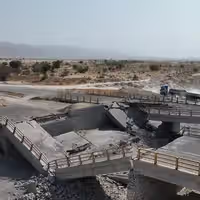
One Russian Ilyushin Il-76TD cargo plane has made at least three runs from Mineralnye Vody in Russia’s northern Caucasus to the Iranian city of Karaj in the past eight days, FT’s report said. At least one more Il-76 flew the same route in late December.
Iran reportedly received up to six Russian Mi-28 attack helicopters in January and operated one of them in Tehran this month.
According to documents seen by the newspaper, Rosoboronexport is selling the 9M336 missiles at €170,000 per unit and the launch systems at €40,000 each.
The deal also includes 500 “Mowgli-2” night-vision sights designed to track aircraft and other targets in darkness, the report added.
Unlike larger Russian strategic air defense systems such as the S-300 and S-400, the Verba systems do not require extensive training or integration and can be deployed more quickly, FT’s report said.
The report added that Verbas have not played a significant role in Russia’s defenses against Ukrainian drone attacks, which could make Moscow more willing to part with them than other air defense systems.
Supreme Leader Ali Khamenei attends a Quran recitation gathering in Tehran, Iran, February 19, 2026
Tehran’s posture increasingly resembles that of an embattled state that sees greater odds of survival in confrontation than in compromise—one that views a decisive clash not as catastrophe, but as a potential turning point.
On February 17, while Iran’s negotiating team was in Geneva for talks with US officials, Supreme Leader Ali Khamenei delivered a stark warning in Tehran that reflected this outlook. “More dangerous than the aircraft carrier,” he said, “is the weapon that can send it to the bottom of the sea.”
Soon afterward, state-aligned poets circulated verses declaring, “We are leaves; we will fall at the foot of this tree.”
Even as negotiations continue abroad, the establishment in Tehran—and its media ecosystem—appear intent on preparing the public not for agreement, but for the possibility of a decisive confrontation.
A shift in expectations
One striking difference between the current talks and previous rounds is the fading expectation of peace.
Earlier negotiations were framed by officials as diplomacy conducted from a position of strength—what Iranian leaders described as being “peace-seeking but capable of war.” Today, many voices close to the establishment express doubt that talks will produce an agreement.
Officials present negotiations primarily as a means of managing escalation and avoiding uncontrolled regional conflict. But in state-aligned media, a parallel narrative has taken hold—one that increasingly treats war as both plausible and potentially advantageous.
Some commentary focuses on technical readiness, discussing force posture and missile deployment. Other voices frame the situation in theological terms, arguing that divine providence will guide Iran to victory. Compromise, in this telling, is not pragmatic diplomacy but strategic defeat.
The comparison frequently invoked is Libya. In this account, Muammar Gaddafi’s decision to abandon his weapons programs paved the way for foreign influence, internal weakening, and eventual collapse. Agreement, within this framework, is seen as the beginning of the end. War, by contrast, could reset the strategic balance—producing ceasefire, deterrence, and renewed legitimacy.
War as mission and test
This outlook draws on a broader ideological shift that has intensified in recent years. The Islamic Republic’s political language has long contained religious and messianic elements, but such themes have grown more prominent following recent conflicts.
Within this framework, confrontation is as civilizational as it is geopolitical. Resistance, even at high cost, is framed as a test of faith in a larger struggle between opposing moral forces.
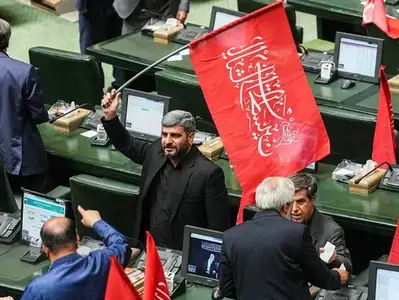
State-aligned commentators and officials increasingly describe the confrontation in existential terms. Military figures have shifted their rhetoric from deterrence to preparedness, suggesting Iran is ready not only to withstand conflict but to prevail. Structural weaknesses or social tensions are interpreted not as vulnerabilities, but as trials to be endured.
This perspective reflects a theological logic deeply embedded in the system’s ideological foundations. Victory, in this view, depends not solely on material advantage but on steadfast adherence to divine principles. Even loss or sacrifice can be reframed as spiritual triumph.
Such thinking also intersects with apocalyptic and messianic narratives present in segments of the regime’s ideological landscape, where the state is cast as an actor in a larger historical and religious mission.
The survival trap
Underlying these narratives is a stark strategic calculation. From the leadership’s perspective, compromise carries existential risks.
An agreement with the United States could require limits on Iran’s missile program, nuclear activities, or regional posture. Such constraints, Iran’s rulers appear to believe, would weaken the system’s core pillars and ultimately threaten its survival.
War, paradoxically, may appear less dangerous.
Proponents of this thinking frequently cite what they see as lessons from past confrontations, arguing that external conflict did not produce collapse or widespread internal revolt. Some even maintain that wartime conditions can strengthen internal cohesion and reinforce legitimacy.
This does not mean that Tehran seeks war for its own sake. Rather, it reflects what might be called a survival trap: a situation in which both diplomacy and confrontation carry risks, but only confrontation preserves the possibility of strategic recovery.
Iran’s military doctrine emphasizes asymmetric warfare and regional escalation, expanding conflict beyond its borders to impose costs on adversaries and create leverage. Such a strategy could transform a limited strike into a broader crisis, forcing negotiations under more favorable terms.
The paradox is stark. Negotiation is intended to prevent war. Yet the very act of negotiating—and the concessions it might entail—can appear more dangerous to the system than war itself.
Three Iranians working as engineers in Silicon Valley were charged with stealing sensitive trade secrets from leading US technology firms and transferring confidential data to unauthorized locations, including Iran, US authorities said on Thursday.
A federal grand jury in the Northern District of California indicted Samaneh Ghandali, 41, Mohammadjavad Khosravi, 40, and Soroor Ghandali, 32, on counts including conspiracy to commit trade secret theft, theft and attempted theft of trade secrets, and obstruction of justice. The three, all residents of San Jose, were arrested and made initial court appearances on Thursday.
According to the indictment, the defendants gained employment at major technology companies involved in developing mobile computer processors. Samaneh Ghandali and her sister Soroor Ghandali worked at Google before moving to another firm identified as Company 3, while Khosravi, who is married to Samaneh Ghandali, worked at a separate company identified as Company 2.
Prosecutors allege the defendants used their positions to access confidential information, including trade secrets related to processor security and cryptography. The indictment says they transferred hundreds of sensitive files to unauthorized third-party platforms, personal devices, and work devices linked to each other’s employers, as well as to Iran.
“As alleged, the defendants exploited their positions to steal confidential trade secrets from their employers,” United States Attorney Craig H. Missakian said. “Our office will continue to lead the way in protecting American innovation and we will vigorously prosecute individuals who steal sensitive advanced technologies for improper gain or to benefit countries that wish us ill.”
FBI Special Agent in Charge Sanjay Virmani described the alleged conduct as a “calculated betrayal of trust,” saying the defendants took deliberate steps to evade detection, including submitting false affidavits and manually photographing computer screens to avoid digital tracking.
The indictment also details travel to Iran in December 2023, when prosecutors say some of the exfiltrated material was accessed from a personal device.
If convicted, each defendant faces up to 10 years in prison for each trade secret-related count and up to 20 years for obstruction of justice.
US Vice President JD Vance, US Secretary of State Marco Rubio and Donald Trump's son-in-law Jared Kushner applaud as US President Donald Trump reacts at the inaugural Board of Peace meeting at the US Institute of Peace in Washington, DC, US, February 19, 2026
US President Donald Trump on Thursday warned Iran it must reach a meaningful nuclear agreement with the United States within two weeks or face consequences, as reports indicate Washington is considering limited strikes to force a deal.
Speaking at the inaugural meeting of his Board of Peace initiative in Washington, Trump hinted at a narrow timeframe for progress and reiterated US demands on Tehran’s nuclear program.
“It’s proven to be, over the years, not easy to make a meaningful deal with Iran. We have to make a meaningful deal; otherwise, bad things happen,” Trump said. “And you’re going to be finding out over the next probably 10 days.”
He added that Iran “cannot have a nuclear weapon” and must halt actions Washington views as threatening to regional stability, suggesting that military measures could follow if diplomacy fails.
The Wall Street Journal reported that Trump is weighing an initial, limited strike on Iran as leverage to compel Tehran to accept US conditions in nuclear talks.
The report said Trump is reviewing targeted military options that could be executed within days if Iran refuses to halt enrichment activity, with the aim of strengthening US negotiating leverage without immediately triggering a broader conflict.
Also on Thursday, US Ambassador to the United Nations Michael Waltz doubled down on Washington’s pressure campaign in media appearances, accusing Tehran of stalling negotiations and saying that economic sanctions have strained the Iranian leadership.
“Even in the face of world condemnation over the killing of somewhere between 18,000 and 40,000 of their own people — an industrial-sized massacre,” Waltz said in an interview with Fox News.
Waltz said sustained pressure would continue even as diplomatic engagement moves forward.
'Obvious gap remains'
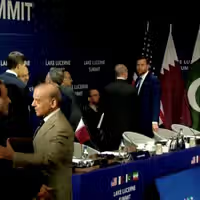
The head of the UN nuclear watchdog, IAEA Director General Rafael Grossi, said on Thursday that an “obvious” gap remains between the United States and Iran over uranium enrichment after attending talks in Geneva on Tuesday.
“It is clear that there is, there is this gap which is, which is obvious, between the position of the United States, which is demanding… no enrichment at all, and what Iran would like to continue to be doing,” Grossi told CNN. He added that while the agency has been allowed back into Iran, inspectors have not been granted access to the nuclear sites targeted in US-Israeli airstrikes in June.
Grossi said he believes the 400 kg of enriched uranium remains “where it was” before the bombings and has not been moved.
Tehran skyline at sunset, with the city's iconic Milad Tower rising in the distance, January 2026
Iran stands at a pivotal moment. If political change brings institutional reform, the country could break decades of stagnation and return to sustained growth. But without credible governance, any transition risks replacing one failed equilibrium with another.
Iran’s recent nationwide protests, which were met with a deadly crackdown unmatched in the country’s modern history, stem directly from five decades of Islamic Republic rule.
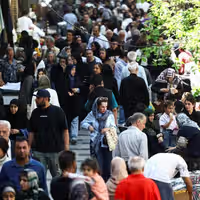
More than half the population lives near or below the $3-a-day abject poverty line. The national currency is in free fall, with hyperinflation and famine in sight. The state seeks to control every aspect of citizens’ lives. Add to this systemic corruption, international isolation, apocalyptic environmental devastation, and a catastrophic brain drain that has driven more than 5% of Iranians to live outside the country.
During a period when most developing countries achieved major gains in living standards, Iran’s GDP per capita under the Islamic Republic has remained below its pre-revolution level for nearly half a century. Once competitive among middle-income nations, Iran’s per capita income has fallen behind war-torn Iraq and now more closely resembles that of low-income neighbors such as Pakistan.
The rulers in Tehran have proven unable to address urgent and mounting economic challenges: soaring inflation, a bankrupt financial system, a shrinking capital stock, and non-viable state-owned enterprises (SOEs).
Beyond these immediate crises, Iran faces deep structural problems that will persist for decades. The population is aging and the demographic window is closing. Soon, ever-larger cohorts will reach retirement with little or no savings. The water crisis is also unlikely to improve, constraining agricultural output and heightening food security risks.
These compounding crises, especially under external pressure, could trigger the Islamic Republic’s collapse—or at least force fundamental changes in its governing structure. Regardless of what political system emerges, Iran’s institutions must be aligned with both political and economic development objectives.
We believe any strategy capable of generating a virtuous cycle of change must prioritize one core objective: building a credible, stable, and legitimate state. Without this foundation, prescriptions for “sound” macroeconomic policy or state-capacity reforms will remain technocratic exercises that fail to take hold, endure, or deliver.
At the highest level, these political transformations can be summarized as follows:
1. State: scaling back
While Iran’s formal central government budget is relatively small (about $50 billion), the state’s true economic footprint is far larger, encompassing well over half of economic activity through para-statal foundations (bonyads), state-linked banks, and SOEs. Some efficiency gains may be possible through spending cuts, including transfers to ideological or religious bodies. But the core challenge is to rationalize and properly govern this broader quasi-state sector.
This requires consolidating and privatizing SOEs, gradually strengthening tax collection, and integrating off-budget entities into a transparent and accountable fiscal framework, while addressing longer-term structural challenges.
2. Democratic accountability
While democracy is an end in itself, strengthening democratic accountability plays a vital role in providing the legitimacy needed for the state to implement painful economic reforms and address short-term dislocations. A political leader elected through a free and meaningful process can better shield technocratic reformers from political pressures and enable difficult but necessary policy decisions.
3. Rule of law
Reforming the rule of law is the slowest and most complex task. While formal legal rules can be changed rapidly, transforming institutional practices and cultural norms is far more difficult. It is unlikely that any future judicial system will immediately apply the law equally to ordinary citizens and elites. But even a “good enough” system—as seen in countries such as China—could be sufficient to support sustained economic growth.
A successful transformation of political institutions could launch a new period of sustained growth. Optimism about a post-Islamic Republic Iran rests on its human capital, natural resources, and a highly capable diaspora able to invest and reconnect the economy to global markets.
Under a stable and legitimate system, near- to medium-term gains could come from lifting sanctions, activating underused capacity—especially in energy—attracting domestic and foreign investment, improving productivity, and expanding tourism and trade.
We estimate these channels could add $100–150 billion to output over five years, raising average incomes by only $3–5 per person per day. Claims of a trillion-dollar economy, as stated by some commentators, are as unrealistic as the Islamic Republic’s long record of unfounded projections.
History offers wide variation in the outcomes of institutional reform in post-authoritarian states. In the post-communist transition, for example, Russia endured a severe contraction of more than 40% of GDP, while Poland pivoted relatively quickly toward sustained growth. A decisive factor in Poland’s success was the prospect of joining the European Union, which provided a powerful external anchor for reform.
Unfortunately, Iran’s trajectory of political and economic transformation appears more likely to resemble Russia’s experience than Poland’s.
In the MENA region, Tunisia and Iraq have undergone post-authoritarian institutional reforms in recent decades. Tunisia, initially viewed as the Arab Spring’s only democratic success, has since regressed into authoritarianism, and its per-capita GDP remains roughly at pre-revolution levels.
Iraq, following the 2003 invasion, has seen per-capita GDP rise from about $1,500 to over $6,000, largely driven by increased oil production, while inflation has generally remained stable. Yet progress in controlling corruption has been limited, with only modest improvements in corruption perceptions.
A post-Islamic Republic government may initially enjoy high legitimacy, but that window will be brief. It must deliver tangible results quickly while managing overlapping crises and unavoidable distributional conflicts over who gains, who loses, and who must wait. Economic recovery and political stability will be tightly linked—and failure in one will undermine the other.
Experience from other transitions is sobering. Beyond early gains, post-authoritarian growth is often slow, fragile, and reversible. Stagnant living standards can create fertile ground for populist politicians who promise shortcuts.
Iran therefore needs a development strategy that integrates political and economic reform. Without it, the country risks remaining trapped in its current low equilibrium.