• العربية
  • فارسی
Brand
  • Iran Insight
  • Politics
  • Economy
  • Analysis
  • Special Report
  • Opinion
  • Podcast
  • Iran Insight
  • Politics
  • Economy
  • Analysis
  • Special Report
  • Opinion
  • Podcast
  • Theme
  • Language
    • العربية
    • فارسی
  • Iran Insight
  • Politics
  • Economy
  • Analysis
  • Special Report
  • Opinion
  • Podcast
All rights reserved for Volant Media UK Limited
volant media logo

Iran has failed to export crude oil by sea for 28 days - TankerTrackers

May 12, 2026, 20:29 GMT+1
A suspected oil spill near Iran's Kharg Island is seen in satellite images

Iran has not successfully exported any crude oil by sea for 28 days amid the US naval blockade imposed in April, according to ship-tracking data from TankerTrackers, while loading activity at Kharg Island remains disrupted following a suspected oil spill near the terminal.

The tracker said on Tuesday crude shipments remain trapped inside the blockade zone despite some refined fuel cargoes escaping sanctions pressure.

“To our best knowledge, Iran hasn't successfully exported any crude oil by sea over the past 28 days,” the monitoring firm said on X, adding that its definition of an export is a tanker successfully crossing the US Navy blockade line without returning with the cargo.

The group said some refined petroleum products had still managed to leave Iran because the US Treasury’s Office of Foreign Assets Control (OFAC) had not sanctioned the tankers involved.

It also reported that multiple empty and loaded tankers remain clustered near the blockade perimeter and in waters not far from Pakistan.

The United States began enforcing a naval blockade on Iranian ports and oil exports on April 13 as part of its broader pressure campaign against Tehran during the ongoing conflict.

Washington has said the measures are aimed at restricting Iran’s oil revenues and limiting its ability to finance military operations and regional armed groups.

Kharg oil spill

Tanker Trackers said Kharg Island, the hub for 90% of Iran's oil exports, has not loaded any tankers since May 6 as a result of an oil leak which Tehran denied taking place.

Satellite images last week showed the suspected oil spill spreading across dozens of square kilometers of water near Kharg Island.

The likely spill, visible as a gray-and-white slick, appeared west of the five-mile-long island in images taken by Copernicus Sentinel satellites between May 6 and May 8 seen by Reuters.

Leon Moreland, a researcher at the Conflict and Environment Observatory, said the slick looked visually consistent with oil and estimated it covered about 45 square kilometers.

Louis Goddard, co-founder of climate and commodities consultancy Data Desk, also said the images appeared to show an oil slick, potentially the largest since the US-Israel war against Iran began in late February.

The cause and origin of the suspected spill remain unclear, Moreland said, adding that May 8 images showed no sign of further active spills.

Most Viewed

Netanyahu says Iran regime change ‘possible, not guaranteed’
1

Netanyahu says Iran regime change ‘possible, not guaranteed’

2
ANALYSIS

The strange stability between Tehran and the Taliban

3

Iran calls proposal to US ‘reasonable and generous’

4
INSIGHT

As Iran’s economy sinks, hardliners turn to conspiracy

5

Iran executes another political prisoner on spying charges

Banner
Banner

Spotlight

  • Iranians told to post pro-government content to regain internet access
    VOICES FROM IRAN

    Iranians told to post pro-government content to regain internet access

  • Fog of war meets fog of law in the Strait of Hormuz
    OPINION

    Fog of war meets fog of law in the Strait of Hormuz

  • Tehran rejects US terms as hardliners push escalation
    INSIGHT

    Tehran rejects US terms as hardliners push escalation

  • As Iran’s economy sinks, hardliners turn to conspiracy
    INSIGHT

    As Iran’s economy sinks, hardliners turn to conspiracy

  • Iranians describe toll of 70 days of internet restrictions
    VOICES FROM IRAN

    Iranians describe toll of 70 days of internet restrictions

  • The strange stability between Tehran and the Taliban
    ANALYSIS

    The strange stability between Tehran and the Taliban

•
•
•

More Stories

Iran's carpet exports collapse from $2.5 billion to near zero, official says

May 12, 2026, 11:31 GMT+1

Iran's handwoven carpet exports, once worth nearly $2.5 billion annually, have now "virtually stopped," a provincial industry official said, reflecting the steep decline of one of the country's best-known exports.

"At the moment, carpet exports have nearly reached zero," Abdolrahman Tasmim Ghatee, head of the union of handicrafts sellers and handwoven carpet producers in Fars province, told the Iranian Labor News Agency (ILNA), a semi-official labor-focused news outlet.

He said exports, which once stood at close to $2.5 billion, had fallen to less than $50 million in recent years, with little trade now taking place.

Market slump hits producers

Tasmim Ghatee said around 90% of the sector depended on tourism, especially foreign visitors, but international tourism had largely dried up.

"Some shops do not make a single sale during the week because there are simply no buyers," he said. "After paying for food and daily expenses, people have nothing left to spend on decorative goods, handicrafts and carpets."

He said the market downturn had worsened after the war that began in late February between Iran, Israel and the United States, which disrupted trade and deepened economic uncertainty, even as a fragile ceasefire remains in place.

Fighting has largely stopped, but tensions persist amid stalled negotiations between Washington, Tehran and Israel over sanctions, regional security and Iran's nuclear program.

  • Iran's Handwoven Carpet Exports Lowest In 24 Years

    Iran's Handwoven Carpet Exports Lowest In 24 Years

  • Iran’s carpet exports unravel with 90% plunge

    Iran’s carpet exports unravel with 90% plunge

Decades-long decline

Iranian handwoven carpet exports generated more than $2 billion in revenue in 1994, one of the industry's strongest years, before entering a long decline driven by sanctions, rising competition and weaker global demand.

Exports fell to $69 million in 2019 and just $2 million in the second quarter of 2020, according to customs data and industry reports. By March 2024, exports had dropped to $39.7 million from $426 million in 2017, according to officials cited by ILNA.

Industry figures have blamed US sanctions, trade restrictions, currency rules and stronger competition from India, Turkey, Afghanistan, China and Pakistan for the downturn. The United States, once a major market for Iranian carpets, reimposed restrictions on Iranian rug imports after Washington withdrew from the 2015 nuclear deal in 2018.

100%

Weavers leave the trade

The number of carpet weavers in Fars province has dropped by about 80% from around 6,000 in 2018 to roughly 1,000 now, Tasmim Ghatee said.

"When carpets and handicrafts are not sold, naturally the weaver will not continue working," he said.

He described how rural women could spend six months weaving a carpet while covering raw material costs and household duties, only to find no market for the finished product.

"How can she start again?" he said.

Officials push digital sales

Gholamhossein Zanhari, head of the carpet department at Fars province's industry and trade office, said the sector needed safer export routes and stronger online sales to survive.

He pointed to regional markets including Armenia, Georgia, Oman and Turkey, as well as Japan, South Korea and Singapore, as potential destinations and said platforms such as Etsy and eBay could help producers reach consumers directly.

"Digitalization is not just a sales tool, but a way to maintain business continuity" during crises, he said.

Australia sanctions Iranian officials, entities over crackdown and destabilizing activity

May 12, 2026, 09:50 GMT+1

Australia sanctioned seven Iranian individuals and four entities on Tuesday over what it called the Islamic Republic’s crackdown on protesters and women and its destabilizing activity through missile and shadow-banking networks.

The Australian foreign ministry said the measures targeted senior officials and entities involved in violence against women and children, mass arrests, torture, forced confessions, internet restrictions and the wrongful detention of foreign nationals.

It said the sanctions were also aimed at parts of Iran’s shadow banking system, which it said helps fund groups such as Hamas, support Tehran’s ballistic missile program and enable other destabilizing activity.

Among those sanctioned was Interior Minister Eskandar Momeni Kalagari, who Australia said is also deputy commander-in-chief of the Law Enforcement Forces, one of the entities listed over its role in the crackdown.

Australia also sanctioned Ruhollah Momen Nasab, saying he was responsible for deploying 80,000 forces to surveil women and girls in schools, universities, public spaces and online and enforce mandatory hijab rules.

Another listed individual was accused of establishing neighborhood intelligence databases through door-to-door data collection and patrols to identify and punish opponents of the Islamic Republic, while others were sanctioned over the wrongful detention of foreign nationals, the government said.

The sanctioned individuals were Momeni, Momen Nasab, Majid Feiz Jafari, Ghorban Mohammad Valizadeh, Mohsen Ebrahimi, Nasser Zarringhalam and Mansour Zarringhalam.

The listed entities were the Law Enforcement Forces of the Islamic Republic of Iran; Seraj Cyberspace Organization, an IRGC-established cyber outfit accused of recruiting and mobilizing pro-Islamic Republic internet users to spread disinformation and attack opponents online; and the exchange firms Berelian Exchange and GCM Exchange.

“Australia continues to stand with the brave people of Iran against a brutal, oppressive regime,” the government said.

The announcement was made alongside new UK sanctions targeting 12 individuals and entities linked to Iran over what Britain called hostile activity, including plotting attacks and providing financial services to groups seeking to destabilize the United Kingdom.

The United States also imposed sanctions on Monday on three individuals and nine companies accused of helping Iran ship oil to China, while EU foreign policy chief Kaja Kallas said the bloc would expand its Iran sanctions to include those responsible for obstructing freedom of navigation.

Australia said Prime Minister Anthony Albanese’s government has imposed more than 230 sanctions on Iranian individuals and entities, including more than 100 linked to the Islamic Revolutionary Guard Corps.

China keeps supplying drone parts to Iran and Russia despite US sanctions - WSJ

May 6, 2026, 09:07 GMT+1

Chinese companies continue to ship drone-related parts and other dual-use goods to Iran and Russia despite US sanctions, the Wall Street Journal reported on Tuesday, citing customs data, former US officials and weapons analysts.

The report said small Chinese firms were openly marketing items including engines, batteries, fiber-optic cables and computer chips that can be used in military drones.

The newspaper highlighted Xiamen Victory Technology, a Chinese company that offered to sell German-designed Limbach L550 engines, which the US has barred from export to Iran and Russia. The engines have been linked to Iran’s Shahed-136 attack drones, which Russia has used in Ukraine, the report said.

The Shahed-136, Iran’s main attack drone, has a range of about 1,000 miles and costs an estimated $20,000 to $50,000 to produce, making it a cheaper alternative to cruise missiles.

According to the Journal, the company sent the marketing email in March during the Iran-Israel war that began in February and has since moved into a ceasefire.

“We are deeply shocked and outraged by the aggression against Iran, and our hearts are with you,” the email said, while promoting the sale of the engines.

  • US waiver on Iran sanctions redirects oil flows from China toward India

    US waiver on Iran sanctions redirects oil flows from China toward India

  • Russia, China back Iran’s view on end of UN sanctions, top diplomat says

    Russia, China back Iran’s view on end of UN sanctions, top diplomat says

Chinese firms adapt to sanctions

China’s Foreign Ministry told the Journal that Beijing enforces controls on dual-use exports in line with its laws and international obligations.

The report said US officials are increasingly concerned because many drone parts are now made in China by smaller firms that have limited exposure to the US financial system and are less vulnerable to sanctions.

The Journal also said Chinese exports of lithium-ion batteries and fiber-optic cables to Russia and Iran rose sharply as both countries expanded drone production and use.

US officials told the newspaper they are also trying to curb Iran’s oil revenue to limit funding for drone and missile programs.

The Wall Street Journal reported that some Chinese firms previously hid shipments through mislabeled cargo or Hong Kong shell companies, but analysts and former officials said some exporters are now acting more openly.

Iran cuts oil output as US blockade strains storage - BBG

May 2, 2026, 14:51 GMT+1

Iran has begun curbing oil production as the US naval blockade tightens around its oil trade, with exports plunging, storage filling and tankers gathering near the country’s main export hub, Bloomberg reported.

The blockade, which took effect on April 13, has left Tehran trying to manage a pressure campaign aimed at its most important source of revenue. Bloomberg said the war has entered a stalemate, with Washington betting that lost oil revenue will force Iran to yield and Tehran betting it can outlast the economic pain and keep global energy prices elevated.

A senior Iranian official told Bloomberg that Tehran is proactively reducing crude output to stay ahead of storage limits rather than waiting for tanks to fill completely. The official said the move could affect as much as 30% of Iran’s oil reservoirs, but argued the risks were manageable because Iranian engineers have years of experience idling and restarting wells under sanctions.

“We have enough expertise and experience,” said Hamid Hosseini, a spokesman for the Iranian Oil, Gas and Petrochemical Products Exporters’ Association. “We’re not worried.”

Bloomberg said Iran’s oil sector had remained resilient before the blockade, producing about 3.2 million barrels a day in March, with exports close to prewar levels. But the current blockade is different from earlier sanctions pressure because the US is physically trying to block waters around the Strait of Hormuz, stranding tens of millions of barrels at sea.

Since the blockade began, Iran has increasingly turned to floating storage. Bloomberg said aging and in some cases derelict tankers have gathered near Kharg Island, Iran’s main export terminal in the Persian Gulf.

US Treasury Secretary Scott Bessent said this week that Kharg Island was “soon nearing capacity,” warning that the pressure could cost Iran about $170 million a day in lost revenue and force Tehran toward negotiations.

“It looks like there’s been a significant slowdown in production,” Antoine Halff, co-founder and chief analyst at Kayrros, said on a conference call. “There is stress in the system.”

If storage fills completely, Iran would have little choice but to cut production by the amount it can no longer export. Based on prewar domestic consumption of about 2 million barrels a day, Bloomberg said that could leave fields operating at roughly half their potential.

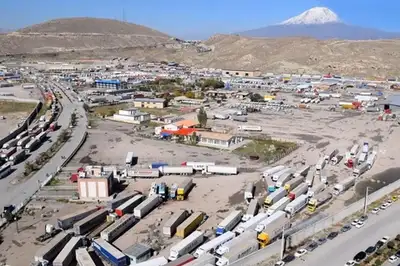
Iran could try to move some oil overland to Turkey, Pakistan, Afghanistan and Uzbekistan, Hosseini said, but he put that capacity at only 250,000 to 300,000 barrels a day.

Other options, including rail shipments of some oil products to China, may be difficult and less economical. Bloomberg added that Chinese “teapot” refineries rely on discounted crude and thin margins, while the U. Treasury has also imposed new sanctions on individuals and networks tied to Iran’s “shadow banking” system, including buyers linked to those refineries.

Analysts said Iran still has tools to keep parts of the system running. Vortexa estimates Iran has access to 65 million to 75 million barrels of floating storage capacity, equivalent to roughly 37 very large crude carriers, both inside and outside the blockade.

That capacity may buy Tehran time, but how much depends on how strictly the US enforces the blockade.

Claire Jungman, director of maritime risk and intelligence at Vortexa, told Bloomberg that Iran’s use of floating storage, ship-to-ship transfers and older tankers means its system has not fully broken.

“This allows flows to continue in the near term, even under tighter enforcement,” she said. “We would frame this as a constrained but functioning system, rather than a full disruption.”

‘Permit for a terrorist’: Canada opposition asks who cleared ex-IRGC official’s entry

May 2, 2026, 09:28 GMT+1
•
Negar Mojtahedi

The Canadian opposition has accused the government of bypassing its own rules after Iran International reported that an IRGC-linked Iranian football official was granted special permission to enter the country despite being inadmissible.

Iran International’s reporting was followed by political backlash in Ottawa, international coverage and Mehdi Taj being turned back within hours of landing in Canada.

Speaking to Iran International’s Eye for Iran, Melissa Lantsman, deputy leader of Canada’s Conservative Party, said the case raised serious questions about who approved Mehdi Taj’s entry and why.

“We need to know who did it, when it happened, how it happened, why it happened, and why it’s never going to happen again,” Lantsman said.

Taj, president of Iran’s football federation, had been expected to travel to Vancouver for the FIFA Congress on April 30 at the Vancouver Convention Center.

Iran International previously reported that Taj was issued a Temporary Resident Permit, or TRP, a tool that allows Canadian authorities to admit a person who would otherwise be barred under immigration law.

Canada listed the IRGC as a terrorist entity in 2024, making people linked to the force inadmissible. Taj has longstanding ties to the Islamic Republic’s security establishment and previously served as an intelligence commander in the IRGC in Isfahan.

Lantsman said the permit showed that the issue was not simply a screening failure.

“Somebody actively made this decision to circumvent our own rules,” she said.

“I can’t believe that I work in a place with a minister who would issue a terrorist a permit.”

Taj was able to board a flight to Canada and land in Vancouver. He was sent back within hours, after Iran International’s reporting on the case had already become public.

That sequence has become central to the political fallout in Ottawa. Critics say the government acted only after the case drew public attention, while ministers have declined to discuss details, citing privacy rules.

Lantsman rejected that explanation in the podcast interview.

“We don’t give privacy to terrorists,” she said. “There is no privacy to people who are inadmissible to our country.”

  • Iran football chief with IRGC ties sent back by Canada after arrival

    Iran football chief with IRGC ties sent back by Canada after arrival

  • Ottawa on defensive after Iran football chief linked to IRGC entered Canada

    Ottawa on defensive after Iran football chief linked to IRGC entered Canada

The issue quickly reached Parliament.

Opposition MPs pressed ministers to explain how a person barred under Canada’s own rules received permission to enter the country.

At Thursday’s meeting of the Standing Committee on Public Safety and National Security in Ottawa, Conservative MP Frank Caputo asked Immigration Minister Lena Diab how a person deemed inadmissible had been granted entry.

Caputo said “the rule of law demands transparency” and asked “who gave him a visa,” saying Iran International’s reporting had brought the case to public attention.

Prime Minister Mark Carney declined to comment on Taj’s case, citing privacy laws, but defended the government’s position on the IRGC.

“Members of the [Iranian] Revolutionary Guard rightly have been prohibited from entering this country and they will not enter this country,” he said.

Foreign Affairs Minister Anita Anand suggested the permit may have been granted and later revoked, saying her understanding was that “there is a revocation of the permission” and that “it was unintentional.”

Lantsman said that response only deepened the need for answers.

“If they unintentionally gave him a permit, then we need to know how that happened and why it happened,” she said. “And if the unintentionality of it was about the revocation, that’s even worse.”

The controversy has turned a single immigration decision into a broader political test of Canada’s handling of officials tied to the Islamic Republic.

Although Canada has formally banned the IRGC, Temporary Resident Permits allow authorities to override inadmissibility in certain cases. Taj’s case has raised questions about how such exceptions are approved and what safeguards exist when national security concerns are involved.

The controversy also comes as anger continues over the Islamic Republic’s crackdown on protests in January, with the IRGC at the center of the state response. Rights groups and Iranian activists have described the violence as among the deadliest episodes in modern Iranian history.

At least three Iranian footballers have been killed during the unrest. Ali Karimi, Iran’s former national team captain, has criticized FIFA’s silence and called on the organization to condemn the killing of athletes and speak out against the crackdown.

Lantsman said the opposition has submitted formal questions in Parliament and would continue pressing the government for details.

“This cannot happen,” she said. “We’re going to continue to keep the pressure on.”

The case has also drawn wider attention beyond Canada. The New York Times, USA Today, Agence France-Presse and The Canadian Press have covered the incident, citing Iran International’s reporting.

For Lantsman, the central issue remains who approved the permit and why.

“Somebody in Canada, somebody very high up in the ministry, decides that it’s in public interest of Canada to have this person here,” she said.

The government has yet to publicly identify who authorized the permit, why it was issued, or what measures are being taken to prevent a similar case.