Iran says acting intelligence minister appointed, name to be announced later | Iran International
Iran says acting intelligence minister appointed, name to be announced later
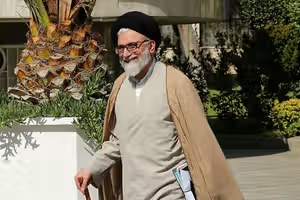
An acting intelligence minister was appointed immediately after the killing of Intelligence Minister Esmail Khatib, a communications aide to President Masoud Pezeshkian said on Sunday.
Mehdi Tabatabaei, deputy for communications and information at Pezeshkian’s office, said the appointment order was issued by the president and conveyed to the relevant authorities, but added that the name of the acting minister would be announced at an “appropriate time.”

Many Iranians say the year 1404 (which ended on March 20) was among the darkest they remember, yet as Nowruz arrives, its rituals offer a fragile but enduring sense of hope in even the most desperate times.
For many Iranians, the holiday is more than a celebration—it is an assertion of life in the face of uncertainty, a reminder that renewal is always possible, even in the darkest of years.
Iranians celebrate Nowruz at the exact moment of the spring equinox, which fell on the afternoon of March 20 this year. In Tehran, the atmosphere on Friday was described as surreal.
As people waited for the official announcement on television, a brief rain gave way to sunlight, and a double rainbow stretched across the sky. Images quickly circulated online, with many calling it a good omen for the country.
But the moment of celebration was short-lived. Just after the New Year was announced and greetings began, air defenses roared to life and explosions echoed across the capital. This marked the first time since the 1980s that Iranians were observing Nowruz during wartime.
For many, the outgoing year was defined by loss and upheaval. Social media has been filled with accounts describing it as a period of “pain and calamities,” marked by two wars, widespread displacement, and the bloodiest crackdown in history. Hundreds of thousands have reportedly fled their homes—twice in a single year—seeking safety elsewhere.
Davoud Heshmati, an Iranian journalist, captured the sentiment in a short post: “In these final hours of the year, it seems to me that what we can all agree on is that the year 1404 was a year of darkness.”
Grief remains fresh. Many mourn those killed in January, victims of the recent strikes and those of the 12-day war in June, and at least five young men executed in the final days of the year for political reasons.
Yet amid the trauma, the rhythms of Nowruz persist, albeit with far less energy and enthusiasm than in the past. In markets and homes, people continue to prepare for the holiday, clinging to rituals that symbolize renewal.
One user wrote: “The city is truly buzzing with the vibrancy of the holiday—shopping for sprouted grains, flowers, and sweets. How fortunate we are that, amid the war and its endless fear, Nowruz still keeps us standing tall.” Another added: “As long as Nowruz is alive we are too.”
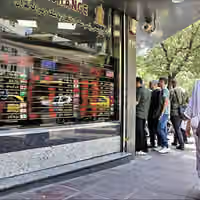
Images from Tehran’s Tajrish Bazaar—once packed with shoppers buying new clothes, sweets, and traditional items for the Haft-Seen table—have circulated widely in recent days. The display typically includes symbolic objects such as sabzeh (grain sprouts), wheat pudding, flowers, candles and goldfish. This year, however, the crowds appear thinner.
“Street vendors say in all these years, even during COVID, the place was never this quiet,” one Tehran resident noted online.
For those who did venture out, the experience was shaped by the realities of war. Faezeh, a Tehran resident, described using a brief period of calm to prepare for the holiday. “While laying the Haft-Seen I was thinking about how to place things so they won’t fall by tremors from the strikes. How resilient are humans?” she wrote.
In another post, she recounted how the sound of explosions and air-defense systems has become part of everyday life, along with the unsettling sight of destroyed buildings that had stood only hours earlier.
Yet even amid such scenes, many emphasize the symbolic power of Nowruz. “Above our heads is the roar of fighter jets and the sound of explosions, but here in the heart of the city, the pulse of life beats for Nowruz. Amid such darkness, we buy flowers and lay the Haft-Seen; because this ritual is our fortress. What has remained proud and eternal through the tempests of history... is Iran, Iran, Iran,” another user wrote.
Economic pressures have compounded the sense of crisis. Prices have surged, jobs have been lost, and some businesses—already weakened by the June conflict and the January crackdown—have shut down or failed to pay New Year bonuses. Reports from both media and social platforms suggest layoffs are becoming widespread.
At the same time, a prolonged internet shutdown—now stretching into its third week—has deepened the isolation felt by many Iranians. For families split between Iran and the diaspora, the inability to communicate during the New Year has been especially painful.
In a reflection of this frustration, Vahid Online played on the traditional greeting “May your every day be Nowruz!” by writing: “May your every day be ‘online’!”
UK Housing Secretary Steve Reed said there is no assessment supporting claims that Iran plans to strike European capitals or has the capability to do so
The comments came after Israeli officials said Iran had fired a long-range missile toward Diego Garcia and warned that European cities could also be within range.
"We have systems and defenses in place that keep the United Kingdom safe, and that will continue to happen, but the PM has been crystal clear about this war,” Reed told Sky News's Sunday Morning With Trevor Phillips program.
"We didn't join the war, we're not going to be dragged into this war, but we will take necessary defensive action to protect British interests, British people, or our allies across the region.”
Diego Garcia lies about 3,800 km (2,360 miles) from Iran, while the distance between Iran and the United Kingdom is roughly 4,400–5,000 km (2,700–3,100 miles), depending on the reference points used.
Iran’s Defense Ministry said on Sunday that the armed forces and the ministry would continue what it called “uninterrupted combat” until the enemy comes to a complete halt and surrenders.
Defense Ministry spokesman Reza Talaei-Nik said the Islamic Republic has the capability to target any source of threat against it, “even beyond Israel,” anywhere in the region.