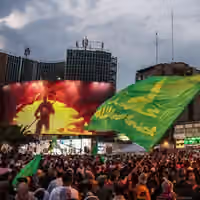
Larijani's son, deputy, senior Basij commander also killed in Israeli strike


The Israeli airstrike that killed Iran's top security official Ali Larijani also killed his deputy at the Supreme National Security Council Ali Bateni as well as Larijani’s son, who served as his special assistant, informed sources told Iran International.
Qassem Qoreishi, deputy head of the Basij paramilitary organization, was also killed in the Israeli strike on the Basij meeting, the sources said.
The meeting was held to discuss how to confront potential protests during the Persian festival of Chaharshanbeh Suri (Fireworks Wednesday), which is now underway in Iran.




"The assassination of Larijani was made possible thanks to valuable intelligence that Israeli intelligence services received from residents of Tehran over the past 24 hours," an Israeli official told Iran International.
"In recent days, Larijani had behaved arrogantly, appearing frequently in public (including at Quds Day rallies), engaging with both local and international media, and thereby exposing himself to public view, which ultimately led to his identification," the official said.
The Israeli official added that the country's intelligence services continue to receive numerous reports that "precisely guide them to the locations of Basij and IRGC checkpoints, significantly aiding their efforts."
Around 300 Basij commanders and field officials were killed in a wave of overnight strikes on key command and operational centers of Iran’s Basij forces, Iran International has learned.
The strikes appeared to hit the logistics and command structure of a force long used to suppress dissent and confront anti-government protests.
In one of the most critical attacks, a Basij support unit’s repair and maintenance center was hit. The site housed hundreds of vehicles and motorcycles used in street operations and neighborhood patrols. Initial reports said the fleet was destroyed.
Facilities linked to the Mohammad Rasoulollah Corps, the IRGC unit responsible for the greater Tehran area, were struck.
The Imam Hadi security unit, a strategic command center in Tehran, was also heavily damaged.
The Imam Ali security battalions, which have played a central role in cracking down on protests, also suffered heavy personnel and equipment losses.
Exiled Prince Reza Pahlavi said the Islamic Republic’s weakening grip on internal repression is bringing closer the moment when Iranians could once again take control of the streets.
He said in an interview with Iran International aired on Monday that a final call for nationwide demonstrations to end the Islamic Republic would come once the authorities’ coercive apparatus had been sufficiently weakened.
“I think all of us, after 47 years of dealing with this criminal government, are counting the days until this system finally disappears,” Pahlavi said in the interview with Morad Vaisi.
“We want to reach the day after its collapse, when the people of Iran can achieve what they truly deserve: complete freedom and an opportunity to rebuild and prosper.”
Many Iranians, Pahlavi added, are hoping that moment will arrive soon but argued that strategy and timing remain critical.
“Conditions must also be taken into account,” Pahlavi said. “As everyone has seen, this government has no hesitation in suppressing people. It is prepared to see hundreds of thousands killed if that means staying in power. Therefore the movement must proceed intelligently. The final call will be issued at the right moment.”

Opposition strategy focuses on weakening security forces
Pahlavi argued that recent developments had already eroded the Islamic Republic’s ability to rely on its security institutions.
The weakening of the Islamic Revolutionary Guards Corps and the Basij militia, he said, was central to opposition strategy, describing foreign military pressure and domestic activism as factors that had shifted the balance.
“This campaign delivered a very heavy blow to the structures of repression in the Revolutionary Guards and the Basij,” Pahlavi said.
Beyond external pressure, he talked about what he described as covert organizing inside the country, including activities by a network he called the “Immortal Guard.”
The network, according to Pahlavi, operates inside Iran and carries out coordinated actions intended to undermine the state’s coercive institutions.
“Groups inside the country, members of the Immortal Guard, through organization and coordinated work, have the ability to deliver further blows from within,” Pahlavi said. “Many of the developments we have seen in the country did not occur spontaneously but were the result of organized work.”
He described the network as emerging from within society and said its activities were aimed at protecting civilians while targeting institutions used for repression.
“The Immortal Guard is born from the people themselves,” Pahlavi said. “At this stage it plays a defensive role, helping protect people’s lives and striking institutions that the authorities use to spread fear and violence.”
Appeal to security forces
Pahlavi also used the interview to address members of Iran’s armed forces and police, urging them to distance themselves from the authorities.
“You still have the opportunity to join the people and separate yourselves from the system and its repressive forces,” Pahlavi said. “You can be part of the solution for the future of the country.”
He warned that those who continue to support the government could face accountability if political change occurs.
“Those who choose to remain defenders and guarantors of this system’s survival will have to answer to the people tomorrow,” Pahlavi said.
At the same time, he sought to reassure members of the military establishment that a future political transition would not necessarily exclude them.
“I come from a military family and I myself was a pilot,” Pahlavi said. “I understand the value of those who defend their country. Whether in the army, the police, or the gendarmerie, we need these individuals to maintain the security of the nation.”
Pahlavi said that anyone not involved in violence against civilians should be able to play a role in the future political system.
“As long as someone’s hands are not stained with the blood of the people, there is no reason they cannot serve in the future of the country,” he added.
Plans for transition after collapse
Pahlavi also described planning efforts for a transitional period following the fall of the Islamic Republic, referring to an initiative known as the “Prosperity Project.”
The effort, he said, involves specialists across various fields preparing proposals for how the country could be governed immediately after a political transition.
“The purpose of the Prosperity Project is to ensure that beyond political activists, professionals and experts are also planning for the future,” Pahlavi said.
He cited areas such as the judiciary, economic policy, health care, and education as subjects under discussion.
“For example, legal experts can explain how justice should be implemented during the transition and how officials of the current system should be handled,” he said. “Economists can outline how to rebuild the economy and attract investment.”
Pahlavi said existing state institutions and civil servants would likely continue operating temporarily to prevent administrative breakdown.
“During an emergency transition period, the country will need to be run by the existing institutions and ministries,” Pahlavi said. “These employees must continue their work until we reach the stage where the future political system is determined.”
The long-term political structure, he said, would ultimately be decided by a constituent assembly and national referendum.
Return to Iran
The exiled prince also said he intends to return to Iran as soon as circumstances permit, even if the Islamic Republic still formally holds power.
“I do not know where the first liberated area will be and it may not necessarily be Tehran,” Pahlavi added. “But as soon as conditions allow, I would prefer to be inside Iran among my compatriots.”
He suggested that his presence inside the country could accelerate defections from state institutions.

“My presence in Iran could encourage faster defections among the forces of the Islamic Republic and help them join the people,” Pahlavi said. “I am ready to accept all necessary and calculated risks in order to return to my country.”
National identity and protest movement
Throughout the interview, Pahlavi framed the opposition movement as a national project rooted in Iranian cultural identity.
He argued that the country’s traditions and historical symbols had played an important role in sustaining resistance to the authorities.
“This uprising is a national movement built around our Iranian identity,” Pahlavi said. “From the first days, the Islamic Republic confronted cultural traditions such as Nowruz and Chaharshanbe Suri (fire festival) because Iran itself was not their priority.”
Despite acknowledging the risks involved in confronting the state, Pahlavi said he believes the authorities will ultimately fail to maintain control.
“I have no doubt that this system will eventually disappear and the people will prevail,” Pahlavi said. “The important thing is that we continue our movement according to the calls that are issued and remain committed to rebuilding the country.”
Signs of discontent, low morale, financial strain and desertion are spreading among parts of Iran’s security and military forces, Iran International has learned.
Members of the Special Units Command received a notice on Friday saying salary payments for some units had run into problems, according to people familiar with the matter. The delay marked the third time this year that wages for those forces are being paid late.
Following the delays, some personnel refused to attend pro-government gatherings, the sources said, causing disruptions in deployment in some major cities.
Retirees and some army personnel have also not been paid for a second straight month.
Some senior commanders accuse the Islamic Revolutionary Guard Corps of using the financial crisis at Bank Sepah to weaken the police force and strengthen other institutions, especially bodies tied to the clerical establishment.
Signs of discontent, low morale, financial strain and desertion are spreading among parts of Iran’s security and military forces, Iran International has learned.
Members of the Special Units Command received a notice on Friday saying salary payments for some units had run into problems, according to people familiar with the matter. The delay marked the third time this year that wages for those forces had been paid late.
Following the delays, some personnel refused to attend pro-government gatherings, the sources said, causing disruptions in deployment in some major cities.
Retirees and some army personnel have also not been paid for a second straight month.
Some senior commanders accuse the Islamic Revolutionary Guard Corps of using the financial crisis at Bank Sepah to weaken the police force and strengthen other institutions, especially bodies tied to the clerical establishment.