• Iran Insight
  • Politics
  • Economy
  • Analysis
  • Special Report
  • Opinion
  • Podcast
All rights reserved for Volant Media UK Limited
volant media logo
  • العربية
  • فارسی
Brand
  • Iran Insight
  • Politics
  • Economy
  • Analysis
  • Special Report
  • Opinion
  • Podcast
  • Iran Insight
  • Politics
  • Economy
  • Analysis
  • Special Report
  • Opinion
  • Podcast
  • Theme
  • Language
    • العربية
    • فارسی

Iran urges regional countries to trust Tehran, not US

Mar 14, 2026, 08:15 GMTUpdated: 11:11 GMT

Countries in the Middle East should trust Iran rather than the US, said spokesperson for the General Staff of Iran’s armed forces even as Iranian attacks continued targeting the neighboring states.

Abolfazl Shekarchi warned regional governments not to rely on what he called America’s “hollow power,” saying the United States could not even defend its own forces or provide security for Muslim countries.

He called on regional states to trust the Islamic Republic and urged unity across the Muslim world against the US and Israel.

Most Viewed

Trump says regime change in Iran will happen but not ‘immediately’
1

Trump says regime change in Iran will happen but not ‘immediately’

2
ANALYSIS

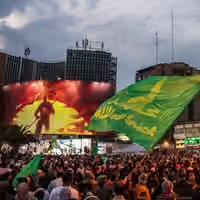
Iran raises ‘human shield’ fears by rallying supporters to the streets

3
EXCLUSIVE

Iran pays Lebanon parliament speaker $500,000 a month to maintain influence

4

IRGC threatens harsher crackdown if protests return

5
OPINION

Russia gains from Iran war but risks more if it drags on

Banner
Banner

Spotlight

  • Iran raises ‘human shield’ fears by rallying supporters to the streets
    ANALYSIS

    Iran raises ‘human shield’ fears by rallying supporters to the streets

  • Russia gains from Iran war but risks more if it drags on
    OPINION

    Russia gains from Iran war but risks more if it drags on

  • Allies rally, rivals brace after Mojtaba Khamenei’s rise
    INSIGHT

    Allies rally, rivals brace after Mojtaba Khamenei’s rise

  • Checkpoint attacks open new front in Iran war
    INSIGHT

    Checkpoint attacks open new front in Iran war

  • Power vs piety: Khamenei Jr inherits legitimacy dilemma of Iran's theocracy
    ANALYSIS

    Power vs piety: Khamenei Jr inherits legitimacy dilemma of Iran's theocracy

  • Can widening the war save Iran’s rulers?
    ANALYSIS

    Can widening the war save Iran’s rulers?

•
•
•

More Stories

Homes shake as blasts hit Tabriz and Urmia, witnesses say

Mar 14, 2026, 08:04 GMT

Powerful explosions shook Tabriz and Urmia on Saturday morning, according to eyewitness accounts sent to Iran International.

Between seven and eight explosions were heard in Tabriz, where homes shook several times early in the morning and several more blasts were heard across parts of the city around 8:30 am.

The strikes hit the Iranian Diesel Engine Manufacturing factory, a steel plant, and a ball bearing manufacturing company in Tabriz, witnesses said.

A witness in Urmia also said a aloud blast was heard around 8:30 am and was followed by shaking similar to an earthquake.

Mass arrests, intensifying crackdown sweep Iran amid attacks

Mar 14, 2026, 07:57 GMT
•
Reza Akvanian

Iranian authorities have launched a sweeping wave of arrests and tightened domestic repression as US and Israeli strikes continue to hit military facilities and security institutions tied to the Islamic Republic.

Hundreds of people have been detained across the country over the past two weeks, according to information reviewed by Iran International and local reports. Many detainees’ identities, locations of detention and legal status remain unknown.

Arrests have been reported in multiple provinces including East and West Azarbaijan, Alborz, Isfahan, Tehran, Khuzestan, Kordestan, Kerman, Kohgiluyeh and Boyer-Ahmad, Gilan, Lorestan and Yazd. Authorities have accused detainees of offenses such as “disturbing public opinion,” “propaganda against the system,” “online activities,” “disrupting public security,” and “cooperation with hostile countries.”

State television and security-linked outlets have simultaneously broadcast forced confessions from some detainees, raising concerns among rights advocates that the statements could be used to justify prosecutions. Human rights organizations have repeatedly criticized the Islamic Republic for using televised confessions obtained under pressure as evidence in court proceedings.

Officials have accompanied the crackdown with increasingly explicit threats.

Ahmadreza Radan, commander of Iran’s police, said more than 80 people had been arrested for spreading “disturbing content” online. He added that thousands of others had received warning text messages over posts deemed to spread panic.

Radan also warned that police would respond forcefully to any street protests, saying officers would be “ready to pull the trigger” if demonstrations occur.

Meanwhile, state television aired a program in which a presenter threatened government opponents, saying authorities would eventually pursue them whether they were inside or outside the country.

Security agencies have also reported new arrests linked to alleged espionage. The Islamic Revolutionary Guards Corps said six people were detained in Kordestan province and one individual was killed during an operation. The Guards-affiliated Fars website reported that intelligence forces arrested 50 people in Kohgiluyeh and Boyer-Ahmad province. The Intelligence Ministry said at least 30 others were detained on accusations of spying for the United States and Israel.

Authorities have also targeted those documenting the conflict. The ministry warned that filming or photographing strike locations could amount to acting as the “enemy’s fifth column.” Guards intelligence officials said some individuals who sent images of attacks to media outlets had already been arrested.

Internet disruptions have further limited the flow of information. The monitoring group NetBlocks reported that a nationwide internet blackout continues for hundreds of hours.

The group warned the shutdown posed a direct threat to civilians by restricting access to vital information. With communications cut in many areas, families of detainees say they often do not know where relatives are being held.

Threats have also extended beyond Iran’s borders. The office of Iran’s prosecutor general issued a statement warning Iranians abroad that assets could be seized and severe penalties imposed if authorities determine they have “cooperated with the enemy.”

The statement broadly defined such cooperation as providing intelligence or engaging in activities benefiting Israel, the United States or other “hostile states.” Officials said legal proceedings against such individuals had entered an “operational phase,” including asset identification and confiscation.

At the same time, reports have emerged of expanded security deployments in cities nationwide. Revolutionary Guards and Basij units have established checkpoints in urban areas, with citizens reporting aggressive searches of vehicles and mobile phones.

A resident of Tehran told Iran International that police at a checkpoint in Haft-e Tir Square forced him to unlock his phone and searched through his calls, photos and videos.

Another resident in Isfahan said Basij personnel threatened him and his family with weapons during an inspection at a busy city square. According to the witness, officers treated civilians as if they were the enemy.

Security checkpoints themselves have increasingly become targets in the ongoing conflict. Video circulating online shows drone strikes hitting Basij checkpoints and equipment in Tehran.

The Fars website reported that at least 10 Basij and security personnel stationed at checkpoints in the capital were killed in strikes on Wednesday evening. Additional attacks on similar positions have been reported in other cities.

The Israeli military later said its air force had targeted Basij checkpoints and personnel in Tehran, describing them as part of the Islamic Republic’s internal security apparatus used to suppress dissent.

Data from the US-based Armed Conflict Location & Event Data Project recorded at least 18 Israeli strikes on Basij checkpoints on Wednesday alone, most of them in Tehran.

The arrests and heightened street controls come as Iran’s prison system is already under severe strain following previous protest crackdowns that saw tens of thousands detained. Human rights groups say many prisons face overcrowding, poor sanitation and shortages of basic supplies.

At the same time, some detention facilities and intelligence buildings have reportedly been damaged in airstrikes, raising further uncertainty about where newly arrested individuals are being held.

With communication restrictions still in place and many detentions unacknowledged by authorities, families and rights advocates say concerns are growing about the fate of hundreds of people detained during one of the most volatile periods in Iran in years.

Hamas urges Iran to avoid targeting neighboring countries

Mar 14, 2026, 06:12 GMT

Hamas on Saturday urged the Islamic Republic to avoid targeting neighboring countries while reaffirming Iran’s right to defend itself against Israel and the United States.

“While affirming the right of the Islamic Republic of Iran to respond to this aggression by all available means in accordance with international norms and laws, the movement calls on the brothers in Iran to avoid targeting neighboring countries,” Hamas said in a statement.

Pahlavi calls on Iranians to wait for moment to challenge Islamic Republic

Mar 14, 2026, 06:05 GMT

Iran’s exiled Prince Reza Pahlavi urged Iranians not to rush into protests, saying civilians should wait until conditions are more favorable to challenge the Islamic Republic.

Pahlavi said a better opportunity to take to the streets could emerge soon following continued US and Israeli strikes on Iranian targets and possible defections from within the government.

“I think at the end of this campaign, certainly the opportunity will create itself again, and that will be a safer time for people to retake the streets,” Pahlavi said in an interview with New Nation on Friday.

He said the ongoing military campaign had weakened the morale of the Islamic Republic’s security forces and could create the conditions for a broader uprising.

He also pointed to signs of possible dissent inside the system, saying there were indications some officials and personnel were refusing orders or failing to report for duty.

While he did not offer a precise timeline, Pahlavi said the moment for renewed protests could come in the “very near future.”

Missile strikes helipad inside US Embassy compound in Baghdad

Mar 14, 2026, 05:32 GMT

A missile hit a helipad inside the US Embassy compound in Baghdad early Saturday, two Iraqi security officials said.

Footage from the Associated Press showed a column of smoke rising over the sprawling embassy complex, one of the largest US diplomatic facilities in the world.

The compound has previously been targeted by rockets and drones launched by militias aligned with Iran. The US Embassy in Baghdad did not immediately comment on the incident.

On Friday, the embassy renewed its Level 4 security alert for Iraq, warning that Iran and allied militia groups have carried out attacks against US citizens, interests and infrastructure and could continue to do so.