Officials in Tehran say the sums are meant to “buy” unity among Lebanon’s Shiite leadership to ensure that they “act in accordance with Iran’s interests, not Lebanon’s interests.”
Nabih Berri did not respond to Iran International’s request for comment. One of his advisers said that Berri would not comment on the matter at this time.
Berri has not publicly opposed Hezbollah’s attacks on Israel in support of Iran, the sources said, because he does not want to risk losing his financial resources.
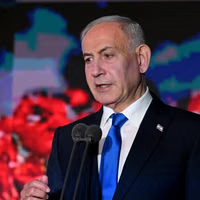
The 88-year-old politician heads Lebanon's Amal Movement and holds significant sway in Lebanon’s domestic and foreign policy.
The Shiite organization, formed in the 1970s, remains one of the country’s main political actors. It maintains close political ties with Hezbollah, and both belong to Lebanon’s Shiite political camp.
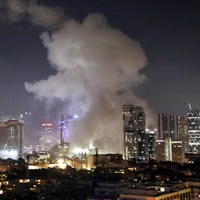
On March 1, Hezbollah targeted Israel in support of Tehran. Israel launched a new military operation in retaliation.
The sources said Berri has been unwilling to support efforts by the Lebanese government to disarm Hezbollah because, in exchange for receiving large sums from Tehran, he must “advance measures in the Lebanese parliament that align with Tehran’s interests.”
In recent months, Lebanon’s President Joseph Aoun and Prime Minister Nawaf Salam have tried to pressure Hezbollah to disarm in order to reduce tensions with Israel and the international community.
Army forces have confiscated Hezbollah weapons in parts of southern Lebanon, but senior Lebanese officials have said that fully implementing the plan could trigger internal tensions, as Hezbollah has refused to hand over its entire arsenal.
Hezbollah Secretary-General Naim Qassem and officials of the Islamic Republic have repeatedly opposed disarming the group.
Following Hezbollah’s attack on Israel, the Lebanese government announced that the group's military activities would be banned.
On March 6, Israeli Defense Minister Israel Katz warned the Lebanese government that if it remains unable to fulfill its commitments regarding Hezbollah’s disarmament, Lebanon will “pay a very heavy price.”
Tehran considers Hezbollah one of the main pillars of the so-called Axis of Resistance—a term used by Iranian officials to refer to allied armed groups such as Hamas, Islamic Jihad, Hezbollah, Iraq’s Popular Mobilization Forces, and the Houthis in Yemen.
The Wall Street Journal reported in November 2025 that Tehran transferred hundreds of millions of dollars in oil revenue to Hezbollah in the preceding year through exchange offices, private companies and a financing network in Dubai.
Israel’s Kan network reported in December 2025 that Tehran had agreed to pay $1 billion to Hezbollah.
Neither report can be independently verified by Iran International.
The office of the Speaker of Lebanon’s Parliament, in a statement issued after the article was published, called the claim "false and baseless."