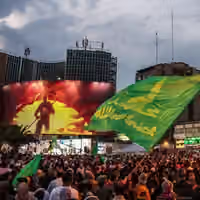
Following the death of Ali Khamenei and the elevation of Mojtaba Khamenei, the Islamic Republic of Iran Broadcasting (IRIB) emphasized that the state—not any individual—is the true source of stability.
IRIB’s rolling news channel, IRINN, repeatedly declared: “The Islamic Republic of Iran is not dependent on a single individual. It is a system based on the rule of law and divine values.”
After the Assembly of Experts named Mojtaba leader on March 9, state television pivoted to stressing the decisiveness of the vote.
Despite reports of clerical unease about the process, IRIB described the outcome as reflecting an 85 percent consensus and presented it as both legally sound and religiously sanctioned.
Broadcasts featured pledges of allegiance from the Revolutionary Guards, the military, the diplomatic corps and even the national football team as evidence of unified support.
Because the transition unfolded during an active conflict with Israel and the United States, state television fused the succession narrative with imagery of military strength.
Shortly after Mojtaba’s appointment, IRIB aired footage of missile launches toward Israel under the caption: “At your command, Sayyid Mojtaba,” invoking both his lineage and his role as wartime commander-in-chief.
The messaging aligned with broader official rhetoric, with security chief Ali Larijani and parliament speaker Mohammad Bagher Ghalibaf both rejecting calls for a ceasefire and signaling that Iran would continue strikes.
These narratives circulated even as Mojtaba himself remained absent from public view. His silence fueled speculation about his condition, with some commentators drawing religious analogies to the occultation of the 12th Imam, while others circulated unverified claims about his whereabouts.
At home, the messaging has been accompanied by tighter control. Iran’s police chief warned that anyone taking to the streets after encouragement from US and Israeli leaders would be treated as an “enemy” rather than a civilian protester—a signal that the space for dissent is narrowing further under wartime conditions.
References to dissent or worsening economic conditions have meanwhile largely disappeared from state coverage.
Skepticism about the hereditary nature of the succession has been framed as foreign psychological warfare, while relatively small pro-government gatherings are presented as signs of broad public enthusiasm.
For now, the message is clear: continuity over disruption, system over individual. But the carefully managed narrative also reflects the pressures facing the leadership at a moment of unusual uncertainty.