Azerbaijan’s Aliyev calls Iran drone hits on airport and school 'terror act'


Azerbaijani President Ilham Aliyev said Iran carried out a “terror act” against Azerbaijan by launching drones at the Nakhchivan Autonomous Republic and ordered the armed forces to prepare response measures.
Speaking at a Security Council meeting he chaired, Aliyev said Iranian drones targeted civilian sites including Nakhchivan International Airport, its terminal building and a school.
“A terror act has been committed against the territory of Azerbaijan and against the Azerbaijani state,” he said, adding that Iran must provide an explanation and apologize, and that those responsible must face criminal liability.
Aliyev said Azerbaijan would not take part in any operations against Iran and had previously assured Tehran that its territory would not be used against neighboring states. He added that Azerbaijan’s armed forces had been put on high alert and that diplomatic steps, including summoning Iran’s ambassador, were under way.
He also noted that earlier in the day Azerbaijan had helped evacuate Iranian embassy staff in Lebanon after a request from Tehran, and stressed that Baku would not participate in any operations against Iran.

Britain’s charity regulator issued fresh guidance on Thursday warning charities to exercise caution in their activities related to Iran as tensions in the region intensify, and said it would act on any evidence of links to extremism or terrorism.
The Charity Commission said charities could be affected in different ways by the “volatile situation” in Iran and the wider Middle East and urged trustees to carefully assess the risks of political activity, public statements and overseas operations.
The watchdog said organizations working in or commenting on Iran should be mindful that individuals and groups in the country are subject to sanctions and other restrictions under UK law.
“As a civil regulator we will respond robustly to evidence of links between charities and extremism or terrorism,” a Charity Commission statement said. “We will make referrals to other agencies where appropriate including where there is evidence of criminality.”
Trustees were reminded that any political activity must directly support a charity’s stated purpose and comply with regulations governing campaigning and social media use.
“In the current context, the Commission urges charities to be careful to ensure that any political activity they are involved in furthers their charity’s objects and complies with our guidance,” the regulator said.
The statement comes amid longstanding concerns in Britain that networks connected to Iran have used charities and religious organizations to promote political influence.
Several UK-based charities have faced investigations in recent years over alleged links to groups aligned with Tehran.


In 2024, the Charity Commission opened a compliance case involving the London-based Dar Alhekma Trust and the Abrar Islamic Foundation following a dossier alleging connections to organizations backed by Iran. Both groups deny wrongdoing.
Other organizations have drawn political criticism over activities seen by some lawmakers as promoting narratives aligned with the Islamic Republic. Conservative MP Bob Blackman last year accused Iran-linked groups of exploiting Britain’s charity sector to expand influence and “sow discord” in local communities.
Security officials and lawmakers have also warned that Tehran has used networks in Europe to extend ideological influence, even as regulators emphasize the need to balance scrutiny with protections for lawful religious and charitable activity.
Israel’s military said it had completed a 12th wave of strikes in Tehran, targeting security and military sites linked to Iran’s authorities.
In a statement posted by its Farsi-language account, the military said strikes in Alborz province hit the headquarters of a special unit responsible for overseeing police forces and commanding units in the province.
It said that in other areas of Tehran it targeted sites belonging to the Islamic Revolutionary Guard Corps and the Basij, as well as a central headquarters of internal security forces.
The military added that dozens of other headquarters and sites used for storing and producing various types of weapons were also struck.
Iran’s intelligence ministry said it had struck positions of Kurdish fighters it accused of preparing to enter the country through its western borders, inflicting heavy losses on them, according to a statement carried by state media on Thursday.
The ministry said the operation was carried out jointly with the Islamic Revolutionary Guard Corps and resulted in the destruction of bases and ammunition depots belonging to the groups.
“Separatist terrorist groups intended to enter the country through the western borders, with the support of the American and Zionist enemy, and carry out attacks in urban and border areas,” the ministry said. “A significant portion of their positions and facilities were destroyed and heavy losses were inflicted.”
The statement added that Iranian forces were coordinating with Kurdish residents in border areas to monitor movements and prevent attacks.
“Armed forces and intelligence units, with the cooperation of courageous Kurdish compatriots, will thwart the American-Zionist enemy’s plans for any aggression against the country’s territory,” the ministry said.
Border officials reject infiltration reports
Local authorities in the western border region denied reports that armed fighters had entered Iran.
“No report of infiltration or illegal movement of armed groups has been registered in this part of the border,” the governor of Qasr-e Shirin on the Iraqi border said, according to Iranian media.
The reports circulating on social media about armed groups crossing the western border had no factual basis, the governor added.
Meanwhile, Nechirvan Barzani, president of Iraq’s Kurdistan Region, said on Thursday that the autonomous region would not be part of any military confrontation or escalation.
A spokesperson for Iraq’s Kurdistan Regional Government also denied reports.
“Iraq's Kurdistan Regional Government denies reports claiming it is involved in plans to arm Kurdish opposition groups and send them into Iran,” the spokesperson said. “The Kurdistan Regional Government is not part of any campaign to expand war or tensions in the region.”
After joint Israeli-US strikes on Iran, the Islamic Republic and allied Shiite militias launched ballistic missile and drone attacks on Iraq’s Kurdistan Region, which hosts several Iranian Kurdish opposition groups in exile.
The strikes mainly targeted the regional capital, Erbil, where explosions, air-raid sirens and missile interceptions were reported.
Regional responses and US position
Regional officials and Washington also commented on Kurdish groups. Turkey said it was closely monitoring the activities of the Kurdistan Free Life Party (PJAK), an Iranian Kurdish opposition group linked to the Kurdistan Workers Party (PKK).

“The activities of groups that fuel ethnic separatism, such as the terrorist organization PJAK, negatively affect not only Iran's security but also the overall peace and stability of the region,” Turkey’s defense ministry told a weekly briefing in Ankara.
US Defense Secretary Pete Hegseth rejected reports that Washington planned to arm Kurdish groups.
“All I would say is none of our objectives are premised on the support or the arming of any particular force,” Hegseth said during a briefing on Wednesday.
White House press secretary Karoline Leavitt also dismissed reports that the administration was considering supplying weapons to Kurdish fighters to spark an uprising inside Iran, saying the claims had “no factual basis.”
The reports come amid speculation that Iranian Kurdish groups could play a role in the wider conflict.
Earlier this week, Axios reported that several Kurdish factions based in Iraq had recently formed a coalition and were preparing for a possible ground offensive into northwestern Iran, citing US and Israeli officials and a source within one of the groups.
The report said some fighters had moved closer to the border in recent weeks, though Kurdish factions have publicly denied launching any attack.
Axios also reported that US President Donald Trump had spoken with Kurdish leaders in Iraq about the war with Iran, while Israeli officials were said to be exploring ways Kurdish forces could increase pressure on Tehran.
Kurds are an ethnic group concentrated mainly in parts of Iran, Iraq, Turkey and Syria, with communities also elsewhere; because Iran does not publish official ethnic census data, estimates of the Kurdish population in Iran vary widely, commonly ranging from about 7 million to 15 million people, or roughly 8% to 17% of the population, with most living in Iran’s western and northwestern provinces near the borders with Iraq and Turkey.
Several Iranian Kurdish opposition parties based largely in Iraq’s Kurdistan Region – including Komala and the Kurdistan Democratic Party of Iran (KDPI) – have generally framed their demands around political rights and Kurdish self-rule within Iran, often describing that goal as autonomy in a federal system, while PJAK, an Iran-based Kurdish armed group aligned with the broader PKK-linked network, has advocated more sweeping political change and Kurdish self-determination.
Lufthansa has extended the suspension of flights to and from Dubai and Abu Dhabi through Tuesday, and to and from Tehran until May 1 due to the situation in the Middle East, the airline group said on Thursday.
“The Lufthansa Group continuously monitors and assesses the security situation in the Middle East and is in close contact with the authorities,” it said in a statement.
Flights to and from Larnaca, Tel Aviv, Beirut, Amman and Iraq’s Erbil are also suspended until later dates in March.
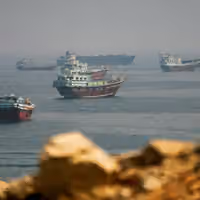
An Iranian remote-controlled boat laden with explosives was used to target and damage the Bahamas-flagged crude oil vessel Sonangol Namibe anchored in Iraqi waters, two Iraqi port security sources told Reuters.
The small boat exploded after hitting the vessel and marked the first recorded attack inside Iraq’s exclusive economic zone, the sources said, describing it as an escalation of threats to commercial shipping in the Persian Gulf.
The Revolutionary Guards said on Thursday they had hit a US vessel in the northern part of the Persian Gulf and that it was on fire.