Iran urges shift to diplomacy at UN rights council
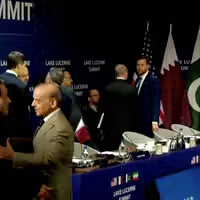
Iran’s deputy foreign minister for legal and international affairs Kazem Gharibabadi told the UN Human Rights Council that countries should turn to diplomacy instead of sanctions and war.
Speaking at the council session, Gharibabadi said states that “tested sanctions and war” should now “experience diplomacy.”
Gharibabadi said the Human Rights Council had become a tool in the hands of what he called false defenders of human rights and that human rights did not matter to them.
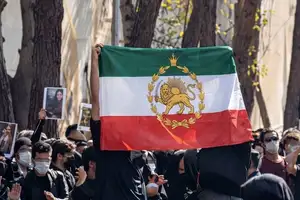
A scene of Iranian student protests on February 23, 2026
A wave of Iranian student activism adopting the pre-1979 Lion and Sun emblem has gathered pace in recent days, as protests entered a third consecutive day on Monday and spread across universities in Tehran, Isfahan and Mashhad.
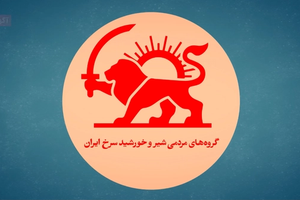
Statements circulated by students at the University of Tehran, Amirkabir University of Technology and Isfahan University of Technology announced the creation of Lion and Sun associations, calling for secular governance, territorial integrity and free elections, and voicing support for exiled Prince Reza Pahlavi as a transitional figure.
At the University of Tehran, a founding statement said students were acting “in solidarity with the people of Iran” and in memory of those killed in recent protests, including four students from the university.
A combination image shows altered university logos featuring the pre-1979 Lion and Sun emblem, shared by student groups during recent campus protests in Iran.
Similar statements were reported at Allameh Tabatabaei University, Iran University of Science and Technology and a branch of Islamic Azad University in Sari.
Videos shared by activists showed students raising the Lion and Sun flag on some campuses and chanting “Javid Shah” (Long live the Shah), alongside slogans such as “Death to the dictator,” “Woman, Life, Freedom,” and “Neither Gaza nor Lebanon, my life for Iran.”
Some students also referenced the former names of their institutions before the 1979 Islamic Revolution.
At Al-Zahra University, protesters chanted that the university should revert to its pre-revolution name, Farah Pahlavi University. A day earlier at Sharif University of Technology, students echoed calls to restore its former name, Aryamehr – a title used by Mohammad Reza Pahlavi during the pre-1979 monarchy.
In several instances, protesters burned the flag of the Islamic Republic.
Pro-government Basij-affiliated students held counter-gatherings on some campuses, where they burned US and Israeli flags and chanted slogans including “Death to the Shah,” a phrase closely associated with the 1979 revolution that toppled the monarchy.
University authorities and security forces signaled a tougher response as demonstrations spread.
The president of Sharif University of Technology, Masoud Tajrishi, warned students that the gatherings were “illegal” and said judicial authorities could intervene.
“The prosecutor has said this is not only a university matter and that we must step in,” he said, adding that some students had already been barred from entering campus and that the university could shift to fully virtual classes if unrest continued.
At Beheshti University in Tehran, security forces reportedly searched dormitory rooms late on Sunday in an effort to identify and detain protesting students.
Some students said they had received text messages informing them that disciplinary cases had been opened and that they were temporarily suspended pending committee decisions.
In Mashhad, students at local universities said participants in rallies had been threatened with expulsion.
At Amirkabir University, videos showed clashes between protesters and Basij members, with students accusing them of attempting to disrupt what they described as peaceful gatherings.
An Iranian lawyer said a court had sentenced a father to death and his daughter to 25 years in prison over their alleged involvement in the January protests.
Ali Sharifzadeh Ardekani said Branch 15 of the Revolutionary Court sentenced Mohammad Abbasi to death on a charge of “enmity against God” in connection with the killing of a police colonel during unrest in Malard. His daughter, Fatemeh Abbasi, was sentenced to 25 years in prison.
He said the case was referred to Branch 39 of the Supreme Court after an appeal but that the court declined to accept the family’s chosen lawyers at the review stage, citing procedural grounds. Sharifzadeh Ardekani said he was told the ruling was about to be issued and that new legal representation would not be accepted.
Judiciary-affiliated media have previously identified Mohammad Abbasi as the main defendant in the case and said the family of the slain officer had requested the death penalty.
Rights groups have repeatedly raised concerns over Iran’s handling of protest-related cases, citing the use of broad national security charges, limits on access to chosen lawyers and allegations of forced confessions and arbitrary detention.
President Donald Trump has a broad range of military options against Iran after a major US buildup in the Middle East, The Economist reported, saying the scale of forces suggests any action could go beyond a limited strike.
The magazine said Washington has deployed two aircraft carriers, around 200 fighter jets, surveillance aircraft and warships capable of firing cruise missiles, giving Trump the ability to launch a sustained air campaign if he chooses.
It said potential targets could include Iran’s nuclear facilities, ballistic missile bases, the Islamic Revolutionary Guard Corps and even senior leadership figures, though the consequences of any attack would be uncertain.
The report said Iran retains the ability to retaliate with ballistic missiles and drones against Israel or US bases in the region, raising the risk of a wider conflict even as diplomatic talks are expected to continue.
The president of Sharif University of Technology warned protesting students on Monday that legal authorities could intervene and that some could face entry bans if demonstrations continue.
Masoud Tajrishi told students the gatherings were “illegal” and said: “The prosecutor has said this is not only a university matter and that we must step in.”
He added that the university had barred some students from entering campus and warned: “If the number of those banned from entry increases, we will make the whole university virtual.”
A file photo shows the trading floor of the Tehran Stock Exchange in Tehran.
More than 107.8 trillion rials ($66.5 million) in retail money has flowed out of the Tehran Stock Exchange over the past 24 trading sessions, marking what analysts describe as a new phase of liquidity depletion driven by political uncertainty and fears of military escalation.
Habib Arian, a financial markets researcher, told ISNA that the turning point came on January 10, when the market recorded a one-day outflow of 9.4 trillion rials ($5.8 million), at the time the largest daily withdrawal of individual investor funds.
“That figure showed that trust, which is the main asset of the capital market, had been severely damaged,” Arian said. “From that date onward, the Tehran bourse was unable to return to an upward trajectory, and any positive fluctuation was treated as an opportunity to exit.”
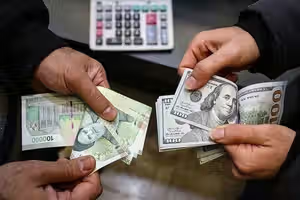
Outflows accelerated as regional tensions intensified and speculation grew about possible confrontation between Iran and the United States. Investors shifted from equities toward hard assets, pushing the dollar above 1,650,000 rials and lifting domestic gold prices sharply.
Between January 8 and February 21, the benchmark index fell 15% while 18-karat gold posted a 33% gain over the same period. Gold-backed funds rose 20%, emerging as a primary destination for funds exiting equities.
“The 48-percentage-point gap between gold and stocks explains why liquidity has fled the equity market at this speed,” Arian said.
On Sunday alone, the main index shed another 103,000 points as retail investors pulled out a record 41 trillion rials ($25.3 million) in a single session, according to market data cited by Arian.
He said the stock market was now driven less by economic fundamentals than by political risk. “The market today is more hostage to political tensions and the shadow of war than to economic variables,” he said. “As long as geopolitical risks do not subside, the capital market will continue to act as a liquidity provider for parallel markets.”
The exodus from stocks comes against a backdrop of broader capital flight and currency weakness.
The rial has traded around 1,630,000 per dollar in recent weeks, reflecting deep structural imbalances, falling oil income and persistent uncertainty surrounding nuclear negotiations and sanctions.
Analysts say the combination of record outflows from equities, a weakening currency and rising demand for gold shows the erosion of investor confidence, with households and businesses seeking safety in assets perceived as more resilient to inflation and political shocks.
“In this environment, investors prefer the security of gold and dollar-linked assets to the ambiguity of shares,” Arian said.