Iran denies defense in protester group death sentence case, lawyer says

Nineteen-year-old protester Mohammadamin Biglari has been sentenced to death in a group case tried alongside six other defendants, with the maximum punishment issued for all individuals in the case, Tehran-based news outlet Emtedad reported, citing his lawyer.
"The head of Branch 9 did not grant us permission to review the case file nor permission to present a defense," Emtedad quoted Biglari's lawyer Hassan Aghakhani as saying.
He added that Mohammadamin had been under his grandmother’s guardianship since childhood and had been working two jobs at the same time.










In Iranian culture, the fortieth day after a death is a solemn threshold. Families and friends traditionally gather at the grave, laying flowers, reciting prayers and receiving visitors – a ritual of grief that is both private and communal, and that often carries religious undertones.
This week, cemeteries were only part of the picture as mourners map memory onto the sites of violence. With so many deaths concentrated in urban centers and around hospitals, intersections and residential streets, memorials have spread outward from cemeteries into the everyday fabric of cities.
Videos sent to Iran International and others circulating on social media show flowers placed not only on graves but on asphalt, sidewalks and hospital entrances – at the very spots where protesters were shot.
In Shiraz, relatives and close friends of Hamidreza Hosseinipour covered the boulevard where he was killed in petals. In Tehran’s Sadeghieh Square, citizens gathered at the traffic circle where demonstrators had been shot, laying flowers in what is normally a site of rush-hour congestion.
In Tehranpars district of the capital, mourners placed flowers and candles outside a hospital where wounded protesters were taken and where some died.
In Mazandaran province, black balloons were released into the sky.
Schools, too, became sites of commemoration. Videos show groups of schoolgirls lighting candles and singing patriotic songs, marking the chehelom inside classrooms rather than in mosques.
The sites of commemoration have widened beyond the places where many Iranians once expected mourning to unfold. Where people believe their loved ones fell, they now leave photographs, flowers or pieces of clothing.
Pavements become shrines. Traffic circles are transformed into temporary altars. Hospital gates turn into gathering points. The geography of grief has changed.
There are simply too many dead, and too many sites tied to their final moments, for remembrance to remain confined to cemetery gates.
Even when ceremonies do take place at graves, the atmosphere captured in recent videos differs sharply from older conventions of public mourning, where religious elegies used to set the tone. Today, music and movement have emerged as ways of carrying grief.
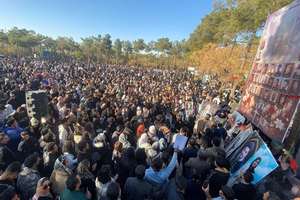
At Behesht Zahra cemetery in Tehran, footage shows families gathering and playing traditional musical instruments. In Najafabad, Isfahan province, mourners applauded and played music.
In Zanjan, kites were sent into the sky above the cemetery as names were read out.
In Shahreza, a video shows a traditional Qashqai dance performed during the fortieth-day memorial for 20-year-old Pouria Jahangiri, killed on January 8.
In Qarchak, near Tehran, mourners clapped in time to songs played for Hamid Nik, a resident who died after being hit during the crackdown. In another video from Najafabad, fireworks illuminate the night as people gather and chant.
In Mashhad, the memorial for Hamid Mahdavi – a firefighter whose act of carrying an injured protester on his back had spread widely online – took place not in silence but amid chants in the street: “For every one person killed, a thousand will rise behind them.”
These moments do not erase grief, they translate it.
The scenes appearing in recent weeks suggest a shift: not away from mourning itself, but away from a single, familiar language of mourning. Music, clapping, balloons released into the sky, kites and dance have become part of the ritual vocabulary.
After decades in which public mourning was steeped in official religious symbolism, the scenes in recent weeks suggest some are shaping something different: a mourning that is national in tone, public in form, and edged with defiance.
The fortieth day has long been a marker of closure in Iranian tradition – a moment when visitors thin out and life, at least outwardly, resumes.
But with flowers now laid on asphalt and candles lit at hospital doors, the boundary between mourning and daily life has blurred. The city itself has become the setting of remembrance – and, for many, the proof of how profoundly the culture of grief is changing.