Crackdown agent recounts January killings in Tehran

Iran International

For two nights in January, Kazem says he was deployed in Tehran. He says he didn’t shoot at protesters but watched others and helped load bodies into refrigerated trucks, including a little girl whose earrings were torn off before she was thrown inside.
His account, given in an extended interview, offers a detailed insider description of how forces were assembled, armed and deployed – and how protesters were shot and bodies removed. Certain personal and operational details are not being published for security reasons.
Kazem, a 40-year-old Tehran resident, says he was present as part of the state’s repression apparatus during two nights of mass violence, January 8 and 9.
He says he had previously spent a relatively long time in detention by the IRGC Intelligence Organization and was released after promising cooperation. He maintains that he did not kill anyone and that he fired only into the air.

For two nights in January, Kazem says he was deployed in Tehran. He says he didn’t shoot at protesters but watched others and helped load bodies into refrigerated trucks, including a little girl whose earrings were torn off before she was thrown inside.
His account, given in an extended interview, offers a detailed insider description of how forces were assembled, armed and deployed – and how protesters were shot and bodies removed. Certain personal and operational details are not being published for security reasons.
Kazem, a 40-year-old Tehran resident, says he was present as part of the state’s repression apparatus during two nights of mass violence, January 8 and 9.
He says he had previously spent a relatively long time in detention by the IRGC Intelligence Organization and was released after promising cooperation. He maintains that he did not kill anyone and that he fired only into the air.

The call-up
Kazem says that on the afternoon of January 7, while returning home from work, he received a call from a security contact instructing him to report to the IRGC’s Vali-e Asr garrison at 10 a.m. the next morning.
The compound houses intelligence operations for Tehran province and coordinates deployments of security and plainclothes forces across the capital.
“I assumed it was related to Pahlavi’s call for January 8 and 9,” he said.
He says dozens of men were present when he arrived, some of whom he had seen during previous security mobilizations.
“There were two types of people,” he said. “Some looked like office employees or shopkeepers – probably like me, under their knife – and others looked like thugs and hooligans. Those were especially violent.”
Roughly 50 to 60 men were taken into a hall, he says, where an intelligence official outlined the “possibility of unrest” and said they would assist in “controlling riots.”
Those without firearms experience received brief weapons instruction. Pre-prepared authorizations were distributed for Kalashnikov rifles, handguns and ammunition.
“The document I received was a temporary mission order,” he said, “on the letterhead of the Mohammad Rasoulallah Corps” – the IRGC’s main Tehran command, responsible for coordinating IRGC Ground Forces and Basij operations in the capital – signed by a senior operations official at the Imam Ali headquarters, a Basij-affiliated security structure created to respond to street protests and internal unrest.
“I received a weapon from the armory and was told to report at 5 p.m. to the Qods Basij Resistance Base in Jannat Abad, northwestern Tehran”
From there, he says, groups were assigned geographic zones. Some moved two by two on motorcycles; others in Toyota Hilux or Peugeot vehicles. He says he was deployed to western Tehran before 8 p.m.
Hunting leaders and death ambushes
Kazem describes Sadeghieh, a bustling northwestern neighborhood of the capital, as one of the primary confrontation zones.
He says he observed what he calls two distinct operational patterns.
The first he describes as “hunting leaders.”
According to Kazem, experienced intelligence operatives infiltrated protest crowds while appearing to join demonstrators. Their task, he says, was to identify individuals perceived as organizers or focal points – often those who appeared physically fit or athletic.
“After identifying targets, at an opportune moment – such as in dark streets where lights had been cut – they would shoot them from behind at close range with handguns,” he said. “Or they would communicate with snipers stationed on nearby rooftops, giving descriptions of clothing so the target could be shot.”
He says rooftop snipers were positioned on multiple buildings in the area.
The second pattern, he says, involved steering crowds into enclosed spaces.
“They would drive and direct frightened people into dead-end alleys or places already under control,” he said. “This pattern was repeated many times Friday night in the part of Tehran where I was. The goal was to kill as many as possible. No one was meant to be arrested there. Many fell into ambushes and were killed.”
Multiple videos sent to Iran International, along with documented reports published by outlets including Reuters and verified by Amnesty International, indicate that snipers were positioned on rooftops – including on top of a police station – and fired at protesters’ heads and upper bodies.
One eyewitness told Iran International that on Sunday morning, January 11, even after municipal water trucks had washed the streets, blood traces were still visible along Ashrafi Esfahani Street in Sadeghieh.
According to information shared with Iran International, during an emergency meeting with Tehran medical officials on the morning of January 9, a senior health official said that aggregated figures from the city’s treatment centers up to that point showed at least 1,800 people had been killed in the crackdown on the evening of January 8.
Finishing shots
Kazem describes encountering injured protesters in southern Tehran in the early hours.
In one instance, he says, he approached a man who had lost a significant amount of blood.
“He pleaded, ‘I have a small child, don’t shoot,’” Kazem recalled.
“I told him to pretend to be dead so they wouldn’t give him a coup de grâce,” he said.
Minutes later, he says, a motorcycle stopped beside the wounded man.
“The officer kicked him to confirm he was alive, then shot him in the head at close range.”
Killing children and refrigerated trucks
Kazem says children were among those killed. Based on what he says he personally observed in Sadeghieh and in one southern Tehran district, he estimates that at least 200 children died over the two nights.
He says bodies were collected using refrigerated trucks belonging to the Mihan ice cream company, similar to methods he says were used during earlier protests.
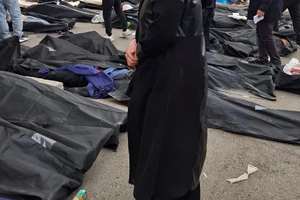
“Like in the 2022 protests, refrigerated Mihan ice cream trucks were used,” he said. “I personally helped load corpses.”
According to Kazem, the trucks were used to remove bodies from streets and transport them to undisclosed locations.
He describes a scene that remains vivid to him.
“We were loading bodies into a Mihan truck when I saw the man next to me tear the necklace and earrings off a 9- or 10-year-old dead girl before throwing her into the truck. I looked at him in fear. He looked back in a way that frightened me. I said, ‘It’s your right, take it, what’s it to me?’”
Kazem says he did not intervene and continued loading bodies.
Reports suggest the removal operation was systematic.
Iran Human Rights said in a report published on February 3 that, citing an eyewitness in Lorestan province, security forces transported the bodies of those killed in refrigerated Mihan ice cream trucks to the courtyard of a hospital in the province.
Iran International contacted Mihan to ask whether the company’s trucks were used to move bodies during the January 8-9 protests and whether the company confirmed the account. No response had been received by the time of publication.
France 24 and Amnesty International’s Switzerland office have also reported the use of food transport vehicles and containers to move the bodies of those killed.
Burning property and foreign forces
Kazem says he personally witnessed security personnel setting fire to banks and mosques after first clearing valuables.
“They would first evacuate valuables before burning the site,” he said. “I personally witnessed instructions to remove valuable items from a mosque before it was set on fire.”
He also says he saw a small number of fighters affiliated with Iraq’s Popular Mobilization Forces in Sadeghieh on the first night.
“The absolute majority were IRGC, plainclothes, Basij and security forces,” he said. “But I did see a small number of Hashd al-Shaabi.”
In the areas where he was present, he says regular police and special units appeared less directly engaged in lethal force.
“I think they weren’t prepared for killing on that scale,” he said.
Media reports have confirmed a limited presence of Hashd al-Shaabi forces in some areas during the crackdown. Videos from inside Iran also suggest that damage to public property was carried out by security forces footage – that several outlets, including Le Monde, have verified.
Payment for the dead
Kazem says he returned his weapon to the Vali-e Asr garrison on Saturday morning and was no longer required.
He says that afterward he heard from contacts that families seeking the bodies of loved ones were sometimes required to pay money, calculated according to neighborhood and reported property damage.
“They couldn’t charge everyone for bullets,” he said. “But when they did, it was based on how much damage the neighborhood had suffered.”
Iran International has documented in multiple reports that authorities extorted money from bereaved families in exchange for returning the bodies of their loved ones.
Kazem describes January 8 and 9 not as spontaneous security responses but as a coordinated operation across multiple districts of Tehran.
New details from eyewitnesses and medical staff in Iran’s southeastern city of Kerman indicate that security forces opened fire and killed dozens of protesters attempting to reach a statue of slain IRGC commander Qassem Soleimani in early January.
Witnesses said the violence unfolded on the evening of January 8 around Azadi Square, where one of the country’s most prominent monuments to Soleimani stood.
Read the full article here.
Security forces raided the village of Chenar in Asadabad county, Hamedan province, arresting hundreds of residents after surrounding the area early Monday, people familiar with the matter told Iran International.
The raid began at around 4:30 a.m., involving dozens of armored vehicles as well as several minibuses and vans, sources said. Forces also deployed four DShK heavy machine guns on the rooftops of some homes across the village.
Sources said detained residents were paraded through the city in vehicles fitted with cage bars before being transferred to the Asadabad police station.
Read the full article here.

New details from eyewitnesses and medical staff in Iran’s southeastern city of Kerman indicate that security forces opened fire and killed dozens of protesters attempting to reach a statue of slain IRGC commander Qassem Soleimani in early January.
Witnesses said the violence unfolded on the evening of January 8 around Azadi Square, where one of the country’s most prominent monuments to Soleimani stood.
Protests in Kerman had begun days earlier with small, scattered gatherings around the city’s bazaar and residential neighborhoods, residents said. But by late afternoon on January 8, significantly larger crowds, including families, were moving toward the square.
One resident said Azadi Square had gradually become a focal point for protesters in the preceding days, despite the absence of formal calls to gather. Videos reviewed by Iran International show the Soleimani statue set on fire during the unrest.
According to a member of the medical staff at a Kerman treatment center, at least 70 protester deaths were registered in the city’s hospitals. He said the figure included only those formally recorded in medical facilities and did not capture all fatalities.
Iran’s government has not provided city-level breakdowns of protest deaths but leaked documents obtained and reviewed by. Iran International shows up to 36,500 people were killed across the country on those two days.
Witnesses said security forces had deployed in force around Azadi Square before peak gathering hours, blocking roads with vehicles and personnel to prevent crowds from reaching the monument. Protesters instead gathered along surrounding streets, including Jomhouri Boulevard, Khajoo intersection, and Bahmanyar and Esteghlal streets.
One protester said security forces initially used tear gas, pellet fire and warning shots. Drones were visible overhead between roughly 7:00 and 8:00 p.m. By around 8:00 p.m., he said, live ammunition was being fired directly at crowds.
He said some of the heaviest clashes occurred near Khajoo intersection and along Jomhouri Boulevard, where large crowds had formed. Witnesses also reported gunfire from elevated positions on nearby buildings, though this could not be independently verified.
Because of the concentration of hospitals, clinics and medical complexes near Azadi Square, many wounded protesters were able to reach treatment facilities quickly. Medical staff described treating gunshot wounds, severe bleeding and respiratory injuries caused by tear gas exposure.
In the days that followed, security forces detained medical personnel who had assisted protesters, according to a healthcare worker familiar with the arrests. He said at least 10 doctors in Kerman had been detained, though only two—Amir Shafiei and Saman Salari—have been publicly identified.
Witnesses said the scale of the January 8 turnout had been significantly larger than previous protests in the city. Some participants said the presence of families and older residents created a false sense of safety, leading many to underestimate the likelihood of lethal force.
A woman who took part in the protests said clashes continued across multiple neighborhoods late into the night and into the following day. Tear gas and gunfire affected large areas of the city, forcing residents indoors.
She also described the sudden appearance of motorcyclists who vandalized banks and government buildings while security forces present at the scene did not intervene. After the motorcyclists left, she said, security forces moved against protesters. The identities and affiliations of the motorcyclists could not be independently confirmed.
The crackdown was followed by widespread arrests and legal action, according to a lawyer in Kerman familiar with the cases. He said detainees were frequently moved between facilities, making it difficult for families to determine their whereabouts.
The lawyer said at least 30 detainees have been charged with “moharebeh,” or waging war against God, a capital offense under Iranian law. He also reported that approximately 500 detainees had received prison sentences, including medical staff and young protesters, while many others remained in legal limbo.
These figures could not be independently verified.
Families have often been reluctant to publicize arrests or disappearances, he said, citing fear of retaliation and reports of abuse in detention.
Among those whose deaths have been publicly confirmed were Mehdi Khosravi, 24, who was shot on January 8, and Ehsan Jafari, a university student who died weeks later after being wounded during the protests. Other victims included students, teachers and residents from across Kerman province.
The protests in Kerman focused in part on the Soleimani statue, which has become a symbol of state authority in the city where the general is buried.
Residents said many protesters viewed the monument as a representation of the political system itself. Their attempt to topple it was met by a brutal force that turned the surrounding streets into one of the deadliest flashpoints of unrest in the city.
The full death toll in Kerman remains unknown.

Iran has sentenced at least 14 protesters to death in group online trials, people familiar with the matter told Iran International, with additional indictments accusing detainees of acting against the country’s security on calls from the US president and Israel.
The trials were presided over by Judge Abolghasem Salavati, head of Branch 15 of Tehran’s Revolutionary Court, who is widely known for handing down severe sentences in protest-related and political cases, the sources said.
Salavati has been holding simultaneous virtual hearings in which detainees are tried in groups of 14, according to the sources.
Among those sentenced is Abolfazl Karimi, a detained protester who the sources said had told his family in a phone call that he had been subjected to forced confessions under beatings and torture.
Karimi is the father of a young child and previously worked as a motorcycle courier in eastern Tehran.
He was arrested on January 6 while returning from work in Tehran’s Hengam neighborhood, where he encountered two injured women whose legs had been hit by gunfire from security forces, the sources said.
When he went to assist them, officers shot his leg with pellet rounds and arrested him along with the two wounded women, the sources added.
After about a month in detention in Greater Tehran Prison, he was recently transferred along with around 50 other protesters to Ghezel Hesar Prison, the sources said.
In a later phone call, Karimi told his family he had been tortured without medical treatment for his wounds and, while blindfolded, was forced to sign papers containing confessions against himself, according to the sources.

In recent days, Iran’s judiciary has intensified the process of trying protesters detained during the nationwide protests and issuing death sentences, the sources said.
On Monday Tehran Revolutionary Court, also presided over by Salavati, sentenced 19-year-old Mohammadamin Biglari to death on the charge of “enmity against God,” and the case has been referred to the Supreme Court, the sources said.
Biglari was arrested on January 8 on Tehran’s Damavand Street.
His mother is deceased, and his father was unaware of his fate for weeks, searching for him among bodies in Kahrizak before authorities informed him after three weeks that his son had been detained, the sources said.
Separately, on Sunday, the judiciary announced the first hearing session for three detained protesters—Ehsan Hosseinipour Hesarloo, Matin Mohammadi and Erfan Amiri—on charges including allegedly setting fire to Seyed al-Shohada Mosque in Pakdasht and alleged participation in murder.
Other charges against the three were announced as “assembly and collusion to appear and act against the country’s internal security following calls on hostile social media, particularly the US president and the Zionist regime (Israel)…” according to the judiciary-affiliated Mizan News Agency.
Norway-based rights group Hengaw said the case against the three was marred by due process violations.
"The hearing was held despite reports that the detainees have been denied basic rights since their arrest, including access to a lawyer of their choice and contact with their families. They were subjected to intense pressure and torture during detention and compelled to provide forced confessions," Hengaw said.
Tens of thousands of people have been arrested during the nationwide protests, many facing heavy charges, the sources said.
Some families have reported being pressured by security bodies to refrain from speaking to media or publicly discussing the cases of detained relatives, the sources added.