Residents in Tehran and nearby cities chanted anti-government slogans from their homes on Tuesday evening, according to videos obtained by Iran International.
In Qods city in Tehran province, residents chanted slogans including “This is the final battle, Pahlavi will return.”
In Pardis, also in Tehran province, chants of “Death to Khamenei” could be heard from residential areas.
In the Gisha neighborhood of Tehran, chants of “Death to the dictator” were heard from homes.
In Golshahr, Karaj, just west of Tehran, residents chanted “Long live the Shah” and “Death to the dictator,” according to a video sent to Iran International.
Italy has summoned Iran’s ambassador after an Iranian lawmaker tore up an image of President Sergio Mattarella during a parliamentary session in Tehran, Foreign Minister Antonio Tajani said on Tuesday.
“In Tehran, an Iranian MP tore up an image of President of the Republic Sergio Mattarella during the inaugural session of parliament. I have already instructed that the Iranian ambassador be summoned to the Farnesina to express firm condemnation over what happened,” Tajani said on X.
“I extend all my solidarity to the Head of State over this serious incident directed against him,” he added.

Forty days after Iran’s deadly January crackdown, senior officials repeated claims of foreign influence while some insiders—even from the hardline camp—offered sharply different explanations.
The fortieth day after a death carries special significance in Shiite tradition, often marking a moment of collective mourning and reflection.
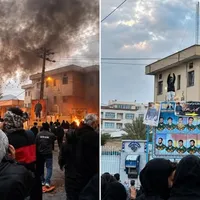
Families of those killed in the January 8 and 9 crackdown marked the occasion this week with memorial ceremonies across the country, even as authorities maintained a heavy security presence.
On February 17, Supreme Leader Ali Khamenei, President Massoud Pezeshkian and Parliament Speaker Mohammad Bagher Ghalibaf repeated the government’s longstanding assertion that foreign forces played a decisive role in fueling the protests.
At the same time, officials acknowledged that some of those killed were “innocent,” drawing a distinction that appeared intended to preserve the official narrative while recognizing the scale of the bloodshed.
Yet beneath that public consensus, alternative interpretations are emerging—even from figures long associated with the system.
Hassan Beyadi, a hardliner and secretary-general of the Abadgaran (Developers) Party, which helped propel Mahmoud Ahmadinejad to the presidency in 2005, offered a starkly different assessment in an interview with Khabar Online.
“People came to the streets because their dignity was trampled by politicians,” Beyadi said, describing the unrest as a reaction to corruption, discrimination and violations of basic citizenship rights.
Only “essential changes in the structure of the system and its economic policies” could restore public trust, he added.
A more conservative but still revealing analysis came from Abbas Ghaemi, a director at the Social Analysis Center of Imam Sadeq University, an institution closely tied to the Islamic Republic’s political elite.
Ghaemi argued that many participants in the January protests had already been shaped by previous waves of unrest, including the 2009 Green Movement, the 2018 and 2019 economic protests and the 2022 Women, Life, Freedom uprising.
“We are facing a society that has tried many different ways without achieving results,” he said.
Ghaemi emphasized the need for dialogue between society and the political system, an idea that has surfaced periodically within establishment circles but has rarely translated into sustained engagement.
Iran’s Supreme Leader, who holds ultimate authority over state policy, has never granted a media interview during his more than three decades in power.
Analyses published in Iranian media since the crackdown point to broader structural concerns, with some commentators describing a society marked by declining trust, growing anger and widening distance between the state and its citizens.
Former government spokesman Ali Rabiei, writing in the reformist-leaning newspaper Etemad, warned against attempts to channel public anger into state-controlled expressions of mourning.
“Looking at the frosty streets of Iran in Winter 2026,” he wrote, “it is clear that turning angry protesters into mourning protesters and vice versa reflects the inefficiency of a policy that will lead to one crisis after another if the system remains unreformed.”
Such warnings suggest the state may be struggling to fully impose its narrative of the unrest, even within establishment circles.
Former Israeli defense minister Yoav Gallant said on Tuesday that any lasting agreement with Iran would require first degrading Tehran’s military and nuclear capabilities, outlining what he described as lessons from Israel’s strikes in 2024 and 2025 in an analysis published on his Substack.
“No deal will hold without first degrading Tehran’s capabilities," Gallant wrote. “If military action is coming, it will most likely need to conclude before summer."
“Whether internal political change comes is ultimately a decision for the Iranian people, though external action may help create the conditions for it. Stripping the regime of its ability to threaten its neighbors is a realistic objective that would reshape the balance of power in the Middle East,” he added.
Iran rapidly covered large sections of the new Taleghan 2 facility at the Parchin military complex with soil over the past two to three weeks, nonproliferation expert David Albright said on Tuesday.
“Once the concrete sarcophagus around the facility was hardened, Iran did not hesitate to move soil over large parts of the new facility. More soil is available, and the facility may soon become a fully unrecognizable bunker, providing significant protection from aerial strikes,” Albright wrote on X.
“Stalling the negotiations has its benefits,” he added, as the first round of mediated talks between Iran and the United States ended in Geneva.
“In what language should we say we don’t want nuclear weapons? We are ready for any kind of verification in this regard,” Iran’s President Masoud Pezeshkian said on Tuesday.
“Based on the fatwa of the Supreme Leader, from an ideological standpoint we are absolutely not pursuing nuclear weapons, and however they wish to verify it, we are prepared,” he added.
Pezeshkian said Iran would not give up what he described as its peaceful nuclear program used for medical, agricultural and industrial purposes.