Former Israeli defense minister Yoav Gallant said on Tuesday that any lasting agreement with Iran would require first degrading Tehran’s military and nuclear capabilities, outlining what he described as lessons from Israel’s strikes in 2024 and 2025 in an analysis published on his Substack.
“No deal will hold without first degrading Tehran’s capabilities," Gallant wrote. “If military action is coming, it will most likely need to conclude before summer."
“Whether internal political change comes is ultimately a decision for the Iranian people, though external action may help create the conditions for it. Stripping the regime of its ability to threaten its neighbors is a realistic objective that would reshape the balance of power in the Middle East,” he added.
Iran rapidly covered large sections of the new Taleghan 2 facility at the Parchin military complex with soil over the past two to three weeks, nonproliferation expert David Albright said on Tuesday.
“Once the concrete sarcophagus around the facility was hardened, Iran did not hesitate to move soil over large parts of the new facility. More soil is available, and the facility may soon become a fully unrecognizable bunker, providing significant protection from aerial strikes,” Albright wrote on X.
“Stalling the negotiations has its benefits,” he added, as the first round of mediated talks between Iran and the United States ended in Geneva.
“In what language should we say we don’t want nuclear weapons? We are ready for any kind of verification in this regard,” Iran’s President Masoud Pezeshkian said on Tuesday.
“Based on the fatwa of the Supreme Leader, from an ideological standpoint we are absolutely not pursuing nuclear weapons, and however they wish to verify it, we are prepared,” he added.
Pezeshkian said Iran would not give up what he described as its peaceful nuclear program used for medical, agricultural and industrial purposes.

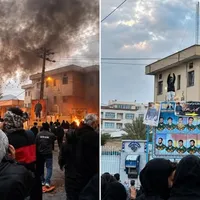
Memorial ceremonies marking 40 days since the killing of protesters were held across Iran this week despite a heavy security presence, with mourners gathering at gravesides, performing traditional rituals and often chanting against the country’s rulers.
Families of those killed in the January 8 and 9 crackdown had called for commemorations from Monday through Wednesday. Exiled prince Reza Pahlavi had also urged supporters to attend.
In the days leading up to the memorials, families reported calls from security agencies warning against gatherings. There were reports of cemetery closures in Arak and a heavy security presence at Tehran’s Behesht Zahra cemetery.
Videos sent to Iran International showed military vehicles and motorcycle patrols deployed in cities including Sanandaj in Kurdestan province and Chamestan in Mazandaran province.
Despite the restrictions, mourners gathered in multiple cities, applauding the slain, performing the “dance of grief” and chanting slogans.
In Abdanan in Ilam province, residents gathered in the streets ahead of ceremonies for local victims including Alireza Seidi and Yasin Elahi, chanting anti-government slogans including “Death to Khamenei,” according to videos and local sources.
Internet disruptions were reported in the area.
In Zanjan, attendees at the 40th-day ceremony for 17-year-old Mohammad Mahdi Ganjdanesh stood and applauded at his graveside. He was killed on January 8 after being shot in the head, according to people familiar with the case.
In Kermanshah, the family of 25-year-old Erfan Jamehshourani mourned at his grave during a ceremony on Monday. He was killed during the January crackdown, according to relatives.
Similar scenes were reported across central and northern Iran.
In Shahin Shahr in Isfahan province, mourners performed the dance of grief at the grave of 18-year-old Mohammadreza Ghorbani, whose father identified his body days later by recognizing a tattoo on his hand.
In Bandar Anzali, participants dressed in white and gathered for 29-year-old Milad Mianehkhah Monfared, a former youth player for Malavan football club who was killed on January 9. The ritual has become a symbol of mourning for those killed in the unrest.
In Noorabad Mamasani in Fars province, mourners sang at the grave of 64-year-old Abdolsadat Shamseddini, who was shot on January 10. In Baharestan in Isfahan province, relatives of 42-year-old Farhad Pourkaveh said his death would not be forgotten.
In Tehran, families marked the day by preparing and distributing traditional mourning foods such as saffron pudding and halva. At the grave of 24-year-old Mehdi Sepehran, a musician played handpan as mourners gathered.
At another ceremony, relatives released white doves in memory of Somayeh Yousefi, who was killed during the unrest.
The exact number of children killed remains unclear. The Coordination Council of Iranian Teachers’ Trade Associations has said at least 200 students were among the dead, highlighting the heavy toll among young people.
Some outlets inside Iran acknowledged the broader impact.
The moderate Rouydad24 news website wrote that the fortieth day had arrived “despite the deep wound left on society and public trust,” and noted that no meaningful effort had been made by authorities to address it.
At the same time, the government held its own ceremony in Tehran attended by senior officials including Vice President Mohammad Reza Aref and IRGC Quds Force commander Esmail Qaani, blaming what it described as terrorist elements for the violence—a stark contrast to the grassroots mourning taking place across the country.
The current US military build-up in the Middle East “appears to be preparing for direct action” against wide-ranging targets in Iran, BBC Verify reported, citing analysts from UK-based defense intelligence firm Janes.
BBC Verify earlier reported that the USS Gerald R. Ford aircraft carrier may be heading to the Mediterranean, and that two US AWACS (Airborne Warning and Control System) command-and-control aircraft, which provide battlefield management, have landed in the UK.
Such preparations indicate the US is positioning for sustained operations, as seen in the “constant flights of tanker and transport aircraft into the region,” the report quoted two military intelligence analysts at Janes as saying.

Tehran's decision to form a committee to investigate violence during January protests has been met with widespread skepticism, including from some moderate voice inside Iran who say only an independent investigation can establish credibility.
The administration of President Masoud Pezeshkian announced on January 21 that it had created a committee to examine the causes and consequences of the unrest. Government spokesperson Fatemeh Mohajerani said the body is collecting documents and testimony related to the violence.
Critics across Iran’s political spectrum have questioned whether a government-appointed panel can impartially investigate events in which state institutions themselves are accused of involvement.
The United Nations Human Rights Council has already mandated an independent fact-finding mission to investigate alleged serious rights violations linked to the protests.
Established after the 2022 “Woman, Life, Freedom” uprising and extended in January 2026, the mission has never been permitted to enter Iran. Tehran has refused to cooperate with the UN inquiry, dismissing it as politically motivated.
Even moderate commentators—who typically favor gradual change within the system—have questioned the credibility of the government’s initiative.
The reformist newspaper Tose’e Irani wrote that rebuilding public trust would require participation from figures independent of the state.
“For the report of the committee investigating the January events to be credible,” it said, it must include “independent lawyers, human rights activists and even prominent Iranian academics living abroad.”
Journalist Ahmad Zeidabadi similarly warned that any internal investigation would face deep public suspicion.
“What is the problem with inviting the UN High Commissioner for Human Rights to send a professional team to investigate?” he wrote, arguing that “only a credible international report can end the conflict of narratives.”
Lawyer and political activist Hassan Younesi urged the president to pursue a genuinely independent inquiry, while journalist Hossein Yazdi wrote that a committee would be trusted only if formed by individuals “not themselves accused.”
Public distrust reflects a broader history of disputed official investigations.
Many Iranians have cited previous cases—including the 1999 attack on Tehran University dormitories, the 2020 downing of a Ukrainian passenger plane that killed 176 people, and the death of Mahsa Amini in morality police custody—as examples where official explanations were widely contested.
Iran’s presidential office says 3,117 people died in the January unrest, including more than 2,400 civilians and security personnel whom authorities say were killed by “foreign enemy agents.”
That figure has been widely challenged. Human rights groups and independent media have reported far higher death tolls. Iran International has reviewed leaked internal government documents indicating the toll may be as high as 36,500.
Allegations from within Iran’s own political establishment have further fueled skepticism.
In a leaked audio recording, reformist politician Ali Shakouri-Rad said security institutions had “deliberately injected violence into the scene” to justify a sweeping crackdown, describing such conduct as “systematic” in Iran’s security policies.
Former president Mahmoud Ahmadinejad has made similar claims, saying forces within the state were responsible for protest deaths.
Pezeshkian initially dismissed Shakouri-Rad’s remarks as “unfair,” but later softened his position, saying he had ordered further investigation into the allegations and authorized additional review through relevant officials.
For many critics, the central question remains whether institutions accused of responsibility for violence can credibly investigate themselves, especially while Tehran rejects all international scrutiny, even refusing to recognise the UN investigators’ mandate.