EU parliament calls for release of Iranian Nobel laureate
Narges Mohammadi
European Parliament called for the immediate release of Nobel Peace Prize laureate Narges Mohammadi and other women held in detention in Iran, condemning violence against the country’s population.
“MEPs condemn the violence by the Iranian regime against its own population, particularly targeting civil society actors, protesters, women, minorities and communities. They denounce the oppression of women and call for the immediate release of women in detention, especially Nobel Peace Prize laureate Narges Mohammadi,” read a statement following a resolution adopted on Thursday.
The European Parliament on Thursday condemned what it described as systematic repression by Iran’s authorities against protesters and civil society, warning that reported killings during recent unrest could amount to crimes against humanity.
Lawmakers said that the death toll from the latest wave of protests may have reached around 35,000 and called for alleged atrocities to be independently documented by United Nations bodies, with evidence preserved for potential future prosecutions.
In a resolution adopted by 524 votes in favor, three against and 41 abstentions, members of the European Parliament (MEPs) demanded an immediate end to violence against civilians, including arbitrary detentions, enforced disappearances and torture.
They also urged Iranian authorities to stop prosecuting doctors and healthcare workers over treating injured protesters.
The resolution reaffirmed solidarity with the Iranian people, saying they are the “sole legitimate source of sovereignty” in the country, and called on the European Union’s Council and Commission to expand targeted sanctions.
MEPs further pressed the EU and its member states to develop a counter-strategy to support families of detainees and to prevent what they described as Iran’s use of hostage diplomacy.
Lawmakers emphasized that the Islamic Revolutionary Guard Corps (IRGC), designated by the EU as a terrorist organization, plays a central role in the repression.
They also demanded the immediate release of detainees, particularly women activists, including Nobel Peace Prize laureate Narges Mohammadi, and condemned what they called the regime’s oppression of women and minorities.
The parliament adopted similar resolutions on the human rights situations in Türkiye and Uganda on the same day.
The United Nations said a congratulatory letter sent by Secretary-General António Guterres to Iranian President Masoud Pezeshkian on the anniversary of Iran’s 1979 Revolution was a routine diplomatic gesture and should not be interpreted as an endorsement of Tehran’s policies.
UN spokesperson Stéphane Dujarric told Iran International that the message, sent on Iran’s national day, followed a decades-long protocol applied uniformly to all UN member states.
According to the spokesperson’s office, each country receives an identically worded letter on its national day. The messages are prepared in advance and do not signal any shift in the United Nations’ position toward a particular government.
“The letter should not be interpreted by anyone who receives it as an endorsement of whatever policies that government may be putting in place,” Dujarric said during the UN’s daily noon briefing.
The clarification came as Iran faces renewed scrutiny over crackdowns, arrests and reports of repression.
In recent weeks, families across the country have mourned losses, while human rights groups have documented detentions and what they describe as heavy-handed security measures.
News of the letter triggered backlash from activists and members of the Iranian diaspora, who argued that even if the message followed established administrative practice, its timing appeared insensitive given the political tension and public grief inside Iran.
They said the congratulatory tone risked being seen as disconnected from the reality faced by many Iranians demanding accountability and political change.
State-affiliated media in Iran widely amplified the letter, portraying it as a sign of international legitimacy. The coverage further fueled criticism from those who say such messaging can be instrumentalized for domestic political purposes.
The United Nations has repeatedly raised concerns about Iran’s human rights record, including through reports by the Office of the High Commissioner for Human Rights and discussions at the Human Rights Council and General Assembly.
UN officials maintain that diplomatic protocol operates separately from the organization’s human rights monitoring mechanisms.
Still, the episode underscores the tension between institutional diplomatic practice and the sensitivities surrounding governments facing sustained domestic unrest and international criticism.
This keeps it firmly in straight news territory, sharpens the opening, clarifies the backlash, and tightens the language without shifting tone.
An Iranian teachers' union has confirmed the identities of 200 students killed during the January protests and published their names, defying efforts to suppress information about the deaths.
The Coordinating Council of Iranian Teachers’ Trade Associations released the list in a public statement, calling it both a record of loss and a demand for accountability.
The council emphasized that documenting the names is not only a way to honor the victims but also to assert fundamental rights – life, education, and a future – that it says were systematically taken from these children.
The group said that the publication is a direct response to efforts to obscure the circumstances surrounding the deaths.
Little is known about the students’ lives, as many families have been pressured into silence, with some avoiding mentioning the cause of death in funeral notices for fear of retaliation.
Activists report that threats have included warnings regarding the safety of surviving children.
The teachers’ council addressed these pressures directly, writing: “They banned the names, forced burials in silence and denied the truth. Erasure, denial and distortion were a continuation of the same policy that had already taken their lives.”
Mohammad Habibi, spokesperson for the council, stressed the scale of the loss in a post on X: “We are no longer talking about ‘desks’ and ‘classrooms’; by reaching the number 200, they have effectively massacred an entire school.”
On social media, users have circulated photos and accounts of the teenagers under hashtags such as “empty desks,” sharing stories that are largely absent from official media coverage.
Ghazal Jangorban
Fifteen-year-old Ghazal Janghorban, an only child and a computer studies student, was killed in Isfahan on January 9 while protesting with her parents.
She was struck by three bullets – one to the chest, one to the abdomen, and one to the leg – and died in the same hospital where she was born. Her mother has shared videos of her singing and images of her empty room on Instagram, paying tribute to her daughter and writing that her cat still waits for her return.
Sina Ashkbousi
Sina Ashkbousi, also an only child, was shot dead in eastern Tehran on January 8.
Just days earlier, friends had celebrated his seventeenth birthday at a café with a Harry Potter theme, reflecting his love for the series.
His father later wrote online that he was proud of a son who had grown up quickly and whose life had ended too soon.
Amir-Mohammad Safari
Amir-Mohammad Safari, 15, was killed in Tehran on January 8 by two live rounds to the heart.
His family searched for six days before identifying his body in a hospital. Like several others on the list, he balanced school with work, taking on manual labor and street vending to help support his family.
Sam Sohbatzadeh
Also among those named is 14-year-old Sam Sohbatzadeh, who had worked since age 10 to help support his household.
He left school in the fall to work full time and was killed by a direct gunshot wound to the head on January 8 in southern Tehran.
According to the Kurdpa news agency, his family secretly transported his body overnight to their hometown, where he was buried two days later in a village cemetery in Ardabil province.
Abolfazl Norouzi
Some families continue to grieve quietly. Fifteen-year-old Abolfazl Norouzi, killed by gunfire in Mashhad, had left school to work in a mechanic’s shop and support his family.
Relatives say security authorities pressured the family to label him a member of the IRGC’s Basij volunteer paramilitary forces, a request they refused. They also report being denied permission to hold a formal mosque ceremony and say mourning banners were removed from their home.
Abolfazl had planned to resume his studies in evening classes and dreamed of buying a motorcycle with his earnings. Friends and relatives describe him as kind, responsible, and eager to help, a teenager whose plans for the future were cut short.
Free expression group ARTICLE 19 said China has spent more than a decade helping Iran build one of the world’s most restrictive internet control systems, supplying technology and a governance model used for censorship, surveillance and shutdowns.
The report released on Monday, titled “Tightening the Net: China’s Infrastructure of Oppression in Iran,” traces cooperation dating back to at least 2010 and says Chinese firms supplied or supported equipment and know-how used for internet filtering, deep packet inspection, centralized traffic management, and mass surveillance.
It named companies including ZTE, Huawei, Tiandy, and Hikvision, and describes how Iran built out a tightly controlled “National Information Network” designed to function as a domestic intranet while progressively limiting access to the open, global internet.
“In its pursuit of total control over the digital space, Iran borrows directly from the Chinese digital authoritarian playbook,” Michael Caster, head of ARTICLE 19’s China program, said in the report.
The organization said Tehran’s embrace of Beijing’s “cyber sovereignty” concept – the idea that governments should have near-total authority over online information flows within their borders – has helped normalize censorship and surveillance in international forums.
“Emulating China’s infrastructure of oppression helps Iran entrench power, sidestepping accountability and exercising full control over the information environment. That way, dissent is not just silenced, it is prevented from ever surfacing,” said Mo Hoseini, the head of the group’s Resilience department said.
ARTICLE 19 said the technology and institutional alignment have become more visible during major crackdowns, including the recent wave of protests that began late December.
The group said authorities responded with widespread violence and arrests, and then escalated to nationwide network interference on January 8, 2026, followed by broad disruption of internet, phone, and mobile networks by January 11, cutting off communications as security forces moved to suppress dissent.
The report said the latest blackout showed a level of centralized control that reached beyond social media and messaging, affecting essential services including banking, healthcare, and emergency response.
It added that Iran has repeatedly used shutdowns during earlier periods of unrest, including during the 2022 “Woman, Life, Freedom” protests and demonstrations in 2019-2020, but argued the 2026 disruption was broader and more aggressively enforced than previous episodes.
ARTICLE 19 said Iran also intensified efforts to restrict satellite connectivity. It said Starlink traffic was heavily disrupted during the crackdown and that the sophistication of the disruption suggested military-grade capabilities.
The report said authorities also seized satellite equipment door-to-door and imposed harsh penalties under a 2025 law criminalizing the possession of satellite internet terminals.
While the group said China’s direct role in the specific Starlink disruption was not confirmed, it argued that Chinese assistance has been central to the foundations of Iran’s internet control architecture, and that Beijing continues to provide a template for the state’s approach to “digital authoritarianism.”
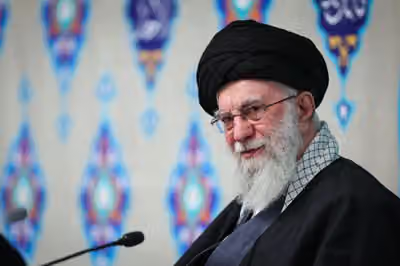
The report describes Iran’s Supreme Council of Cyberspace – established in 2012 and chaired by Supreme Leader Ali Khamenei – as structurally similar to China’s Cyberspace Administration of China, with both bodies overseeing centralized filtering, restrictions on foreign platforms, and the expansion of state-approved domestic alternatives.
It said Iran’s National Information Network increasingly mirrors features associated with China’s “Great Firewall,” including embedded surveillance and mechanisms to compel service providers to share data or throttle traffic.
The organization said the spread of surveillance and censorship tools risks entrenching repression inside Iran while eroding broader norms of internet freedom.
It also called for stronger export controls and sanctions enforcement targeting suppliers of surveillance and filtering technologies, greater corporate transparency, and increased support for secure circumvention tools and resilient connectivity options for Iranians during shutdowns.
The Canadian Senate held a hearing on Tuesday on a new immigration and border security bill with much of the discussion focusing on individuals allegedly linked to the Islamic Republic living freely in Canada.
The bill, dubbed C-12, introduces strict asylum filing deadlines, shifts many decisions to paper-based reviews, expands border officers’ powers to search digital devices without judicial oversight, and allows the government to suspend visas and permits for public interest reasons.
Among those who testified were Ardeshir Zarezadeh, a lawyer and president of the International Centre for Human Rights, Timothy McSorley, National Coordinator of the International Civil Liberties Monitoring Group; as well as representatives from Amnesty International and the UN Refugee Agency, UNHCR.
“Thousands of Iranians have been killed in the streets simply for protesting, while at the same time individuals affiliated with the Iranian regime are able to live comfortably in Canada and benefit from Canadian values,” Zarezadeh said.
He called the bill’s emphasis on asylum deadlines a “misdirection” and said Canada already has tools to identify and deport Islamic Republicagents — the failure is in “weak visa screening systems prior to entry.”
Other witnesses argued that rigid one-year claim deadlines disproportionately harm genuine refugees, especially those traumatized or suddenly displaced, while security threats often enter with fraudulent documents and evade such barriers.
While the government emphasizes the need for swift passage of the bill to address US border security concerns, the Senate committee is currently synthesizing these expert testimonies to prepare its final report.
Canada last week condemned the killing of protesters and use of violence by Iranian authorities after a video shared by Iran International showed an armored vehicle operated by Iranian security force running over demonstrators in Ardabil, northwest of Iran.
Human rights advocates in Canada are urging the country’s national police to gather evidence on Canadians linked to Iran’s repression apparatus after thousands of protesters were killed in January.
The push comes amid mounting demands for accountability after Iran International’s Editorial Board confirmed that more than 36,500 Iranians were killed by security forces during the January 8–9 crackdown, the deadliest two-day protest massacre in history.
Advocates say Canada must ensure perpetrators cannot find refuge abroad — and that Iranian Canadians have a direct avenue to report evidence.