Iran to close Hormuz Strait if war breaks out, official warns


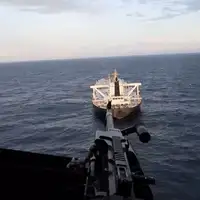
Any US-Iran war would threaten energy security and could lead to the closure of the Strait of Hormuz, warns the secretary of Iran’s Strategic Council on Foreign Relations on Thursday.
“If a war happens in the region, energy security will be endangered, the Strait of Hormuz will be closed,” Jalal Dehghani Firouzabadi said.
He added that if the strait is closed, “the first country to be harmed is China,” arguing that this makes China oppose war.

Up to a dozen nuclear devices could theoretically be made from Iran’s stockpile of highly enriched uranium that remains buried under bombed underground sites, UN nuclear watchdog chief Rafael Grossi said, warning inspectors still lack access months after the attacks.
Grossi said Iran has blocked International Atomic Energy Agency (IAEA) inspectors from entering key enrichment facilities at Natanz, Fordow and Isfahan that were struck during last June’s 12-day war between Israel, the United States and Iran.
Tehran says 400 kg of uranium enriched to just above 60% purity – close to weapons grade – remains under the rubble. Western powers have voiced concern about the material’s fate.
“The material is there and this material is enough to manufacture a few, maybe a dozen devices,” Grossi said, adding the IAEA has a “firm impression” the uranium remains at the underground sites, though it cannot be fully certain without physical inspection.
He said Iran had cited the need for “specific measures or protocols” before allowing access, describing that as “fundamentally a political stance.”
“Compliance for us means giving us full access to inspect,” Grossi said, noting that under the Nuclear Non-Proliferation Treaty Iran is permitted to enrich uranium but must allow verification to ensure material is not diverted.
Inspectors have also been unable to visit a newly declared underground facility in Isfahan that was due to be inspected on June 13 – the day Israel began its bombing campaign.

The United States is organizing for a major attack on Iran, Mark Levin, a conservative American media figure, said in an interview with Israel’s Channel 14, voicing hope it would lead to regime change.
“My guess is that we’re organizing now for a major attack, hoping for regime change, because that’s the only thing that will work,” he said. “This regime must be destroyed, starting with Khamenei and down.”
Levin added, “I don’t think we’re putting about a third of our fleet in and around the Middle East just for leverage. That’s my guess.”
He said Trump was “very good at hiding the ball” and sending mixed messages that confuse “enemies and allies alike,” and said he believed Trump and Israeli Prime Minister Benjamin Netanyahu were “in the same boat.”
Levin also issued a direct threat toward Iran’s Supreme Leader Ali Khamenei, saying: “We’re coming to get you.”
Australia urged Iran to end killings, the use of force, and arbitrary detention of protesters, the Department of Foreign Affairs and Trade said on Thursday.
“We have called on the Iranian government to cease killings, the use of force, and arbitrary detention in response to its violent suppression of recent protests,” a spokesperson said.
Australia could not confirm media reports that an Iranian individual who previously lived in Australia had been executed in Iran, the spokesperson added.
According to The Guardian, “there are grave fears for a former Canberra high school student after claims he was killed in Iran.”

US Treasury Secretary Scott Bessent said on Wednesday Iran understands the language of force as he raised the possibility that President Donald Trump could order another attack against the country.
“What the Iranians understand is brute force, whether it's in the financial markets, whether it's on the military field and at Treasury, we have exercised maximum pressure,” he said in an interview on Fox News.
His remarks came after Trump met Israeli Prime Minister Benjamin Netanyahu at the White House earlier Wednesday.
Bessent described their discussions as “very detailed talks,” without elaborating further.

The United States and Iran appear willing to compromise to reach a nuclear deal, the Turkish foreign minister told the Financial Times and warned that expanding the talks to include Tehran’s ballistic missile program would risk “nothing but another war.”
“It is positive that the Americans appear willing to tolerate Iranian enrichment within clearly set boundaries,” Hakan Fidan said, adding that Tehran now recognizes it needs an agreement and Washington understands Iran has “certain limits.”
“It’s pointless to try to force them,” he added.
Fidan also dismissed the prospect of regime change in Iran even in a conflict, saying government institutions and other targets could be badly damaged, but “the regime as a political entity would be a functioning entity.”