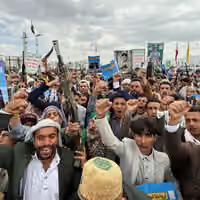
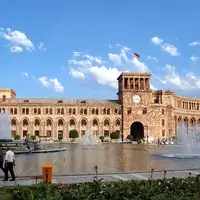
Balloons in the three colours of Iran's flag are released to the air at Tehran's iconic Azadi Square as part of the state-sponsored rally to mark the 1979 Revolution, February 11, 2026
Iranians took to social media on the anniversary of the 1979 Revolution to challenge the Islamic Republic’s claims of overwhelming public support, sharing videos of anti-government chants and questioning the authenticity of state broadcasts.
Authorities said “tens of millions” rallied nationwide to back Supreme Leader Ali Khamenei and the Islamic Republic’s ideology on the 47th anniversary of the revolution. Opponents—many still grieving the deaths of thousands shot during January protests—argued that attendance was often compelled and official imagery exaggerated.
State television aired long processions of marchers chanting pro-government slogans.
In Tehran, special police units and armored vehicles were deployed in what officials described as a show of stability. Critics said the heavy security presence signaled coercion rather than confidence.
What was presented as a unified celebration instead revealed competing narratives. While state media depicted unwavering loyalty, many Iranians online asserted that genuine political support cannot be measured in choreographed crowds or tightly controlled broadcasts.
Fireworks and counter-chants
Tuesday evening’s commemoration began with fireworks across Tehran and other cities. As in previous years, mosque loudspeakers and Basij bases urged citizens to step outside at 9 p.m. on the eve of the anniversary to chant “Allah-u-Akbar” from rooftops and streets.
But videos posted online from several cities, including Tehran, showed opponents raising anti-government slogans such as “Death to the dictator”, at times drowning out pro-state chants amplified through megaphones.
Clips shared on X and Instagram captured competing chants echoing across neighborhoods, reflecting a contested public atmosphere rather than a single unified voice.
Social media users also accused authorities of pressuring public employees, teachers, conscripts and others to attend the marches. Some alleged that participation was encouraged through incentives, including paid leave or material benefits—even implied threats to job security.
In several cities, critics said buses transported families to designated gathering points despite the anniversary being a public holiday.
One widely circulated claim alleged that relatives of those detained during the January unrest were told that sharing photos or videos of their families attending anniversary rallies could help secure the release of their loved ones. The claim could not be independently verified.
•
•
Staged testimonials?
Accusations extended to state media broadcasts. Opponents pointed to a now-viral clip in which the same woman—holding portraits of Khamenei and revolutionary founder Ruhollah Khomeini—appeared in live footage from Qazvin and Khorramabad, cities hundreds of kilometers apart.
One user wrote that the anniversary had produced “a woman teleporting on state TV.”
Others questioned the authenticity of official images, alleging digital manipulation or the reuse of footage, though no conclusive evidence has been publicly presented.
State media also aired interviews with participants including women without traditional hijab expressing loyalty to the leadership. Opposition voices dismissed the segments as staged propaganda.
In one broadcast from Isfahan, a woman said she had joined the marches after 30 years “for love of the Leader, to support the country and Islam against threats.”
In another clip released Wednesday, a woman without a headscarf declared: “Many enemies of Iran said the Islamic Republic would not see this anniversary—we’re glad it didn’t happen because if it had, surely Iran would have split.”
Critics argued such testimonials were carefully selected to project enthusiasm that may not reflect the broader political mood.
During state-organized rallies marking Iran’s 1979 revolution anniversary, demonstrators in several cities burned large statues of a horned, bull-headed figure identified by organizers as “Baal,” an ancient deity referenced in biblical and Islamic tradition.
The burnings, some reported to have taken place at the same time in different cities, were presented by organizers as a symbolic protest linked to renewed online conspiracy theories surrounding the late financier Jeffrey Epstein and alleged child abuse by Western elites.
Iranian news agency Mehr said the effigy represented “the idol of Baal,” described in religious texts as a false god associated with deviation from monotheism.
Participants, chanting “Death to Israel” and “Death to America,” were quoted as saying the act symbolized resistance to what they described as corrupt Western systems and Zionist ideology.
Images circulated by Iranian and foreign media showed a giant statue with a bull’s head engulfed in flames in Tehran’s Azadi Square. Some versions included additional imagery such as the number “666” and references to US President Donald Trump.
Hardline outlets and channels said the burning was a symbolic reference to documents recently released by the US Justice Department related to Epstein, who was charged in 2019 with running a sex trafficking ring involving underage girls. Epstein died in jail later that year.
Online speculation in recent weeks has revived unverified allegations linking Epstein to ancient deities such as Baal or Moloch, figures that in some traditions are associated with child sacrifice.
Fact-checkers and mainstream media have previously reported that many such claims stem from misinterpretations of financial documents or from longstanding internet conspiracy theories, including allegations about a “temple” on Epstein’s private island that US media said was designed as a music pavilion.
Baal, a title meaning “lord” in ancient Semitic languages, was worshipped by Canaanite peoples in the ancient Near East and is portrayed in Jewish, Christian and Islamic texts as a false deity. Some scholars say there is limited archaeological evidence of child sacrifice practices in parts of the ancient Levant, though interpretations remain debated.
Iranian organizers described the statue burning as a “symbolic protest” aimed at drawing attention to alleged moral corruption in the West.
One conservative outlet linked the initiative to the Masaf Institute, a group associated with propagandist Ali Akbar Raefipour, which has promoted anti-Western and anti-Zionist narratives.
The coordinated burnings formed part of broader anniversary events that included anti-US and anti-Israel slogans, flag burnings and displays criticizing Western governments.
While state media framed the act as a message from Tehran to the world, some Iranian clerics expressed concern about the symbolism, and online users debated whether the act itself risked unintended religious connotations.
The European Parliament on Thursday condemned what it described as systematic repression by Iran’s authorities against protesters and civil society, warning that reported killings during recent unrest could amount to crimes against humanity.
Lawmakers said that the death toll from the latest wave of protests may have reached around 35,000 and called for alleged atrocities to be independently documented by United Nations bodies, with evidence preserved for potential future prosecutions.
In a resolution adopted by 524 votes in favor, three against and 41 abstentions, members of the European Parliament (MEPs) demanded an immediate end to violence against civilians, including arbitrary detentions, enforced disappearances and torture.
They also urged Iranian authorities to stop prosecuting doctors and healthcare workers over treating injured protesters.
The resolution reaffirmed solidarity with the Iranian people, saying they are the “sole legitimate source of sovereignty” in the country, and called on the European Union’s Council and Commission to expand targeted sanctions.
MEPs further pressed the EU and its member states to develop a counter-strategy to support families of detainees and to prevent what they described as Iran’s use of hostage diplomacy.
Lawmakers emphasized that the Islamic Revolutionary Guard Corps (IRGC), designated by the EU as a terrorist organization, plays a central role in the repression.
They also demanded the immediate release of detainees, particularly women activists, including Nobel Peace Prize laureate Narges Mohammadi, and condemned what they called the regime’s oppression of women and minorities.
The parliament adopted similar resolutions on the human rights situations in Türkiye and Uganda on the same day.
The message coming out of Tehran on the anniversary of the 1979 Islamic Revolution was that Iran is willing to negotiate with the United States, though it remains unclear how its declared “red lines” can be squared with Washington’s demands.
The signals of flexibility were buried beneath the usual chants of defiance and confrontational theatrics at the annual rally marking the foundation of the Islamic Republic. Coffins bearing photos of US officials were paraded through the streets. An effigy of Jeffrey Epstein was set on fire.
The messaging unfolded as Israeli Prime Minister Benjamin Netanyahu met President Donald Trump at the White House—a meeting that could reinforce calls in Washington for a harder line on Tehran.
Two dozen Western reporters were in Tehran. Some appeared delighted to meet Iranian schoolchildren speaking fluent English; others were charmed by Persian cuisine and elderly men eager to shake hands. Few seemed inclined to recall that, just four weeks earlier, thousands of protesters had reportedly been killed in those same streets.
Away from the orchestrated celebrations and from the state-approved “fixers” guiding journalists through carefully staged displays of loyalty, senior officials blended familiar defiance with cautious hints of compromise.
Foreign Ministry spokesman Esmail Baghaei said Iran was ready for talks about the level of enrichment and even the extent of its stockpile of enriched uranium.
“If the negotiations are meant to bear results, there needs to be some kind of compromise,” he added, acknowledging that “this is the difficult part of the job.”
Ali Larijani, secretary of the Supreme National Security Council, struck a similarly measured tone, telling Al Jazeera that talks in Oman had been positive while reiterating Tehran’s position that conflicts with Washington’s demand for stricter limits.
“There is no talk of zeroing out enrichment,” he said. “We need it in the fields of energy and pharmaceutical manufacturing.”
The comments followed Larijani’s visits to Oman and Qatar, where he reportedly delivered a red folder that some analysts suggested could contain Khamenei’s response to a message from President Trump.
Photographs show him handing a letter to the Sultan of Oman and later presenting a red envelope in Doha, despite aides’ denials that any formal message was conveyed.
In an interview with Oman’s state television, Larijani offered an unusually restrained assessment of US policy, saying Washington’s framework “has become more realistic.”
Whether these tonal shifts signal a durable change in Iran’s messaging or a tactical adjustment on a symbolic day remains unclear.
Another unusual development added to the speculation. For decades, Supreme Leader Ali Khamenei has marked the anniversary by meeting a delegation of Iranian Air Force officers, echoing a similar gathering with Ayatollah Ruhollah Khomeini in 1979.
This year, he skipped the meeting and instead sent the officers to pay their respects to Hassan Khomeini, the founder’s grandson and presumed heir—a gesture that reignited the never-ending whispers of succession.
One month after a sweeping and deadly crackdown on nationwide protests, Islamic Republic marked its anniversary with state-organized rallies that appeared designed to project strength even as anti-government chants reverberated across neighborhoods nationwide.
The annual commemoration of the 1979 Islamic Revolution has long served as a showcase of mass loyalty. This year, however, it unfolded under the shadow of what critics describe as a deepening crisis of legitimacy following the January bloodshed.
In Tehran, security forces and Basij units maintained a visible presence as supporters gathered in Azadi Square. State media broadcast images of families and children waving flags, and highlighted what it portrayed as festive participation across the country.
Among the more striking displays were symbolic coffins bearing the names and photos of senior US military officials, including US Army Chief of Staff Randy George and CENTCOM Commander Brad Cooper. Cooper was part of the US delegation that recently held talks with Iranian officials in Oman.
American and Israeli flags were also burned during the rally.
The imagery of defiance came as Iranian officials engage in renewed diplomatic contacts with the United States. The juxtaposition reflected a dual message: confrontation abroad and consolidation at home.
President Masoud Pezeshkian, addressing the rally, repeated the government’s narrative about the recent unrest, accusing protesters of sabotage and violence and saying “no Iranian takes up arms to kill another Iranian.”
Iranian President Masoud Pezeshkian speaks during the 47th anniversary of the Islamic Revolution in Tehran, Iran, February 11, 2026.
He acknowledged widespread dissatisfaction but said the government was prepared to “hear the voice of the people,” while emphasizing loyalty to Supreme Leader Ali Khamenei and adherence to his “red lines” in diplomacy, a tacit reference to Iran’s uranium enrichment, missile program and support for regional militia groups.
State television placed particular emphasis on images of children and families at the rallies, a move that analysts say may reflect efforts to soften the government’s image after weeks of reports about civilian casualties.
Rights advocates have long criticized the use of minors in political events, arguing that it instrumentalizes children for propaganda purposes.
The commemorations took place roughly a month after a violent suppression of protests that erupted in late December.
The editorial board of Iran International said earlier this month that more than 36,500 people had been killed in a targeted crackdown ordered by Khamenei.
Even as the government staged its anniversary spectacle, dissent surfaced in other forms. On the eve of 22 Bahman, residents in multiple neighborhoods of Tehran – including Narmak, Ekbatan, Majidieh and Naziabad – shouted slogans such as “Death to Khamenei” and “Death to the dictator” from rooftops and balconies. Similar chants were reported in cities including Mashhad, Arak, Qazvin, Kermanshah and Shahriar.
Videos circulating online showed nighttime fireworks lighting the sky as anti-government slogans rang out.
In one clip from Arak, residents could be heard chanting against Khamenei in response to mosque loudspeakers broadcasting the traditional “Allahu Akbar.”
In Tehran, one resident said the fireworks were so loud “we thought America had attacked.”
In isolated incidents, pro-government speakers appeared to inadvertently repeat anti-Khamenei slogans during live broadcasts, prompting abrupt cuts in coverage.
One state reporter in Sistan and Baluchestan was heard listing “Death to Khamenei” among rally chants before the feed was interrupted.
Political analyst Iman Aghayari told Iran International that the anniversary had become “an arena of confrontation between the government and the people,” adding that unlike in previous years, authorities seemed less concerned with demonstrating broad public backing and more focused on asserting control.
“This time,” he said, “the regime is not trying to prove people are with it. It is simply declaring that it rules.”
As Iran navigates renewed diplomacy abroad and mounting pressure at home, the 22 Bahman (February 11) anniversary appeared to reflect a widening gap between official displays of unity and the anger that continues to surface beyond the state’s stage-managed events.
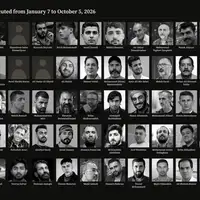
An Iranian teachers' union has confirmed the identities of 200 students killed during the January protests and published their names, defying efforts to suppress information about the deaths.
The Coordinating Council of Iranian Teachers’ Trade Associations released the list in a public statement, calling it both a record of loss and a demand for accountability.
The council emphasized that documenting the names is not only a way to honor the victims but also to assert fundamental rights – life, education, and a future – that it says were systematically taken from these children.
The group said that the publication is a direct response to efforts to obscure the circumstances surrounding the deaths.
Little is known about the students’ lives, as many families have been pressured into silence, with some avoiding mentioning the cause of death in funeral notices for fear of retaliation.
Activists report that threats have included warnings regarding the safety of surviving children.
The teachers’ council addressed these pressures directly, writing: “They banned the names, forced burials in silence and denied the truth. Erasure, denial and distortion were a continuation of the same policy that had already taken their lives.”
Mohammad Habibi, spokesperson for the council, stressed the scale of the loss in a post on X: “We are no longer talking about ‘desks’ and ‘classrooms’; by reaching the number 200, they have effectively massacred an entire school.”
On social media, users have circulated photos and accounts of the teenagers under hashtags such as “empty desks,” sharing stories that are largely absent from official media coverage.
Ghazal Jangorban
Fifteen-year-old Ghazal Janghorban, an only child and a computer studies student, was killed in Isfahan on January 9 while protesting with her parents.
She was struck by three bullets – one to the chest, one to the abdomen, and one to the leg – and died in the same hospital where she was born. Her mother has shared videos of her singing and images of her empty room on Instagram, paying tribute to her daughter and writing that her cat still waits for her return.
Sina Ashkbousi
Sina Ashkbousi, also an only child, was shot dead in eastern Tehran on January 8.
Just days earlier, friends had celebrated his seventeenth birthday at a café with a Harry Potter theme, reflecting his love for the series.
His father later wrote online that he was proud of a son who had grown up quickly and whose life had ended too soon.
Amir-Mohammad Safari
Amir-Mohammad Safari, 15, was killed in Tehran on January 8 by two live rounds to the heart.
His family searched for six days before identifying his body in a hospital. Like several others on the list, he balanced school with work, taking on manual labor and street vending to help support his family.
Sam Sohbatzadeh
Also among those named is 14-year-old Sam Sohbatzadeh, who had worked since age 10 to help support his household.
He left school in the fall to work full time and was killed by a direct gunshot wound to the head on January 8 in southern Tehran.
According to the Kurdpa news agency, his family secretly transported his body overnight to their hometown, where he was buried two days later in a village cemetery in Ardabil province.
Abolfazl Norouzi
Some families continue to grieve quietly. Fifteen-year-old Abolfazl Norouzi, killed by gunfire in Mashhad, had left school to work in a mechanic’s shop and support his family.
Relatives say security authorities pressured the family to label him a member of the IRGC’s Basij volunteer paramilitary forces, a request they refused. They also report being denied permission to hold a formal mosque ceremony and say mourning banners were removed from their home.
Abolfazl had planned to resume his studies in evening classes and dreamed of buying a motorcycle with his earnings. Friends and relatives describe him as kind, responsible, and eager to help, a teenager whose plans for the future were cut short.