The report released on Monday, titled “Tightening the Net: China’s Infrastructure of Oppression in Iran,” traces cooperation dating back to at least 2010 and says Chinese firms supplied or supported equipment and know-how used for internet filtering, deep packet inspection, centralized traffic management, and mass surveillance.
It named companies including ZTE, Huawei, Tiandy, and Hikvision, and describes how Iran built out a tightly controlled “National Information Network” designed to function as a domestic intranet while progressively limiting access to the open, global internet.
“In its pursuit of total control over the digital space, Iran borrows directly from the Chinese digital authoritarian playbook,” Michael Caster, head of ARTICLE 19’s China program, said in the report.
The organization said Tehran’s embrace of Beijing’s “cyber sovereignty” concept – the idea that governments should have near-total authority over online information flows within their borders – has helped normalize censorship and surveillance in international forums.
“Emulating China’s infrastructure of oppression helps Iran entrench power, sidestepping accountability and exercising full control over the information environment. That way, dissent is not just silenced, it is prevented from ever surfacing,” said Mo Hoseini, the head of the group’s Resilience department said.
ARTICLE 19 said the technology and institutional alignment have become more visible during major crackdowns, including the recent wave of protests that began late December.
The group said authorities responded with widespread violence and arrests, and then escalated to nationwide network interference on January 8, 2026, followed by broad disruption of internet, phone, and mobile networks by January 11, cutting off communications as security forces moved to suppress dissent.
The report said the latest blackout showed a level of centralized control that reached beyond social media and messaging, affecting essential services including banking, healthcare, and emergency response.
It added that Iran has repeatedly used shutdowns during earlier periods of unrest, including during the 2022 “Woman, Life, Freedom” protests and demonstrations in 2019-2020, but argued the 2026 disruption was broader and more aggressively enforced than previous episodes.
ARTICLE 19 said Iran also intensified efforts to restrict satellite connectivity. It said Starlink traffic was heavily disrupted during the crackdown and that the sophistication of the disruption suggested military-grade capabilities.
The report said authorities also seized satellite equipment door-to-door and imposed harsh penalties under a 2025 law criminalizing the possession of satellite internet terminals.
While the group said China’s direct role in the specific Starlink disruption was not confirmed, it argued that Chinese assistance has been central to the foundations of Iran’s internet control architecture, and that Beijing continues to provide a template for the state’s approach to “digital authoritarianism.”
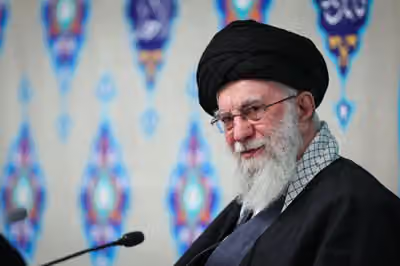
The report describes Iran’s Supreme Council of Cyberspace – established in 2012 and chaired by Supreme Leader Ali Khamenei – as structurally similar to China’s Cyberspace Administration of China, with both bodies overseeing centralized filtering, restrictions on foreign platforms, and the expansion of state-approved domestic alternatives.
It said Iran’s National Information Network increasingly mirrors features associated with China’s “Great Firewall,” including embedded surveillance and mechanisms to compel service providers to share data or throttle traffic.
The organization said the spread of surveillance and censorship tools risks entrenching repression inside Iran while eroding broader norms of internet freedom.
It also called for stronger export controls and sanctions enforcement targeting suppliers of surveillance and filtering technologies, greater corporate transparency, and increased support for secure circumvention tools and resilient connectivity options for Iranians during shutdowns.