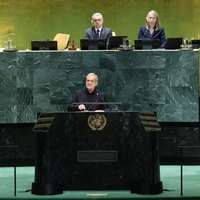
Iran security chief Larijani meets Hamas leaders

Ali Larijani, secretary of Iran’s Supreme National Security Council, met with a group of Hamas leaders at the Iranian embassy in Doha on Wednesday, state media reported.

Ali Larijani, secretary of Iran’s Supreme National Security Council, met with a group of Hamas leaders at the Iranian embassy in Doha on Wednesday, state media reported.

Geneva-based rights group UN Watch said it has called on UN Secretary-General António Guterres to rescind an invitation for Iran’s Foreign Minister Abbas Araghchi to address the opening session of the UN Human Rights Council and to release a reported congratulatory message sent to Tehran marking the anniversary of the 1979 Revolution.
The group said it sent a formal letter urging Guterres to withdraw Araghchi’s invitation to speak at the council’s annual opening in Geneva on February 23.
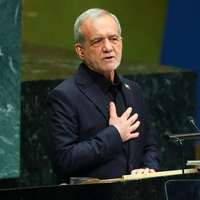
It also called on the UN chief to publish the full text of a message Iranian state media reported he sent to President Masoud Pezeshkian congratulating Iran on the 47th anniversary of the Islamic Revolution.
“It is an outrage that the UN Human Rights Council would provide a platform to Abbas Araghchi,” UN Watch Executive Director Hillel Neuer said, accusing Iranian authorities of “mass killings, torture, executions, and systematic oppression.”

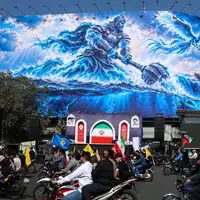
Iranian education officials asked school students to burn photos of US President Donald Trump and Israeli Prime Minister Benjamin Netanyahu as part of government-organized events to mark the 1979 Islamic revolution.
A message shared on the Shad educational application, the Education Ministry’s student-learning and messaging platform, showed an instructions to students to film the act and send the video to school authorities, reminding them that they will be honored at a celebration in exchange.
Officials titled the campaign “Khamenei Is My Life,” presenting it as an initiative for students to demonstrate loyalty to Supreme Leader Ali Khamenei.

An Iranian teachers' union has confirmed the identities of 200 students killed during the January protests and published their names, defying efforts to suppress information about the deaths.
The Coordinating Council of Iranian Teachers’ Trade Associations released the list in a public statement, calling it both a record of loss and a demand for accountability.
The council emphasized that documenting the names is not only a way to honor the victims but also to assert fundamental rights – life, education, and a future – that it says were systematically taken from these children.
The group said that the publication is a direct response to efforts to obscure the circumstances surrounding the deaths.
Little is known about the students’ lives, as many families have been pressured into silence, with some avoiding mentioning the cause of death in funeral notices for fear of retaliation.
Activists report that threats have included warnings regarding the safety of surviving children.
The teachers’ council addressed these pressures directly, writing: “They banned the names, forced burials in silence and denied the truth. Erasure, denial and distortion were a continuation of the same policy that had already taken their lives.”
Mohammad Habibi, spokesperson for the council, stressed the scale of the loss in a post on X: “We are no longer talking about ‘desks’ and ‘classrooms’; by reaching the number 200, they have effectively massacred an entire school.”
On social media, users have circulated photos and accounts of the teenagers under hashtags such as “empty desks,” sharing stories that are largely absent from official media coverage.

Fifteen-year-old Ghazal Janghorban, an only child and a computer studies student, was killed in Isfahan on January 9 while protesting with her parents.
She was struck by three bullets – one to the chest, one to the abdomen, and one to the leg – and died in the same hospital where she was born. Her mother has shared videos of her singing and images of her empty room on Instagram, paying tribute to her daughter and writing that her cat still waits for her return.

Sina Ashkbousi, also an only child, was shot dead in eastern Tehran on January 8.
Just days earlier, friends had celebrated his seventeenth birthday at a café with a Harry Potter theme, reflecting his love for the series.
His father later wrote online that he was proud of a son who had grown up quickly and whose life had ended too soon.

Amir-Mohammad Safari, 15, was killed in Tehran on January 8 by two live rounds to the heart.
His family searched for six days before identifying his body in a hospital. Like several others on the list, he balanced school with work, taking on manual labor and street vending to help support his family.

Also among those named is 14-year-old Sam Sohbatzadeh, who had worked since age 10 to help support his household.
He left school in the fall to work full time and was killed by a direct gunshot wound to the head on January 8 in southern Tehran.
According to the Kurdpa news agency, his family secretly transported his body overnight to their hometown, where he was buried two days later in a village cemetery in Ardabil province.

Some families continue to grieve quietly. Fifteen-year-old Abolfazl Norouzi, killed by gunfire in Mashhad, had left school to work in a mechanic’s shop and support his family.
Relatives say security authorities pressured the family to label him a member of the IRGC’s Basij volunteer paramilitary forces, a request they refused. They also report being denied permission to hold a formal mosque ceremony and say mourning banners were removed from their home.
Abolfazl had planned to resume his studies in evening classes and dreamed of buying a motorcycle with his earnings. Friends and relatives describe him as kind, responsible, and eager to help, a teenager whose plans for the future were cut short.

Iranian exiled Prince Reza Pahlavi urged Iranians abroad to stay united as they prepare for protests by Iranian expat communities around the world on February 14.
“As you are prepare for the Global Day of Action on February 14th, I ask all my fellow compatriots around the world no to pay attention to side issues and distractions, but instead with unity of voice and continued discipline — just as in past weeks — to be a worthy representative of the Iranian nation and the Lion and Sun Revolution,” he wrote on X.
Prince Pahlavi has declared February 14 as a global day of action and solidarity in support of the uprising, urging Iranians abroad, particularly in Munich, Los Angeles, and Toronto, to take to the streets and demand immediate, practical support from the international community for the people of Iran.

Iranian singer Mehdi Yarrahi resurfaced online with a new song titled “Auschwitz,” triggering widespread discussion on Iranian social media.
Yarrahi, who is known for his protest songs in support of the Women, Life, Freedom movement, received 74 lashes as part of his sentence last March.
He was arrested in August 2023 after releasing Rousarieto (Take Off Your Headscarf).
The new track features lyrics by Hossein Shanbehzadeh, an Iranian blogger who was arrested in 2024 after posting a single dot in response to a tweet from Supreme Leader Ali Khamenei.