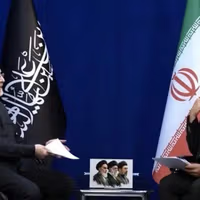
Iran’s Foreign Minister Abbas Araghchi said on Tuesday that Tehran would pursue its diplomatic track with the US without trusting the other side while relying on armed forces.
“We will go down this path with eyes open, considering all past experiences, without trust in the other side, and with confidence in the armed forces,” Araghchi said during a meeting with army commanders.
Major General Amir Hatami, commander-in-chief of Iran's army also warned in the meeting that Iran’s adversaries would face an unprecedented response if they miscalculated.
“If the enemies make a mistake, they will certainly receive a response they have neither seen nor experienced until today,” Hatami said.


The possibility of additional military action against Iran is expected to be discussed when President Donald Trump meets Israeli Prime Minister Benjamin Netanyahu in Washington, the Associated Press reported.
Netanyahu is is expected to press Trump during his visit to expand the scope of ongoing high-stakes nuclear talks with Iran, the report said.

Iran’s foreign ministry spokesperson said on Tuesday that Washington should decide whether it can negotiate independently of outside pressure, arguing that US alignment with Israel harms the region, Iranian media reported.
“Our negotiating party is the United States,” Esmaeil Baghaei said. “It is up to the US to decide to act independently of pressures and influences that are to the detriment of the region.”
Baghaei also said Iran remained determined to secure its national interests through diplomacy.
Iran’s foreign ministry spokesperson added that Iran was prepared to stay at the negotiating venue for consecutive days to ensure the talks produce results.
Baghaei also said last week’s nuclear talks with the United States were aimed at gauging the “seriousness” of the other side.
Iran’s air force commander said on Tuesday that Tehran would not accept negotiations under threat and stressed a tougher military posture alongside diplomatic outreach.
Brigadier General Bahman Behmard made the remarks in a meeting with foreign military advisers, according to state media.
“Iran has always welcomed diplomacy to create regional and international stability,” Bahmard said.
The armed forces, he said, had carried out a “smart review” of Iran’s defense doctrine, keeping a deterrent approach while upgrading “from relying solely on defensive reactions toward active deterrence and offense.”
Behmard described the shift as support for Iran’s diplomacy and said it meant that “no dialogue in the shadow of threats” and “no pressure at the cost of national security and interests” would be accepted.
Iran’s armed forces general staff said in a statement on Tuesday that the country would respond forcefully to any “threat, plot, and excessive demand,” amid tensions between Tehran and Washington.
The armed forces, the statement said, would “stand powerfully and with steadfastness” and would meet threats “with a more crushing and broader response.”
The general staff also called on Iranians to take part in rallies marking the anniversary of the 1979 Islamic Revolution.
Exiled Prince Reza Pahlavi on Monday urged US President Donald Trump to order military action against Iran’s Islamic Revolutionary Guard Corps (IRGC), saying strikes on the force are needed to support civilians protesting the Islamic Republic.
Speaking to radio host Hugh Hewitt on Salem News Channel, Pahlavi said only US military intervention could “level the playing field” between protesters and the state’s security forces, which he described as the government’s main instrument of repression.
“This is a genocide in the making. And the only thing that will equalize the playing field for these brave Iranians who are fighting for their own liberation is to have assistance that is needed help at this time to neutralize elements that the regime has used against its own citizenry to brutalize them the way they have,” Pahlavi said.
"This is the reason why the Iranian people have been anxiously awaiting the action that the president has promised he will do in support of the Iranian people that help will arrive," he added.
Pahlavi dismissed recent threats by Iranian authorities, including an AI-generated video depicting attacks on US naval forces, as what he described as propaganda from a weakening government.