Armed Iranian boats tried to stop a US-flagged oil tanker in the Strait of Hormuz on Tuesday, The Wall Street Journal reported, citing US officials.
The report cited maritime security firm Vanguard Tech as saying in a message to clients that six Iranian gunboats armed with 50-caliber machine guns approached the tanker as it entered the strategic waterway and ordered it to shut down its engines and prepare to be boarded. The vessel instead increased speed and was later escorted by a US warship, the report said.
Earlier, the UK Maritime Trade Operations agency said it had received a report of an incident involving a vessel about 16 nautical miles north of Oman, within the inbound traffic separation scheme of the Strait of Hormuz.
TIME magazine on Tuesday published a cover titled “After the Ayatollah,” focusing on Iran’s nationwide protests and the crackdown that followed, which the magazine described as one of the most intense episodes of civilian killings by gunfire in decades.
The cover illustration, by artist Edel Rodriguez, shows what appears to be a clerical figure viewed from behind, with the figure’s robe composed of stylized faces representing protesters, some raising fists or making victory signs.
A meeting between Iran’s Foreign Minister Abbas Araghchi and President Donald Trump’s envoy Steve Witkoff, which had been expected to take place in Istanbul on Friday, may now be held outside Turkey, Middle East Eye reported, citing Turkish officials.
“The exact location of the meeting has not yet been finalized,” Middle East Eye quoted an unnamed Turkish official as saying. “What is important for us is the establishment of a peace table. We are ready to contribute wherever the diplomatic table is established.”

The United States has deployed dozens of aircraft to bases near Iran and assembled about a dozen warships in or around the Middle East over the past month, moves that could set the stage for possible US strikes against Iran within weeks, The Washington Post reported on Tuesday, citing US defense officials, satellite imagery and tracking data.
The report, citing unnamed current and former US officials, said the buildup falls short of preparations seen ahead of last year’s strikes on Iran’s nuclear program, but provides President Donald Trump with a credible military option as his administration seeks to pressure Tehran back into nuclear talks.
The report said the aircraft carrier USS Abraham Lincoln, accompanied by three guided-missile destroyers, entered US Central Command’s area of responsibility on Jan. 26 and is operating in the north Arabian Sea.
At least eight other US warships are in the region, including destroyers near the Strait of Hormuz, according to US defense officials and satellite imagery cited in the report.
Iran has also increased activity in the area, the report said, citing flight tracking data and satellite imagery showing Iranian drones operating near the Strait of Hormuz and what analysts identified as an Iranian drone carrier, the Shahid Bagheri, in the same waters.
More than three dozen US aircraft, including fighter jets, drones, and refueling, reconnaissance and transport planes, have moved through or into the region since mid-January, with many landing at al-Udeid Air Base in Qatar, according to the report.
Additional US aircraft were observed at bases in Jordan, including fighter jets and search-and-rescue aircraft, analysts told the newspaper.

A newly announced grassroots network of Iranian doctors, nurses, paramedics and volunteers says it will provide safe medical relief and neighborhood support amid what it describes as a deepening humanitarian emergency after the crackdown that followed nationwide protests.
The group, calling itself the “People’s Red Lion and Sun Groups of Iran,” issued its founding statement on Tuesday, nearly a month after demonstrations erupted across the country and the subsequent violence that has left more than 36,500 people dead, with tens of thousands more suffering physical injuries and profound psychological trauma.
“We speak in days when Iran is wounded,” the statement said. “The people of Iran are mourning and angry because of losing at least thirty thousand of their best sons and daughters.”
The initiative says many of the wounded have been pushed into hiding, unable to seek treatment openly for fear of arrest or retaliation.
“Reports show that many of the wounded are forced to be treated at home and in hiding,” it said, warning that others have been deprived of medical care altogether because they cannot safely access trusted doctors or secure facilities. The statement adds that some remain in critical condition.
The group also raised alarm over reports of security forces entering hospitals and detaining injured people. “Reports indicate that Revolutionary Guard suppression forces have gone to hospitals, taken the wounded with them, or arrested citizens at home by reviewing patient lists,” it said.
According to the organizers, attacks on medical centers, intimidation of healthcare workers, and the removal of patients from hospitals have created what they describe as “a national humanitarian and emergency crisis.”
Many, they warned, are now at risk behind closed doors. “If urgent help does not arrive, some will die, and others will face irreversible physical and psychological consequences,” the statement said.
The founders present the network as a strictly humanitarian effort rather than a political organization, emphasizing that its purpose is to protect lives and reduce suffering.
“Our identity is human and relief-based, not political,” the statement declared. “We have been formed to save human lives and reduce the suffering of families.”
“We are not a political organization, not an instrument of power competition,” it added. “We are a grassroots network of relief and resilience.”
The group’s name and symbol deliberately revive the Red Lion and Sun, a historic emblem associated with humanitarian aid in Iran before the 1979 Islamic Revolution.
By restoring it, the organizers say they seek to highlight “heritage, humanity, and collective responsibility,” while committing themselves to what they call non-negotiable principles centered on saving lives.
“Saving human lives is our absolute priority,” the statement said, adding that citizen safety and privacy would be treated as red lines.
“The safety of citizens and their privacy are our red lines. We will have no mechanism for registration, list-making, or traceable recruitment.”
Instead, the initiative describes itself as an educational and resilience-based network built around decentralized neighborhood cells rather than centralized leadership.
“Our work is education, not organization,” it said. “All local cells will be independent and self-governed.”
The structure, according to the statement, is designed to allow rapid and secure assistance under conditions of surveillance and insecurity. Each unit would consist of only three to five people, formed exclusively among long-time friends, family members or trusted neighbors.
“There is no headquarters and no internal hierarchy,” the group explained. “Each cell is an island of resilience.”
The organizers say the model draws on international crisis-preparedness approaches focused on empowering communities when trust in official institutions collapses or when access to formal emergency services becomes impossible.
The mission of the Red Lion and Sun Groups, they said, is practical and urgent: ensuring safe medical treatment for wounded citizens, connecting patients with volunteer doctors and nurses, and preventing injuries from going untreated because of fear or blocked access.
“No wounded person should remain untreated because of fear or lack of access,” the statement said, outlining a vision of neighborhood-based first response so that vital hours are not lost in moments of crisis.
Beyond medical care, the group said it aims to provide emergency support to families facing severe shortages, supply disruptions, or siege-like conditions, including food, medicine, and essential goods.
It also plans to publish short educational materials that can be stored and used even during communication blackouts, covering first aid, trauma care, psychological support, and basic crisis survival.
The statement places particular emphasis on psychological first aid, including reducing panic, supporting children and the elderly, and strengthening social resilience alongside physical rescue and safety measures.
The announcement comes as the group describes a volatile national environment, warning that the scale of violence and the Iranian authorities’ confrontational posture internationally have heightened fears of further escalation and instability.
In closing, the organizers framed their initiative as a covenant of solidarity with ordinary people, urging citizens to form small trusted neighborhood circles to help one another when institutions fail.
“We make a covenant with the people that, within our capacity, knowledge, and means, we will stand beside them,” the statement said.
“If an incident happens in your area, if an injured person seeks help, if treatment arrives too late… this time, the people will not be alone.”
The group ended with a call for readiness and mutual support. “Be ready,” it said. “To save Iranian lives. To save Iran.”

US investigators are examining whether cryptocurrency platforms were used to help Iranian officials and state-linked actors evade sanctions, a blockchain researcher told Reuters, as crypto use rose sharply in Iran amid currency weakness and political unrest.
Ari Redbord, global head of policy at TRM Labs, said the US Treasury is reviewing whether platforms allowed state-linked players to move money abroad, access hard currency or buy restricted goods.
Estimates of Iran’s crypto activity vary. TRM Labs estimated roughly $10 billion in Iran-linked crypto activity in 2025, compared with $11.4 billion in 2024. Chainalysis said Iranian wallets received a record $7.8 billion in 2025, up from $7.4 billion in 2024 and $3.17 billion in 2023. Researchers cautioned that crypto’s pseudonymous nature makes precise attribution difficult and limits the ability to form a complete picture.
Chainalysis estimated that about half of Iran’s 2025 crypto activity was linked to the Islamic Revolutionary Guard Corps (IRGC). TRM Labs said it has identified more than 5,000 addresses it labels as IRGC-linked and estimates the Guards have moved about $3 billion worth of crypto since 2023.
Iran’s largest exchange, Nobitex, told Reuters that around 15 million people in Iran have some crypto exposure, with many using digital assets as a store of value as the rial depreciates. Analysts said funds can be moved off Iranian exchanges to wallets and platforms elsewhere, complicating enforcement for US authorities.
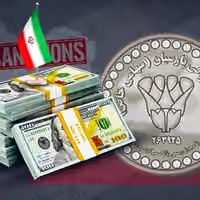
In September, the US Treasury Department’s Office of Foreign Assets Control (OFAC) sanctioned two Iranian financial facilitators and more than a dozen individuals and entities based in Hong Kong and the United Arab Emirates for helping coordinate money transfers — including proceeds from Iranian oil sales — that it said benefited the IRGC-Quds Force and Iran’s ministry of defense.
“Iranian ‘shadow banking’ networks like these—run by trusted illicit financial facilitators—abuse the international financial system, and evade sanctions by laundering money through overseas front companies and cryptocurrency,” read the statement.