Iran rial hits fresh low as dollar tops 1.5 million


Iran’s rial fell to a fresh record low on the unofficial market on Tuesday, with the US dollar quoted above 1.5 million rials, traders said.
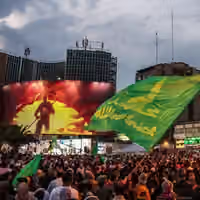
The latest slide follows sharp swings since late December, when the currency’s fall helped trigger protests in Tehran and other cities.
Iran’s economy has been battered by years of sanctions and chronic inflation, prompting many Iranians to turn to hard currency and gold during periods of political and economic uncertainty.


Germany’s federal interior ministry warned that Iranians living in exile in Germany face a risk of intimidation and harassment by Iranian state actors, including possible cyber attacks, in a response to a written question from Green lawmaker Marcel Emmerich.
The ministry said it receives regular reports of what it called transnational repression, meaning efforts by a state to monitor, threaten or pressure opponents abroad.
German authorities take any activity by foreign state bodies or their proxies in Germany very seriously and do not tolerate it, the ministry said, adding this was especially true when refugees could be at risk.
The warning follows protests in Iran that began in late December and quickly grew into nationwide unrest against the Islamic Republic. Iranian authorities moved to crush the protests.
Berlin cites transnational repression
The interior ministry said it works with federal security agencies to counter transnational repression in Germany and coordinates foreign policy steps with the foreign ministry. People who suspect threats from state bodies or intelligence services can contact the domestic intelligence agency confidentially, it said.
Germany’s domestic intelligence service has also alerted people who could be targets of Iranian cyber attacks, the ministry said. Those who feel in immediate danger should contact police, while state police forces are responsible for individual risk assessments and protection.
Emmerich said the measures did not go far enough and called for specialized contact points for those affected, as well as a firmer political stance against repression in Germany.
The government said it continues to push within the European Union to add Iran’s Revolutionary Guards to the EU terrorism list. Approval talks are still under way.
The European Parliament has urged the EU to designate the Revolutionary Guards as a terrorist organization and condemned Iran’s use of force against protesters.
Iran’s approach towards the United States is to keep full military readiness while pursuing a diplomatic path, said the government’s spokesperson on Tuesday.
“The issue of war has cast a heavy shadow over the country and naturally made conditions difficult and complex,” Fatemeh Mohajerani told a news conference.
Mohajerani said Tehran viewed the situation as part of what she called a long-running “hybrid war,” while stressing that the government was pursuing diplomacy.
She added that Iran was also prepared for other scenarios. “This does not mean other options are off the table. We are in full readiness,” Mohajerani said, without specifying what those options might entail.
The United States rejected Iran’s description of peaceful protests as “terrorist operations,” saying Tehran is distorting reality to justify its crackdown on dissent.
In a post on X on Tuesday, the US State Department’s Persian-language account said it takes great audacity for Iranian officials to accuse peaceful Iranians of terrorism while the Islamic Republic uses violence and intimidation to suppress protesters and supports real terrorists abroad.
The statement said portraying protesters as terrorists and blaming them for destruction was an attempt to shift responsibility and present the ruling system as a victim.
“The reality is clear,” the post said, adding that ordinary Iranians were demanding their rights and the authorities responded with repression, as they have for decades.
The United States said the world would not be deceived by what it called overt propaganda, stressing that Washington stands firmly with the people of Iran and that “the Iranian people deserve better.”
Iran’s ambassador to the United Nations said the UN Security Council must explicitly name and condemn what he described as violations committed by the United States, accusing Washington of repeatedly threatening sovereign countries.
Amir Saeid Iravani said US President Donald Trump has publicly and repeatedly threatened Iran with the use of force and military intervention.
Iravani said the Security Council has a responsibility to clearly identify such actions and “call them by their real name.”

The Trump administration wants Tehran to halt its nuclear “escalations,” ballistic missile program and support for regional proxy groups, a spokesperson for the Department of State told Iran International on Monday.
"Iran, the world’s leading state sponsor of terror, must stop its nuclear escalations, its ballistic missile program, and its support for its terrorist proxies," the spokesperson said.
"For decades, the Iranian regime has willfully neglected the nation’s economy, agriculture, water, and electricity to instead squander Iranian people’s vast wealth and future on terrorist proxies and nuclear weapons research."
The spokesperson made the remarks when asked about an Iranian state media report claiming that “recognition of Israel” has been added to the Trump administration’s preconditions for peace with Tehran.
Tehran has long rejected heeding a US diplomatic push for it to rein in its nuclear program and military activities as a violation of its sovereignty by an enemy power.
US President Donald Trump told Axios earlier in the day the situation with Iran is “in flux” after he sent a “big armada” to the region but believes Tehran is eager to cut a deal. “They want to make a deal. I know so. They called on numerous occasions. They want to talk."
Separately, Axios quoted US officials as saying any potential agreement with Tehran would require the removal of all highly enriched uranium from Iran, strict limits on the country’s long-range missile stockpile, a change in Iran’s policy of supporting regional proxy groups, and a ban on independent uranium enrichment inside the country.
US Central Command on Monday confirmed the deployment of the USS Abraham Lincoln Carrier Strike Group to the Middle East. "The Abraham Lincoln Carrier Strike Group is currently deployed to the Middle East to promote regional security and stability."
The deployment came weeks after Trump promised help for Iranian protesters amid a brutal crackdown where at least 36,500 people were killed. He said he had cancelled all meetings with Iranian officials, and that "help is on its way" for Iranian people.
The State Department spokesperson said on Monday "the Iranian people want and deserve a better life."
"The regime’s brutal suppression of the Iranian people is on full display," the spokesperson said.